You're not stuck, you're just alone at the top. Most entrepreneurs hit a ceiling, not because the opportunity isn't there, but because you're solving $10M problems with $1M strategies.
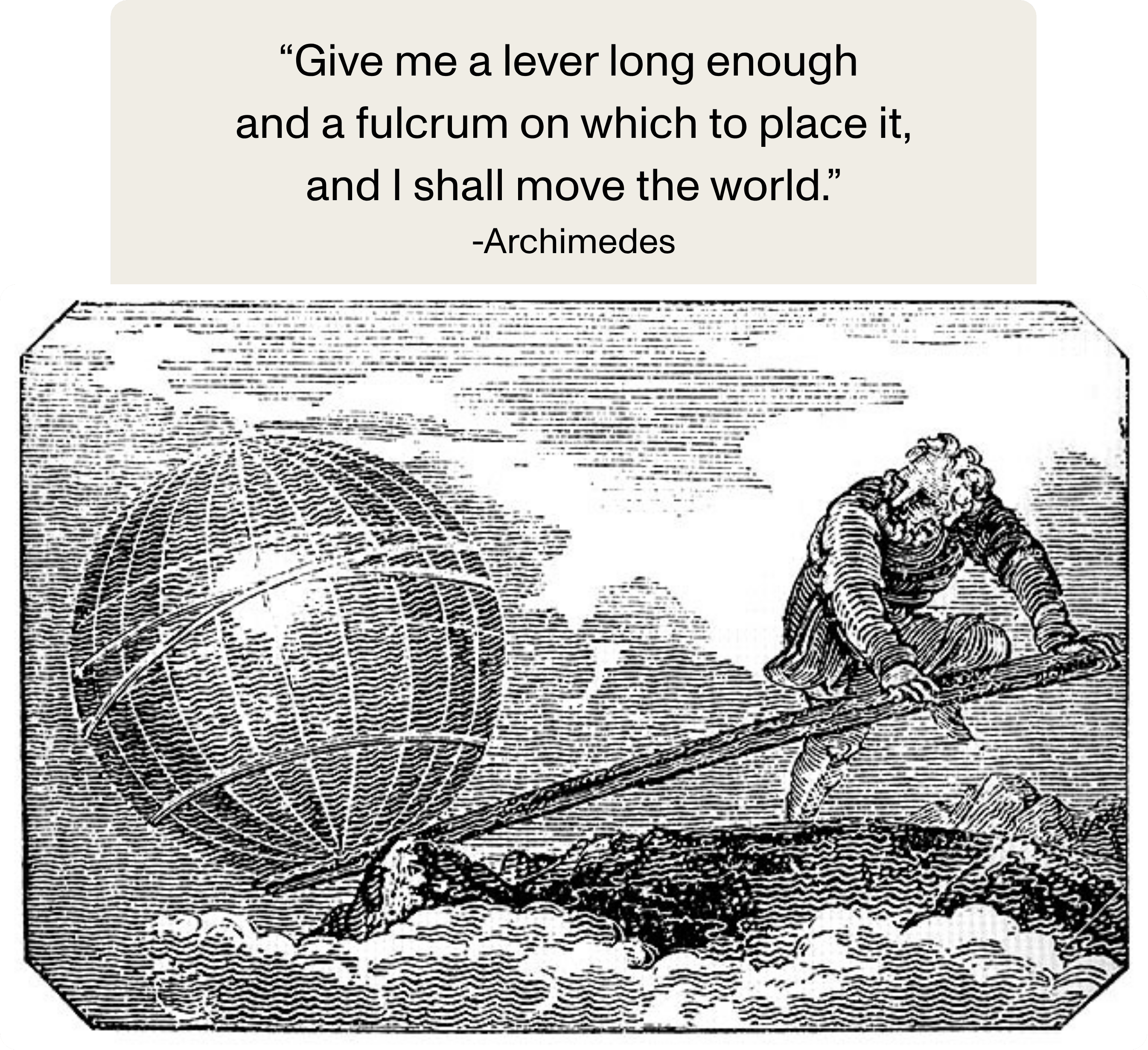
And, as Sam Altman and Naval Ravikant would probably tell you if you asked them today, all these years later, leverage is as powerful a force as ever.
By the time we made our first real money, we'd never been in the same room as Naval Ravikant.
But somewhere between Wall Street and Main Street, a few lines he wrote rewired the entire way we thought about work, money, and time.
Here's the idea that cracked things open for us:
Most people try to get rich by “working harder,” but not the wealthy.
Sure, they work hard. Very hard. You have to. But that’s probably not how they got rich. They might not even know it, but they got rich by using leverage.
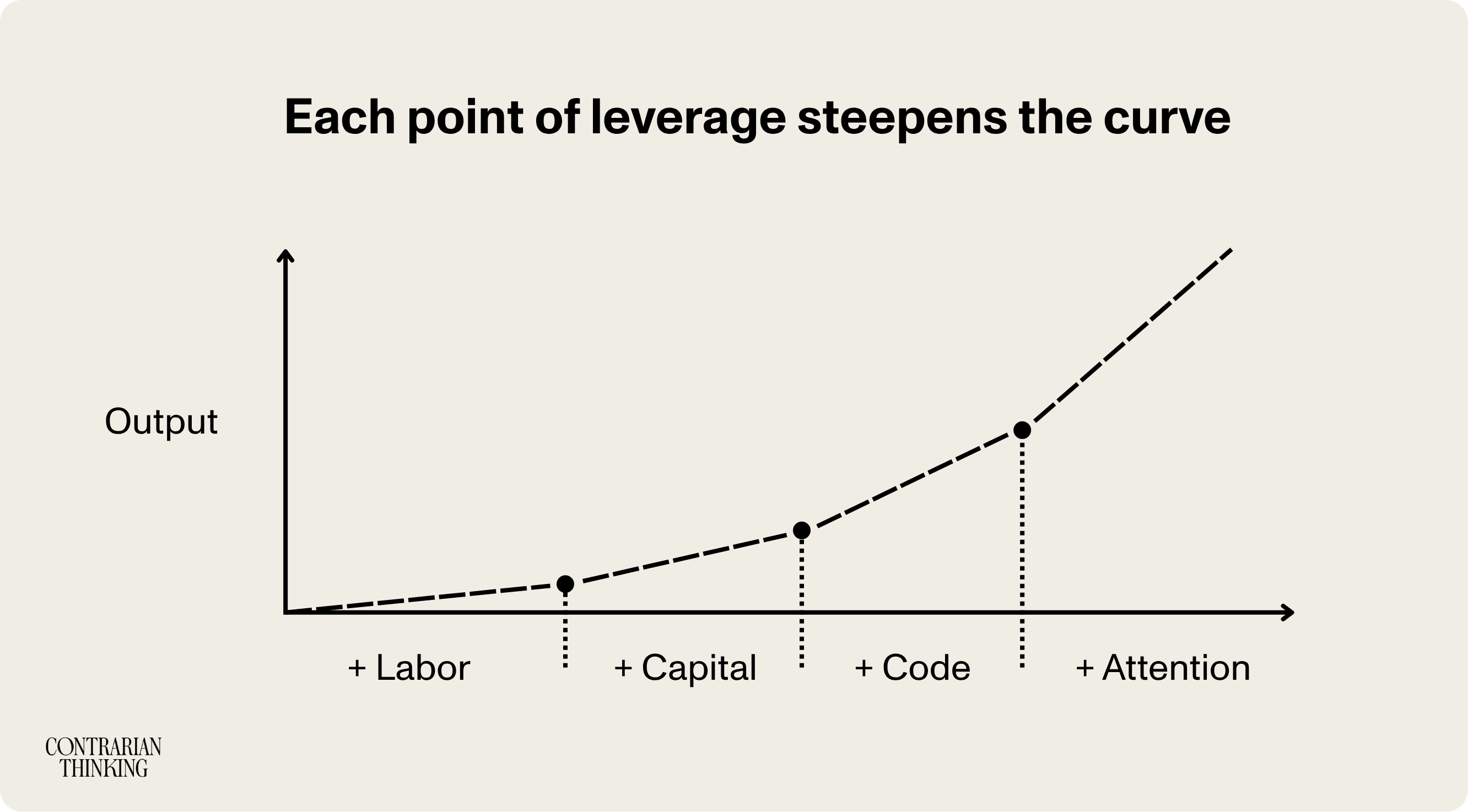
It decouples linear inputs and outputs. Instead of 1x input equaling 1x output, it enables an output greater than 1x (and often, 10x, 100x, or even greater than 1000x larger).
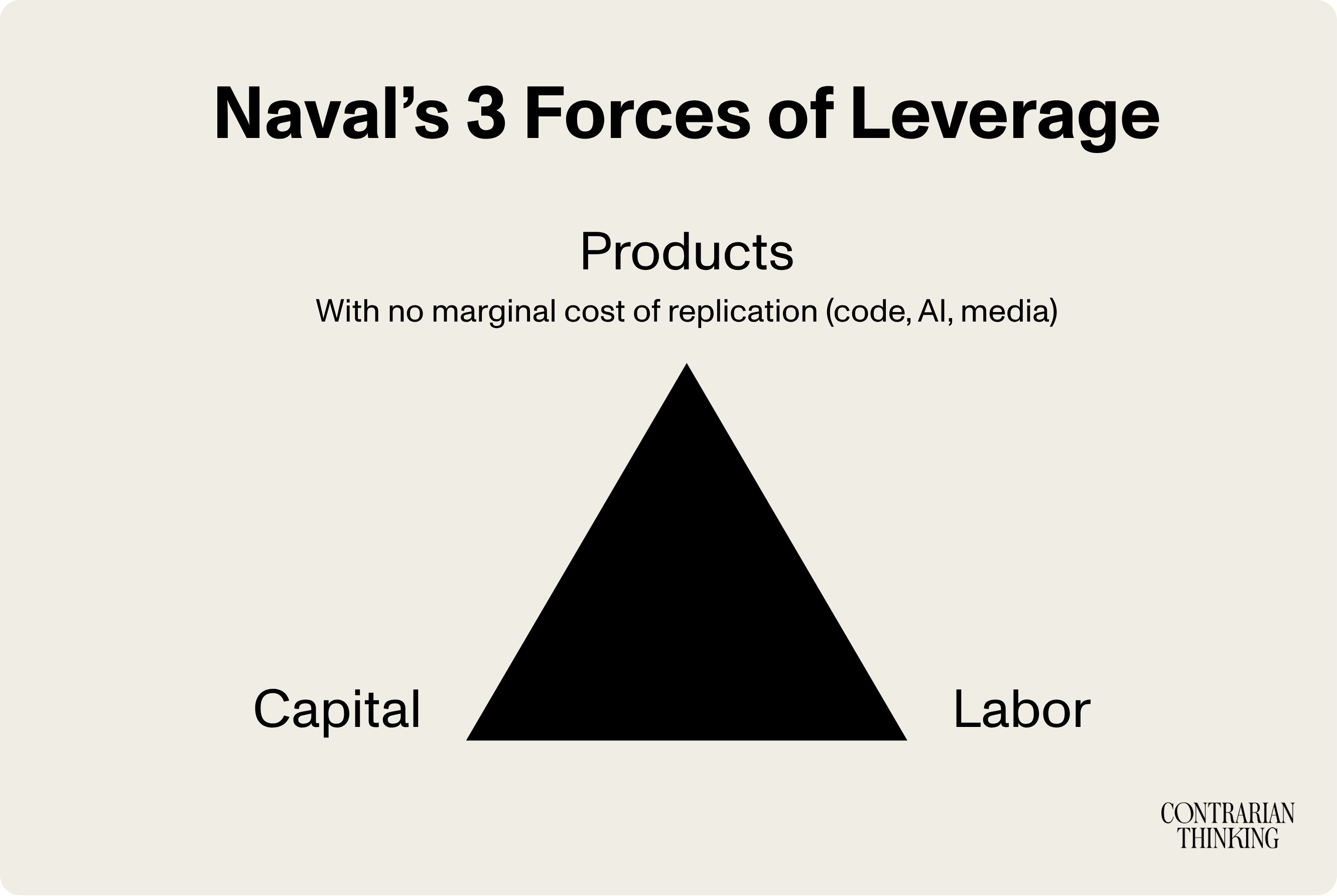
But most people don’t realize that leverage comes in many shapes and sizes. Naval identified these:
We've spent years trying to apply these in the real world, in our business, and helping others see how they can, too.
Force 1: Labor
Labor leverage is simple: other people's time and effort, directed by your judgment, producing output you couldn't generate alone.
Nearly every civilization, every empire, and every company in history has been built on this principle. The railroads. Oil giants. Your local hardware store. McDonald's.
McDonald's is worth studying. Ray Kroc didn't invent the burger. He built a system so airtight that hundreds of thousands of employees across 40,000 locations could execute it identically, every single day, in 100 different countries.
ResiBrands, our family of home services franchises across painting, roofing, window cleaning, garage repair, and handyman services, works similarly. Lots of locations and employees, one great system.
But you should know, Naval actually called labor "the worst form of leverage" because it's the messiest. It has friction. It requires permission. People have to choose to work for you. You have to recruit, train, culture-build, and retain. That limits how efficient it is as a tool.
Managing people also requires tremendous leadership skills. A bad hire can poisonculture, eat your time, and cost you money on the way out. One wrong person in the wrong seat can set a small business back 12 months.
But for the kinds of businesses our Contrarian Academy members buy on Main Street, labor leverage usually isn't optional. A masonry business needs talent. A landscaping company needs crews. An HVAC business lives and dies by the quality of its technicians.
Stage 1: You are the labor
Stage 2: You hire to do the labor and shift focus
Stage 3: You build systems that manage labor at scale
The question is whether you're building a system that people can operate in, or whether you are the system.
Force 2: Capital
Capital leverage is money doing work.
Most people hear that and think: “But I'm not Warren Buffett.” Fair. But the principle scales all the way down to Main Street.
When you buy a business with an SBA loan, you're quite literally using capital leverage. You put in $100K, borrow $400K from a bank, and buy a $500K business generating $120K a year.
Seller financing takes it even further. Instead of a bank, the seller might be willing to become your lender and accept payments over time rather than a lump sum at close.
You get the keys to the business with less capital upfront and incentive alignment with the seller. They get a steady income stream, a better tax rate, and a motivated buyer. Structured right, both sides can win.
One of our Contrarian Academy members, Jesus Wong, used a similar playbook. After 16 years in corporate finance, he left his job, reviewed over 1,000 businesses, and ultimately acquired the largest technical garment repair company in North America, a $7M revenue, 85-person operation with 3 locations across the US and Canada.
The deal was structured with a seller note and performance-based components that protected his downside while giving the seller upside if the business hit its targets. Capital leverage, structured creatively, made the deal work.
Then there's multiple expansion, and this is where capital leverage gets really interesting.
Increase profit by $300k in an industry with a 4x multiple, and you’ve just added $1.2M to your business’s value. Far easier said than done, but do that a few times and you’ve bent the slope of your family’s financial life.
One thing people miss about capital leverage: it’s not just about the money you borrow to buy an asset or the value you add. It can also be combined with labor leverage, by putting capital toward other people’s expertise. Or, as we call it, their 10,000 hours.
Jesus didn't try to figure out deal structure, due diligence, and legal risk on his own. He interviewed ten lawyers before picking one. He worked with accountants and a loan advisor. He used his capital to build an expert deal team in little time.
That's leverage, too.
Force 3: Products With No Marginal Cost of Replication
This is the newest form of leverage, and potentially the most powerful.
Books. Media. Podcasts. Code. AI. Things you build once that scaleinfinitely. You do the work a single time, and the output can keep occurring without you having to “do the work” again.
This is fundamentally different from labor and capital leverage, which have natural ceilings and gatekeepers. This leverage has neither. As Naval puts it, it'spermissionless.
SMB operators who use this permissionless leverage will accelerate. Those who don’t will atrophy. But code and AI are only part of this force, which also includes attention.
We started Contrarian Thinking with a couple of hundred email subscribers. But over time, as we build it up:
Our followers asked the same questions over and over
Those questions became educational programs
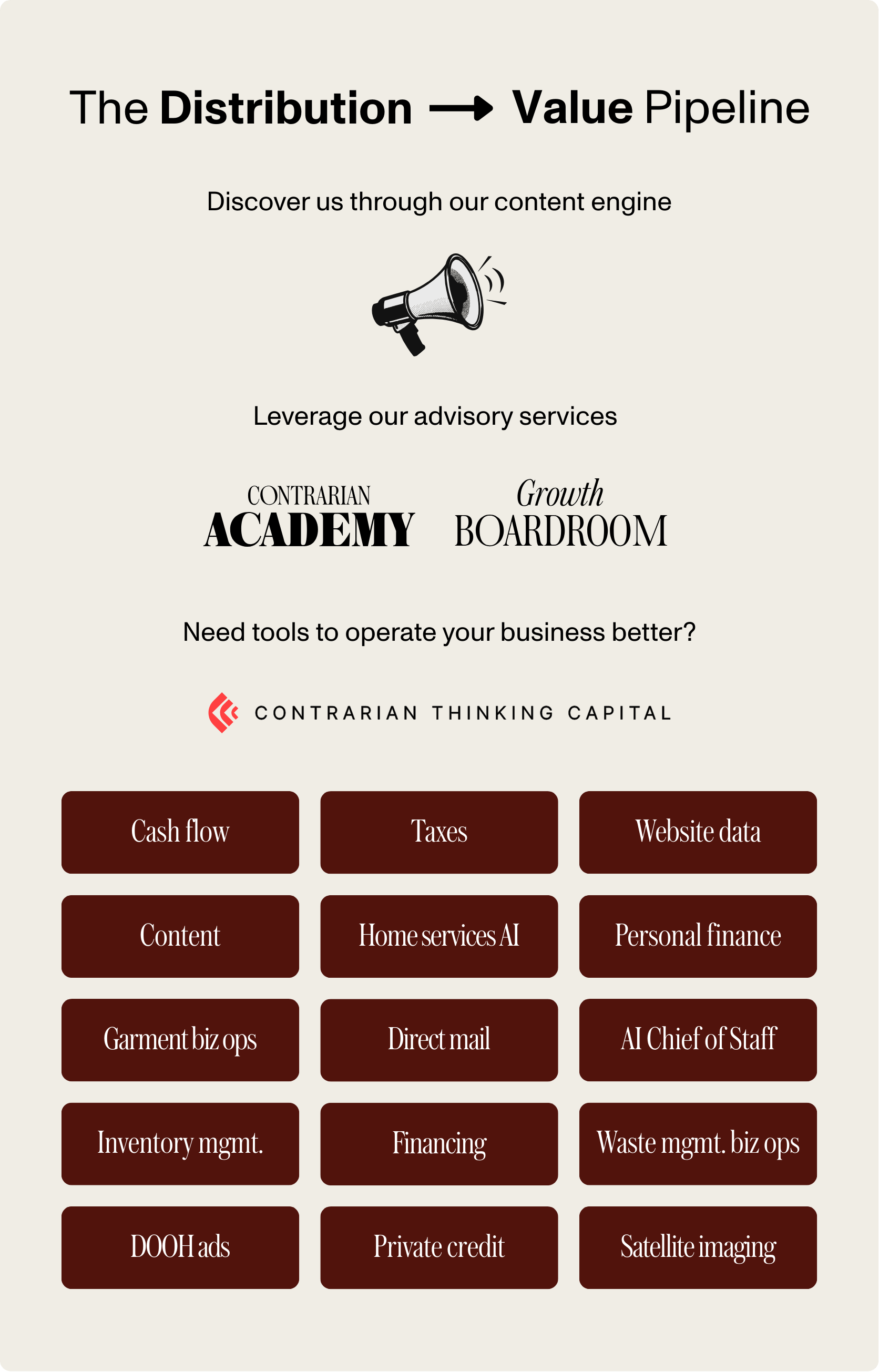
Those programs became large-scale business advisory services, annual events, venture investments, and more
Attention leverage can invert the information asymmetry that pains many businesses. You stop guessing what the market wants because the market is literally in your inbox, telling you.
We built an 8-figure business on that insight
Much of the Contrarian Thinking sales playbook fits on a napkin:
Get someone's email
Send them something useful/fun/cool
Don't be annoying
Repeat forever
Groundbreaking stuff, we know.
But that's the foundation of what took us from $0 —> 8-figure brand.
Fun fact: we actually invested in the company early on. We saw what the team was cooking up, knew we'd end up being customers, wrote a check, then migrated our entire list over.
Turns out our thesis was right because what beehiiv is doing is kind of absurd.
Want to monetize from day one? They'll bring you ad deals.
No one knows you exist yet? Their recommendation network fixes that.
Need a sexy website for all your content and digital products? Only takes minutes with their AI website builder.
Want to automate the entire thing and personalize it at scale? Use their segmenting and automation tools.
And the team. THE TEAM. These people are animals. Doesn't matter if you're a solo creator, a small business, or a major publisher.
Tyler (the CEO) responds to customer feedback at hours that suggest he either doesn't sleep or is actually 2 people in a trench coat.
Anyway, the beehiiv folks wanted to hook our readers up, so here you go:
If you've been sitting on a newsletter idea, or your current newsletter setup makes you want to karate chop your laptop, go to: beehiiv.com/codie, and use code CODIE30 for 30% off for 3 months.
If you’re wondering where to start…
The businesses that compound the fastest often find ways to use multiple forces. Labor to execute. Capital to own and invest. Attention and code to build and distribute.
But right now, the easiest place to start is with code and attention.
Build an audience in your domain. Teach what you know. Use AI to do the work of 3 people. You don't need permission from a bank or a boss to do any of that today.
From there, save and stack. Learn to deploy capital, even small amounts, into a smart and responsible deal. It will change your relationship with money forever.
Most people spend their entire careers stuck as someone else's leverage, trading time for money, 1x input for 1x output.
4,500 years ago, the Egyptians saw this was gonna be a problem and solved it with leverage.
The gap you’re facing can likely be solved with smart leverage, too.
So go close it.
-Team Contrarian
The information contained here is educational, may not be typical, and does not guarantee returns. Background, education, effort, and application will affect your experience and the profitability of any business. Individual results may vary.



















.svg)


