You're not stuck, you're just alone at the top. Most entrepreneurs hit a ceiling, not because the opportunity isn't there, but because you're solving $10M problems with $1M strategies.
The Invisible, Profitable, Unsexy Businesses Behind The Trillion-Dollar AI Boom
April 2, 2026
11 min read
In 1958, an economist named Leonard Read wrote an essay narrated by a pencil.
A pencil?
Why? Because he wanted to make a point about how the economy works, and he figured the most ordinary object he could find would make it best.
The essay traces the pencil, quite literally, back to its roots in the ground.
The cedar in the wood grows in Oregon.
To cut it down, you need loggers.
To equip the loggers, you need saws.
To make the saws, you need steel mills.
To transport the logs, you need trucks and truckers, tires, and oil.
To run the logging camp, you need a cook.
A cook needs food, which comes from farms and so on…
As Read points out, even the cup of coffee the loggers drank at breakfast was touched by an "untold thousands of persons."
And that's just the wood.
He then runs through the graphite, the lacquer, the brass, the eraser. By the end, a six-cent pencil had quietly involved millions of people and businesses across dozens of countries who never met and had no idea they were building something together.
His conclusion: no 1 person or business actually knows how to make and deliver a pencil in its totality, from start to finish.
Great essay. Required reading in economics classes everywhere. And also, it turns out, a perfect way to understand why today’s AI boom is one of the best small business opportunities of our lifetime.
Below, we’ll show you why.
The World's Most Sophisticated Technology Requires a Guy with a Porta-Potty
Very few people are running that same pencil exercise on a data center. And more should be.
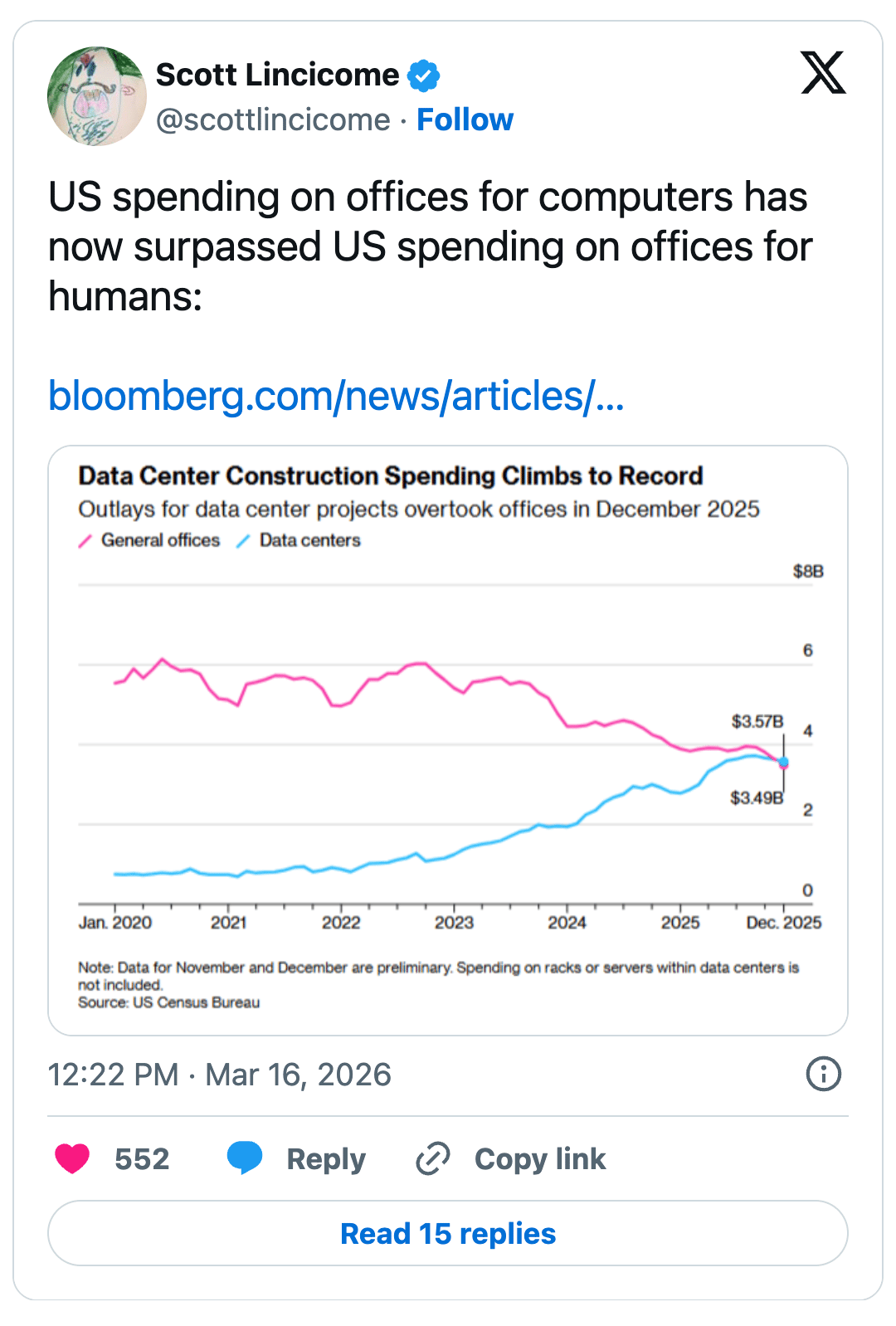
Amazon, Google, Microsoft, and Meta have announced ~$700 billion in AI infrastructure spending for 2026. Not over the decade. This year. The White House has launched AI buildout initiatives worth hundreds of billions, too. It feels like there’s a new data center press release every day.
“Nearly 3,000 new data centers are under construction or planned across the U.S., per a new analysis shared first with Axios — adding to the more than 4,000 already in operation,” Axios put it.
Tech media is arguing about whether the latest model has achieved sentience. Few are asking what it actually takes to clean the sh*t out of the bathroom the guys who built the data center running that model were using for 18 months.
So let's do it.
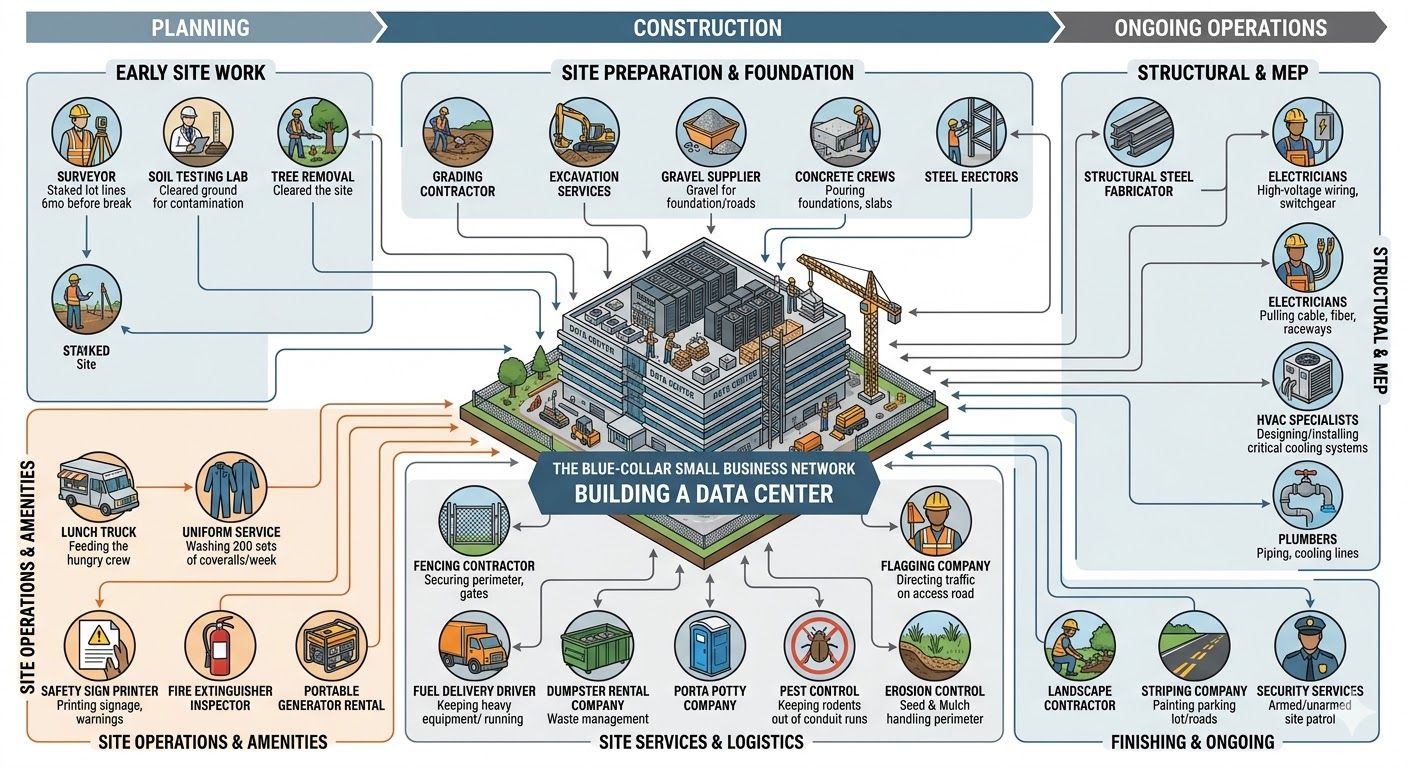
These are just a tiny subset of examples:
Electricians pulling cable.
Concrete crews pouring foundations.
HVAC specialists designing cooling systems.
The porta potty company servicing the construction site.
The fuel delivery driver keeping the generators running.
The fencing contractor securing the perimeter.
The lunch trucks feeding the crews.
The gravel supplier.
The flagging company directing traffic on the access road.
The surveyor who staked the lot lines six months before anyone broke ground.
The tree removal crew that cleared the site.
The pest control company keeping rodents out of the conduit runs.
The uniform service washing 200 sets of coveralls a week.
The safety sign printer.
The dumpster rental company.
The striping company painting the parking lot.
The fire extinguisher inspector.
The portable generator rental outfit.
The soil testing lab that cleared the ground for contamination.
The seed and mulch company handling erosion control on the perimeter.
We could write a similar essay about a GPU, and it would be ridiculously long.
Your Opportunity: Bits Have an Atoms Problem
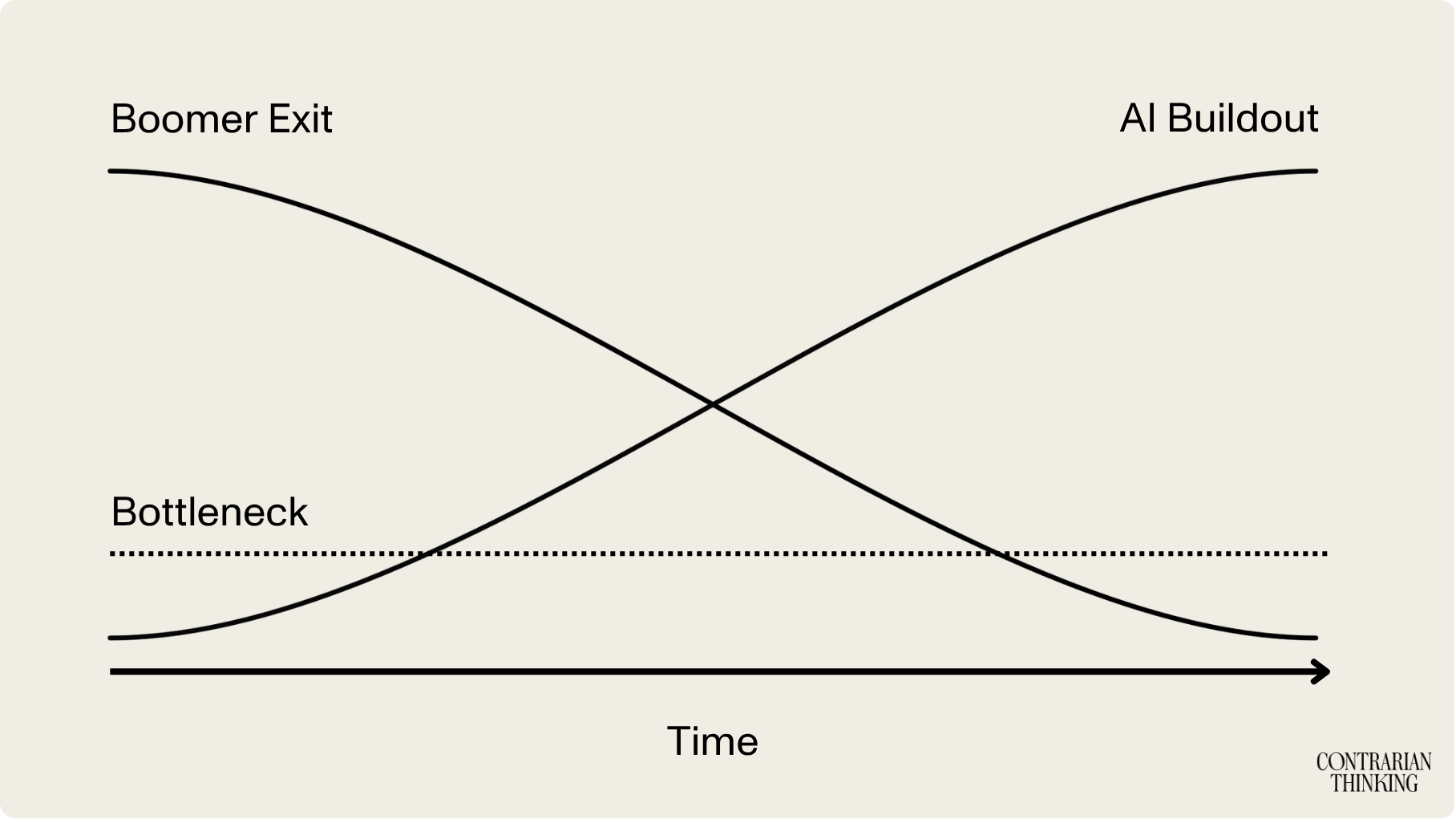
Microsoft President Brad Smith has called the electrician shortage the number one problem slowing U.S. data center expansion.
The math is brutal. Electrical work = 45-70% of total data center construction costs. 300,000+ new electricians are needed over the next decade. About 20,000 retiring annually. Apprenticeship applications jumped 70% between 2022 and 2024, and supply still can't keep up. Google pledged $15 million to the Electrical Training Alliance to try to grow more of them, which is a remarkable sentence when you think about it. Electricians on data center projects are commanding significant wage premiums, with many exceeding $100,000 annually.
The jobs least vulnerable to AI include, with some irony, the ones literally wiring it into existence.
The Infrastructure Paradox
The world's most advanced technology requires the world's most essential trades. While most are thinking about the Algorithm Layer, you should be spending more time focused on the Bottleneck Layer.
Here's the thing. Every industry that explodes tends to rely on a hidden layer of (often unglamorous) businesses.
If it weren’t for plumbers, excavators, and dumpster delivery drivers, Google’s Gemini model wouldn’t be able to one-shot the image below, breaking down this entire process:
Still, You Probably Won’t Become an Electrician, And That’s Okay
You can learn to buy one of their businesses.
Here's who's selling right now. His name is something like Dave or Gary. He started his electrical contracting business in 1987, built it into a solid operation with 10-15 guys, does $6 million in revenue, and has been running it basically the same way since the Clinton administration. He doesn't have a website that works on mobile. His estimating system is a spreadsheet his nephew built in 2009. He is 71 years old, his knees hurt, and he wants to go fishing.
Dave is not alone. Tens of thousands of electrical businesses operate in the United States. Around 30% of union electricians are between 50 and 70 years old. They are retiring in waves, pricing on yesterday, and selling into one of the biggest infrastructure buildouts in American history.
This is the trade.
The Great Transfer
America is on the cusp of the largest wealth transfer in its history. A “Silver Tsunami” doesn’t mean money will rain from the sky, but it does mean lots of unique opportunities will appear.
Boomers own roughly half of all small businesses in the U.S. But they’re beginning to age out. Retiring. Dying. Deciding they don’t want to manage payroll or deal with customers anymore.
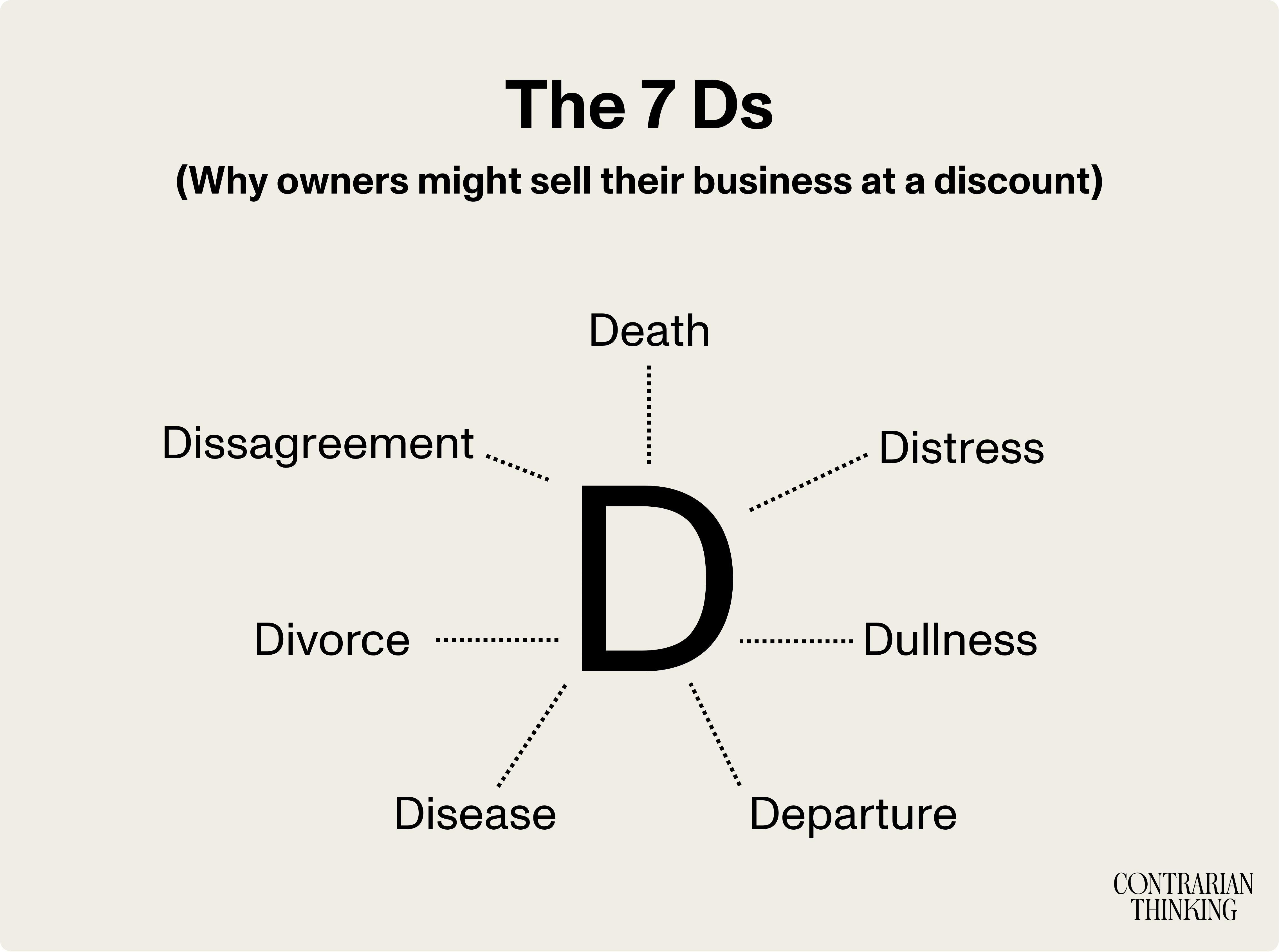
They’re looking to offload what they’ve built. It’s not always because of money. It’s often because life happens:
Departure: Retirement, the most common driver.
Divorce: A forced asset split.
Disease: Health challenges push an exit.
Disagreement: Partners fall out.
Distress: Financial strain forces a sale.
Death: An estate liquidates quickly.
Dullness: The owner is simply bored.
Spot one of these Ds, and you’ve found a pressure point, a moment where a good business may be available at a great price.
But to capture these businesses, you need to understand how to find them, analyze them, make an offer for them, finance them, and, of course, run them.
Why This Matters Now
The uncomfortable truth is that it’s becoming increasingly difficult for income alone to secure your children’s future.
Now you know:
Office tower construction might be slowing, but the HVAC companies servicing them are profitable.
Big Tech jobs might be increasingly scarce, but the plumbing businesses that keep their data centers running aren’t going anywhere.
Those data centers may be the new oil wells, but behind every one are local pest control crews, security firms, and maintenance providers.
This is the unsexy side of the economy where wealth is stealthily being built, and where ordinary Americans can claim a stake. And the good news, for you, is that owning a piece is possible for anyone willing to learn how.
Now’s your chance.
-Team Contrarian
The information contained here is educational, may not be typical, and does not guarantee returns. Background, education, effort, and application will affect your experience and the profitability of any business. Individual results may vary.














.svg)


