You're not stuck, you're just alone at the top. Most entrepreneurs hit a ceiling, not because the opportunity isn't there, but because you're solving $10M problems with $1M strategies.
In 2000, on a mild March morning, a stadium that had hosted Super Bowls, rock concerts, and millions of screaming fans stood silently, waiting for its final moment.
At 8:30 AM, a series of explosions ripped through the Kingdome’s concrete shell. In 17 seconds, one of Seattle’s largest structures was reduced to dust. The event set a Guinness World Record for one of the largest buildings, by volume, ever demolished by implosion.
Reportedly, the 125,000-ton destruction did not cause a “single crack” in the foundation of its replacement, being built just 90 feet away.
The masterminds behind this work? The Loizeaux family, owners of Controlled Demolition, Inc. These are the people you call when something enormous needs to come down without turning everything around it into a crater. The group has spent decades bringing down some of the largest, most awkward structures on Earth.
They did it in Detroit, taking down the towering J.L. Hudson’s department store — once the second-tallest retail building in the world — with pinpoint precision. They did it for the Sands Hotel and Casino in Vegas, erasing an empire in the blink of an eye. And recently, when Baltimore’s Francis Scott Key Bridge collapsed, who did the government call for help? Yup.
To the untrained eye, demolition looks ugly. But to the folks at Controlled Demolition Inc., it’s art and science. Because real demolition isn’t destruction, it’s strategy. It’s knowing exactly where to place the charges, what to remove, and, most critically, what must remain standing nearby.
Now, it seems, another record-breaking demolition is underway, only this time, it’s not the Loizeaux family holding the detonator. It’s Elon Musk. The thing he’s blowing up? One of the largest, most complex structures in the history of the world: the United States government.
Love it or hate it, this is one of the boldest examples of someone taking ownership in modern history. Few have ever taken initiative at this scale, and whether it succeeds or fails, it will be studied for years to come.
What If the IRS Ran Like SpaceX?
Somehow, in an era of AI and instant digital transactions, tax filing in America is somewhere between a sh*t show and an endurance sport. In 2022, individual taxpayers spent 1.15 billion hours preparing their returns. We collectively shell out billions for tax preparers and software, yet 60% of professionally prepared returns contain issues. Even after all that effort? The government still fails to collect $606 billion in annual tax revenues. That’s the best we can do, America?
For decades, inefficiencies like this have been Washington’s default setting. Layers of bureaucracy have hardened up like geological strata, creating a system so bloated that cutting through it one item at a time almost sounds impossible. This is probably why the team tasked with fixing it isn’t bothering with scalpels. They’re bringing dynamite.
It’s hard to argue with this being the type of large-scale problem Elon Musk and DOGE — the Department of Government Efficiency — are uniquely suited to at least attempt to solve.
On top of Tesla and SpaceX, when Musk took over Twitter in 2022, it was a bloated company running on inertia. Within months, he had fired 6,000+ employees (80% of its staff), gutted entire departments, and personally took control of major business decisions, sometimes with a single tweet.
Early on, Musk walked into Twitter HQ carrying a literal sink (to "let it sink in"). Many called it reckless. Defenders called it reckless not to.
Two years later, X is making more money per employee than it did as Twitter. Revenue dropped from $5 billion to $2.7 billion, but adjusted earnings before interest, taxes, depreciation, and amortization (EBITDA) has nearly doubled — from $682 million to $1.25 billion. It wasn’t pretty, but it is building a better business.
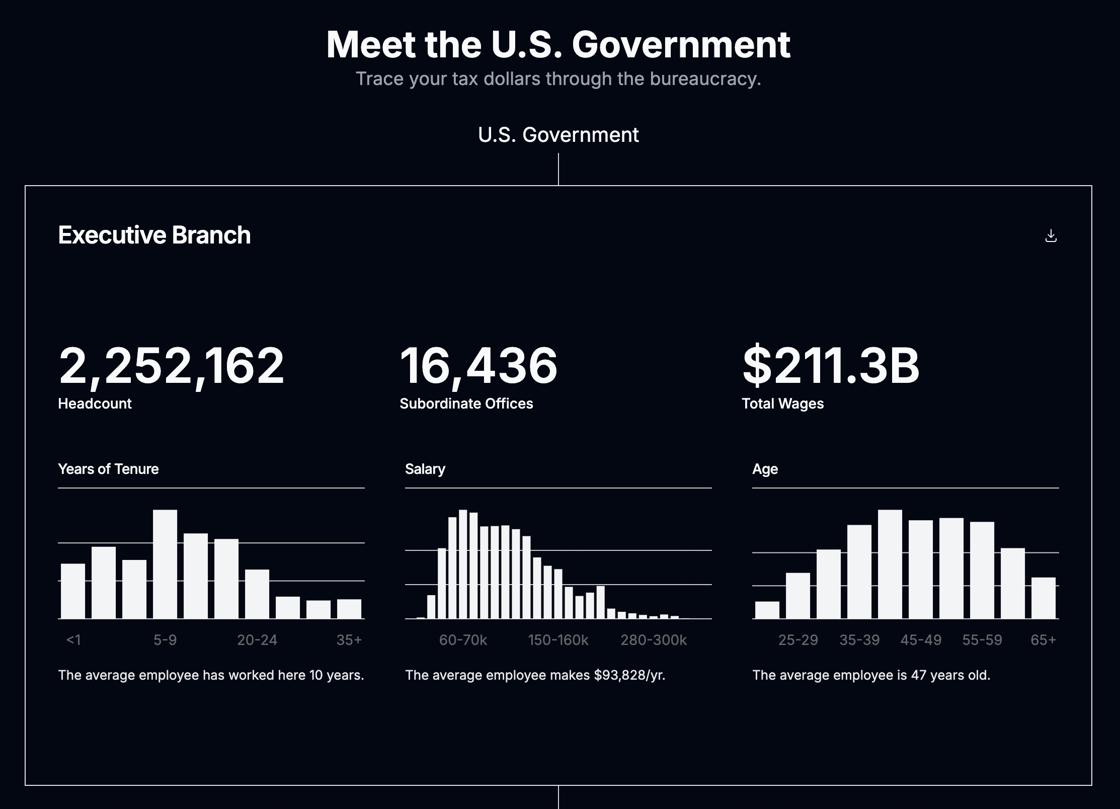
The target this time? A federal workforce of over 2 million people and a budget of nearly $7 trillion. It goes without saying that a tech company is not the U.S. government. Drastic changes could have unforeseen damage, potentially impacting the most vulnerable. Even so, Musk’s stated goal: achieve a trillion-dollar reduction in the federal deficit. “It’s not optional to reduce federal expenses. It’s essential,” he said this week.
Here’s what that will have to entail, according to the man himself:
January 28th: “Lowering the deficit by $1T requires saving ~$3B/day average. Saving $1.8T (current deficit) requires ~$5B/day. Current rate of improvement is ~$1B/day, but will improve rapidly.”
January 30th: “Reducing the federal deficit from $2T to $1T in FY2026 requires cutting an average of ~$4B/day in projected 2026 spending from now to Sept 30. That would still result in a ~$1T deficit, but economic growth should be able to match that number, which would mean no inflation in 2026.”
February 9th: “FY2026 cost reductions are tracking above the $4B/day savings necessary to achieve a $1T reduction in the deficit.”
If this sounds unprecedented, that’s because it is. Slashing trillions in discretionary spending means going very broad, wicked fast, stripping away entire swaths of spending. To track all this publicly, on February 12, DOGE announced an initial website — doge.gov — with a government org chart, a regulatory breakdown, and live updates, with upcoming features set to reveal specific cost cuts, receipts, and a running savings scorecard — all aimed at transparency.
It’s important to remember, demolition is a dangerous art. Place the charges wrong, and the structure collapses into a pile of unintended consequences. So the question is: Can DOGE do what the masters of demolition have perfected? Can it strip away the excess here without bringing down critical foundations nearby? Or are critics right, and is this about to be the most expensive “hold my beer” moment ever attempted?
The Guillotine or the Scalpel
We’ve noticed a spectrum through which people are viewing DOGE:
On one end: “This is reckless, and God only knows if it’s legal. Musk is attempting to bulldoze an incredibly complex institution without understanding how the pieces fit together. A miscalculation here doesn’t just lead to a buggy website or a late car delivery — it leads to critical government functions breaking down.”
On the other end: “This is needed and long overdue. Washington has been running on autopilot for decades, stacking layer after layer of inefficiencies and expenses. If the U.S. government were a business, it would have declared bankruptcy a long time ago.”
Regardless of where you land on this spectrum, we think there are a few things here we can ALL agree on:
Should we, as a country, care more about where our money goes? (Yes.)
Should we demand more transparency in how it’s spent? (Also yes.)
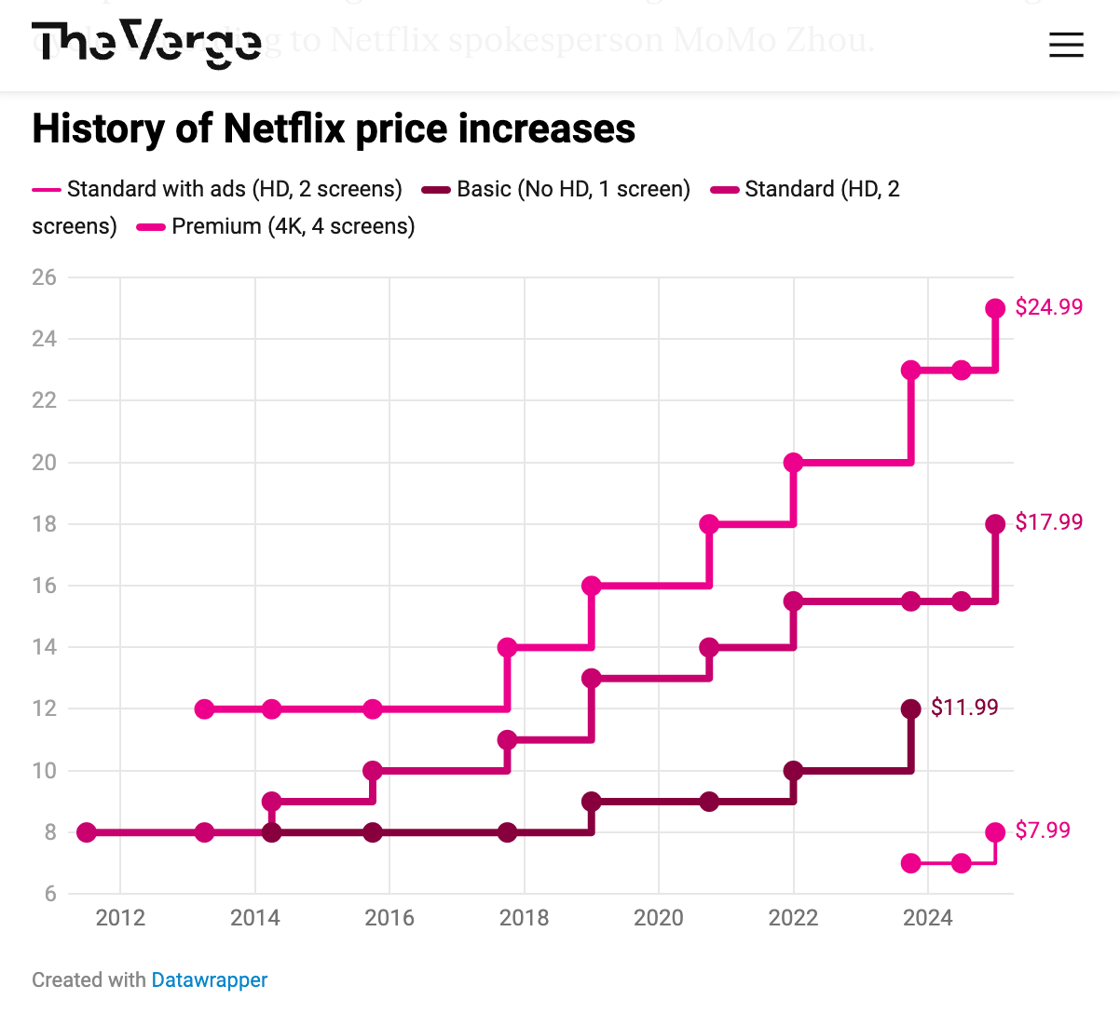
Should we apply the same level of scrutiny to government budgets as we do to Netflix price hikes? (HELL YES… Look at this madness… Just kidding, Netflix is great.)
In other words, it seems like we can ALL get behind taking more ownership over this issue. What we can’t all do is pretend we all suddenly understand the inner workings of federal spending because we skimmed a Congressional Budget Office report while waiting for our Uber Eats.
Yet, every time the government announces a budget cut (or a spending increase), some of us suddenly believe we’re CFO of America, Inc. We act like we have a clear, data-backed, intellectually sophisticated take on whether the National Agricultural Statistics Service should receive an 8% or 12% funding bump. We do not. Elon Musk alone doesn’t either. But if there’s one thing you can’t deny he has experience doing, it’s leading a large-scale teardown in the spirit of efficient growth.
The Strategy Behind This Demolition
Ideally, DOGE could pull this off without a guillotine. Ideally, it could be a precise demolition, done with a scalpel, carefully planned and strategically executed, line item by line item. Unfortunately, we have to be realistic — ain’t nobody got time for that. Doing so would take years that America simply doesn’t have.
Musk has never been one for incremental change. Whether it’s electric vehicles, spaceflight, or Twitter, his playbook is straightforward: move fast, go big, and break things. Now, he’s just applying that mindset to one of the largest and most hot-button problem sets on Earth.
To better understand Musk’s mindset, consider this analogy. During World War II, the U.S. military wanted to reinforce its bombers to reduce losses. They analyzed returning planes and saw that most had bullet holes in the wings and fuselage. The natural assumption? Reinforce those areas.
But mathematician Abraham Wald pointed out the bias: they were only studying planes that survived. The ones that got hit in the engine or cockpit never made it back. So instead of reinforcing where the bullet holes were, the military needed to reinforce the areas where there were no bullet holes — because that’s where hits were fatal.
Musk appears to be operating under a similar understanding. Certain functions of government are absolutely necessary — the “cockpit” and “engines.” These are the things that, if removed, would cause the whole system to crash.
Everything else is a candidate for elimination. For Musk, instead of defending every agency or program’s existence, the burden of proof shifts — they have to prove their value. This forces the government to justify its costs rather than assume continuation. Entire bureaucracies, redundant programs, and unnecessary spending could be wiped out in sweeping motions this way rather than through slow reforms.
Whether you love what he’s doing here or think he’s a reckless wrecking ball, understanding Musk’s strategy is important. You also don’t have to like his methods or agree with his end goal to see why he’s taking this approach. For decades, reformers have tried to improve government through slow, incremental change — studies, commissions, bipartisan panels, and line-item budget cuts. And yet, the system remains bloated, inefficient, and resistant to real transformation.
Regardless of where you stand, one thing is certain: this is not business as usual.
Time For Optimism
For all the pain DOGE may cause, the effort has spawned something this country hasn’t seen in a really long time: a nation genuinely curious about what it’s spending money on.
For years, Americans have treated government spending like gym memberships and TV subscriptions we never cancel. At some point, you look at your finances and realize you’re burning cash on things you don’t use, services you don’t really need, and contracts that probably should have been canceled or renegotiated years ago.
We may not like the way they’re doing it, but DOGE is forcing the country to finally look at our bills. The fact that America is actively debating efficiency — at the highest levels — means our system still works.
In business, healthy companies audit themselves extremely thoroughly. The great ones cut waste before the market forces them to.
In life, smart people track their spending and live below their means. They don’t assume their income will always outpace their lifestyle.
A country that doesn’t care about spending is a country sleepwalking toward decline. Often, political change feels like rearranging deck chairs on the Titanic — different leaders, same sinking ship. Some of you might even feel that way now, but here’s what we think all Americans can be hopeful for:
This will force better accountability. Imagine if every agency had to justify its budget the way a business does. That’s a standard being introduced.
This could clear space for real innovation. Legacy systems don’t just waste money, they waste time and great people.
The key? If the dynamite is placed right, if we take this seriously and deal with care, America could wake up to something historic: a government built for the future, instead of trapped in the past.
Take Ownership
Entropy isn’t just a Washington problem, it’s a human one. Left unchecked, complexity creeps in, distractions multiply, and suddenly, you’re running an unprofitable business model on yourself.
Look around your own life. What needs demolition?
We all hoard — bad habits, cluttered calendars, zombie projects that should’ve been taken out back and shot months ago. The best athletes, investors, and leaders don’t just know how to build — they know how to cut. Dead-weight relationships? Trimmed. Bad distractions? Nuked from orbit.
In times like this, it’s important to focus on the idea that the best part of removing something often isn’t what you take away. It’s what you finally make space for.
The information contained here is educational, may not be typical, and does not guarantee returns. Background, education, effort, and application will affect your experience and the profitability of any business. Individual results may vary.




.png)



-min.gif)


.png)
.png)





.svg)


