You're not stuck, you're just alone at the top. Most entrepreneurs hit a ceiling, not because the opportunity isn't there, but because you're solving $10M problems with $1M strategies.
We're getting close to Thanksgiving, so I want you to picture a turkey.
Every morning, a friendly human shows up and feeds it.
Day 1. Day 50. Day 500.
Every meal makes the turkey a little more sure of how the world works. Humans feed turkeys, and turkeys just keep on gobblin’. That's the deal.
By day 1,000, the turkey has never felt safer.
Then comes the Wednesday before Thanksgiving.
Nassim Taleb tells this story in The Black Swan, and Jack Raines turned it into a chart in his book Young Money:
So what happens when the turkey is you?
The turkey has an Ivy League degree
A guy I follow on X, ex-Wall Street, now running a manufacturing business he bought, posted something this week I can't stop thinking about.
He says the most anxious people in his network all share the same résumé.
Ivy education
Finance job
MBA from a top school
A high-paying run in their chosen field
They’ve always been high performers, but get let go in their early 40s due to “restructuring.” By now though, they’ve got 2 or 3 kids in private school, a summer house somewhere warm, and a burn rate that’ll light their account on fire if they let up.
He says some of these people have been looking for a new job for 3+ years, and they’d happily take a big pay cut just to cover the bills and stop siphoning their retirement.
And Sean Frank, CEO of Ridge, made this point:
(Like, really tight.)
Just don't make it your only option.
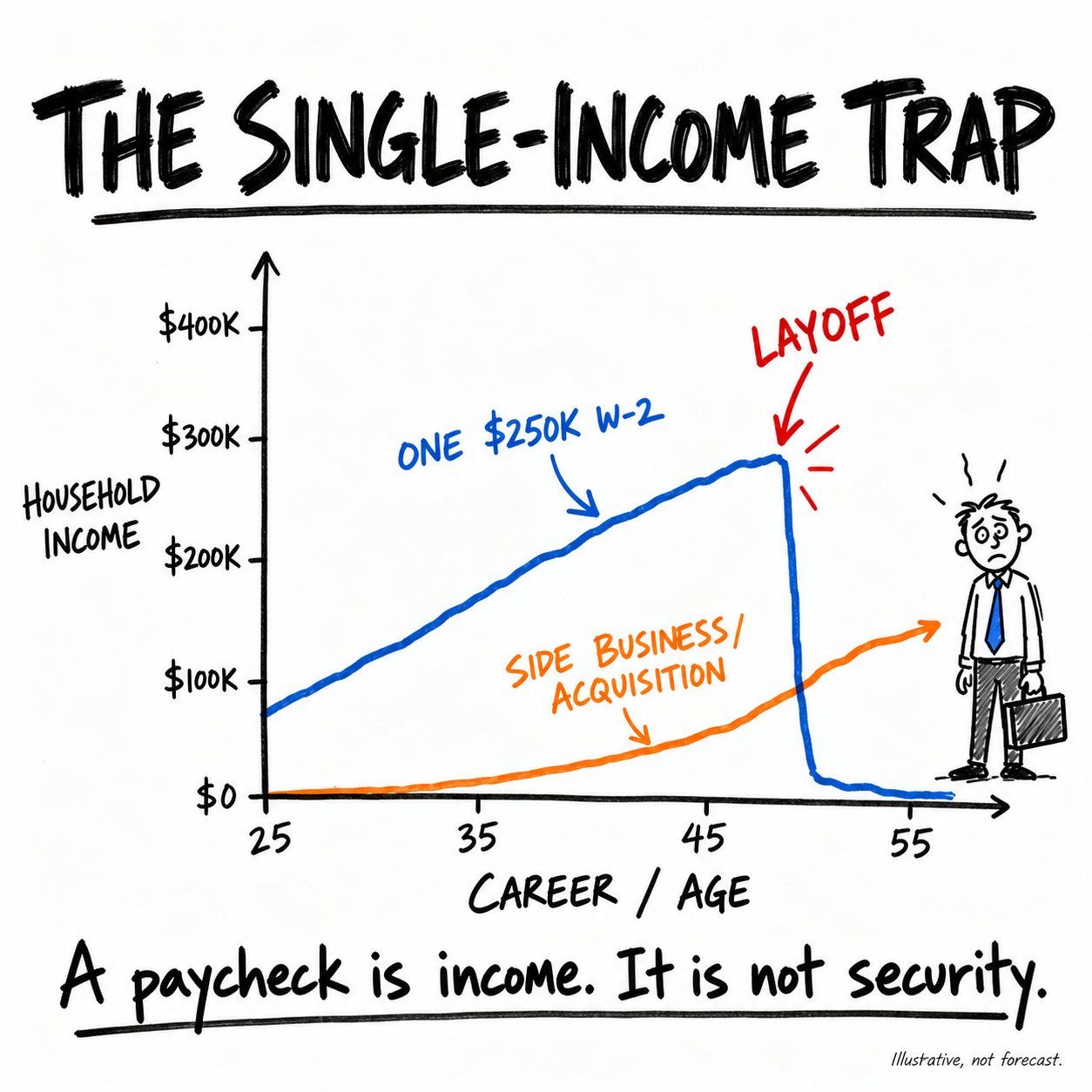
The Single-Income Trap
Everybody loves to dunk on the W-2 employee who wants a business on the side.
But these people aren’t delusional “hustlers,” they’re people who see ownership for what it really is - diversification.
We tell people to diversify their money all the time. “Don't put it all in 1 stock, never put all your eggs in 1 basket.” But if you put 100% of your income in the hands of 1 employer, how’s that any different?
I call it The Single-Income Trap. Your whole life relies on 1 paycheck, and somebody else has their finger on the off switch.
And it gets worse as you age.
The older you get, the more likely you are to be laid off, the longer it takes to land the next job, the cheaper your replacement, and the more AI can do your work.
According to the latest BLS data, 72.9% of displaced workers aged 25 to 54 had found work again. For workers aged 55 to 64, it was just 57.3%.
And even finding another job doesn't mean finding the same paycheck.
Among displaced full-time workers who landed another full-time job and reported their previous earnings, only about half were making as much as they did before.
That $250K salary you built your life around? There's no guarantee the market will give it back.
To make it worse, your costs peak right as your job security drops.
Kids
College
Mortgage
Health insurance
Aging parents
All the things you work hard for add up to a life you can't easily downsize.
"So start something on the side"
Sure.
At 45 or 50.
Against people who are younger, carry fewer responsibilities, and have ideas you haven't thought of yet.
Maybe even paying yourself nothing for the first 2 or 3 years before it turns a profit.
And about half of new employer businesses don't make it to year 5.
That's why I think buying, while far from easy, is often the more rational move for competent people with W-2s.
You start on day 1 with customers, revenue, and a track record. It’s not as sexy as the next AI-driven dating startup, but it’s much more predictable.
"You're just buying yourself a job"
That's the comeback I hear most.
And, to be fair, sometimes it's true. I’ve certainly done it in the past.
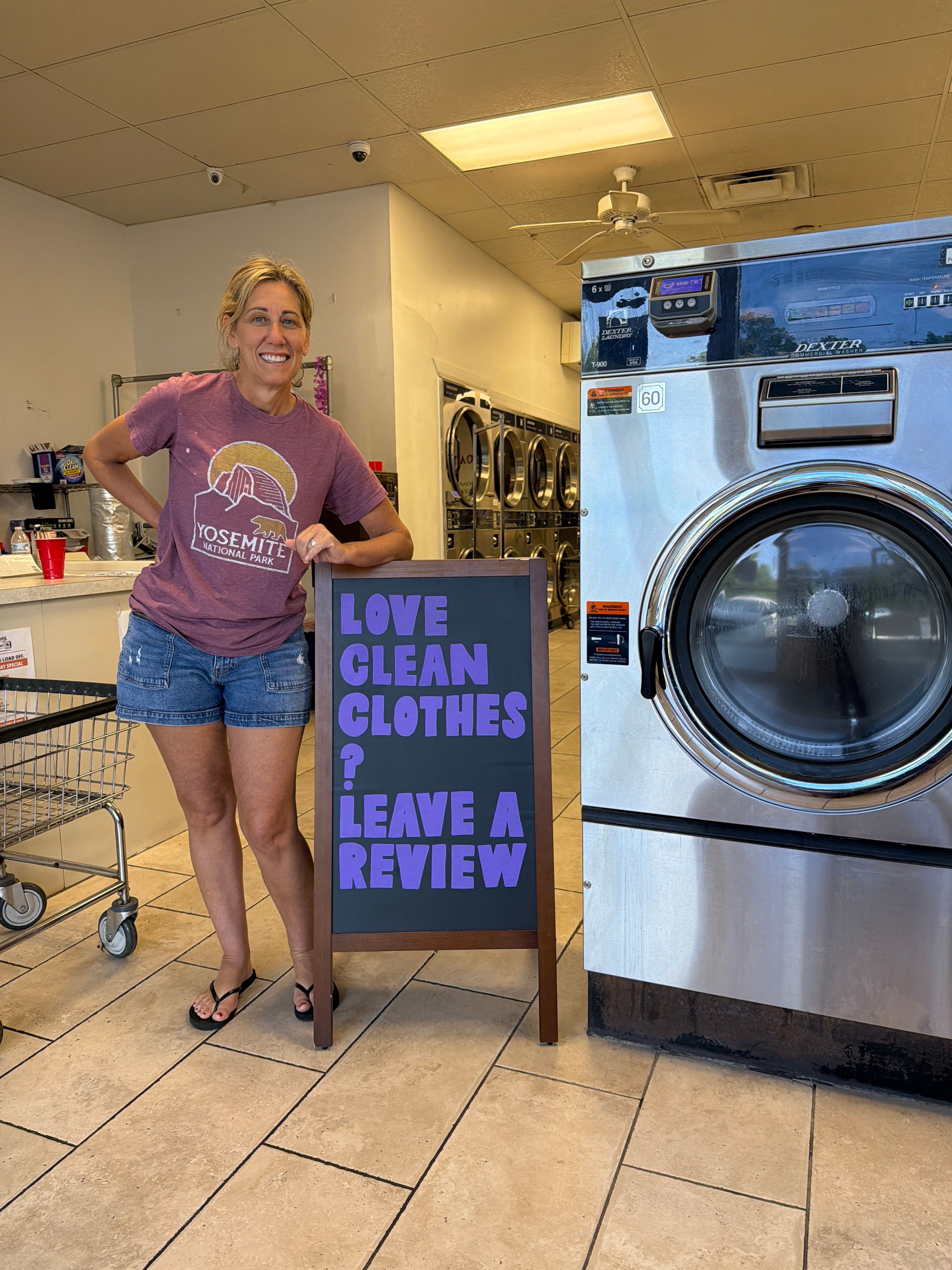
My first business was a laundromat I bought while working 60 to 70 hour weeks in finance. For a while, I wasn't just an owner. I was the person fixing machines and chasing an employee who didn't show up.
And it’s pretty common among some of the biggest owners in the world. Here's a couple other names who bought themselves a "job."
In 1952, a newspaper circulation manager in Oregon sold his house to buy a tire shop with 1 employee and no running water.
That was Les Schwab. He spent year 1 selling and mounting tires himself. Today Les Schwab Tire Centers runs hundreds of stores across the West.
And he’s not the only one.
→ Warren Buffett started buying shares in a struggling textile company in 1962 and took control in 1965. That company became Berkshire Hathaway.
→ Howard Schultz and his investors acquired Starbucks for $3.8M in 1987, when it had just 6 stores. Today it has more than 41,000 locations worldwide.
→ Carl Karcher and his wife put $326 into a hot dog cart in 1941, mostly financed by a loan against their car. That grew into Carl's Jr., with more than 1,000 U.S. restaurants.
→ Wayne Huizenga used a $5,000 family loan to buy a used garbage truck and some customer accounts. Those humble beginnings eventually helped create Waste Management, a company with more than $25 billion in annual revenue.
→ Kenn Ricci acquired a small charter aviation business for about $27,500, including money borrowed from his father. He went on to build an aviation investment group that includes Flexjet.
Some bought businesses, while some bought equipment and built from there. But all of them started with something small, unglamorous, and real.
They bought a truck, a cart, a shack, or a mill nobody wanted.
Every name on this list started by buying something small, often having to “do the job” themselves to get it off the ground.
That “job” is just the price of admission.
The Operator Line
At a certain point, it stops making sense to be the one doing the grunt work.
I call it The Operator Line: the point where a business makes enough profit to pay someone else to run it, and still has money left over for you.
Below the line, you own a job.
Above the line, you own an asset.
Most people buy below the line. Les Schwab did, I did, and so did hundreds of other successful owners.
Starting there is normal, but staying there is the trap.
The Operator Line Test
Grab a pen. Score your business, or the one you're eyeing. 1 point per yes.
THE GM TEST. If you hired a manager at market pay tomorrow, would the business still turn a profit?
THE VACATION TEST. Could you disappear for 2 weeks without revenue dropping?
THE DASHBOARD TEST. Do you know the 3 numbers that tell you whether this week went well?
THE PLAYBOOK TEST. Is the work you do most written down well enough for someone else to do it?
THE CONCENTRATION TEST. Does every customer make up less than 20% of revenue?
4 to 5: You're above the line. Your job now is growing the asset.
2 to 3: You're standing on it. Pick your weakest test and fix that 1 thing first.
0 to 1: You own a job. Good news: so did everybody on that list. Start with test 4. You can't hand off what only lives in your head.
Shopping for a deal while you keep your W-2? Run the test on the listing before you run the numbers. A business that fails test 1 is a job with a price tag.
That's fine, as long as the price reflects it and you’re willing to sweat.
STOP RIGHT THERE.
Wanna see what buying below the line looks like up close?
Meet Erin Blake.
Erin's a mom of 3 who taught elementary school for 15 years. After beating cancer, she wanted more time with her family, so she joined our business buying community and went hunting.
She found a laundromat in Tallahassee that 1 family had run for 20 years. Problem was, the owner wasn't ready to sell. Too much family history tied up in it.
So she followed up. For over a year.
When the business finally listed, the owner called her.
She closed at a $65,000 purchase price on $220,000 in reported revenue.
Then month 1 hit. She caught an employee who'd been skimming cash for years, and she renegotiated the insurance to save $8,000 a year.
That's what owning below the line looks like. You're the one finding the leaks.
(Trust me, I know. My first business was a laundromat too.)
On November 10th, I'm going live for a FREE masterclass to break down how Erin found, financed, and closed this deal, plus the exact strategy I use to find, vet, and buy the right business for your goals.
You'll learn:
Why now is the time to buy
How to buy the right business for you
How to spot red flags early
Plus: 30 minutes of live Q&A with me
Why try to build something that might fail, when you could just buy something that's already making money?
Failing to prepare is preparing to fail
The turkey never saw Thanksgiving coming, because nothing over 1,000 days of evidence said it should.
That's the scary part.
A good run often looks exactly the same right up until day 1,001.
And to be clear, you don't have to walk away from anything. I didn’t walk away until I had built my runway. Keep the job. Love the job, even!
Just start drawing a second line on the chart while the first one's still climbing. Because the days of working the same job for 50 years and retiring with a Rolex and coffee cake in the break room are over.
A $250K salary is great…
Right up until you realize you’re a Turkey on Thanksgiving.
-Codie
P.S. Run The Operator Line Test and hit reply with your score and what the business is.
Low scores especially! The best ones might show up in a future issue.
(If you score too low, we may have to send a personal invite to the Growth Accelerator…)
The information contained here is educational, may not be typical, and does not guarantee returns. Background, education, effort, and application will affect your experience and the profitability of any business. Individual results may vary.