You're not stuck, you're just alone at the top. Most entrepreneurs hit a ceiling, not because the opportunity isn't there, but because you're solving $10M problems with $1M strategies.
Buying a Business in a Hard to Hire Industry (and Picking an Industry)
March 5, 2024
4 min read
From the Boring Business Brief newsletter, originally sent March 5, 2024 as "Do You Also Have THIS Biz-Buying Hiring Dilemma?"
Quick answer: You can buy a business in an industry where hiring is hard, but first figure out whether it is a hard to hire problem or a hard to keep problem. Hard to keep usually points to pay, leadership or culture, which a new owner can fix. Hard to hire points to skills, location or competition for workers. Either can become an advantage if you solve it better than competitors.
Watch: Codie on finding businesses no one else knows about, across more than one industry.
The information contained here may not be typical and does not guarantee returns. Background, education, effort, and application will affect your experience. Your results will likely vary.
Hey Biz-Buyers,
Welcome to this week’s Boring Business Brief, where we share some of the best insights, tips, and stories from our biz-buying community.
Buyer tip: A biz-buying hiring dilemma…
Unless you’re flying solo, successfully running a business means managing talent effectively.
For some biz-buyers, one of the most meaningful parts of ownership is having the chance to hire, develop, and retain great talent.
But it can also be a headache-and-a-half.
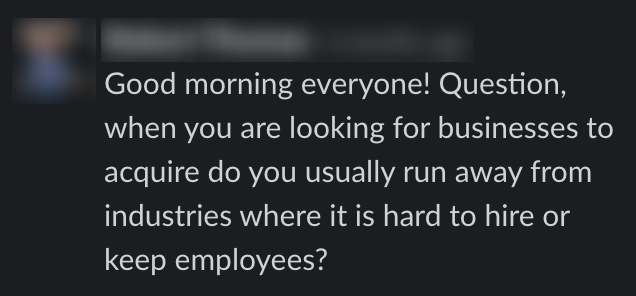
That’s why we loved seeing this question in our Slack👇
The logic is there…
Hiring or retaining employees is already tough.
Toss in an industry where hiring or retaining employees is a known challenge? Fuhgeddaboudit.
Why buy a business if you know the industry comes with hiring headaches or talent shortages?
The community dove right into the nitty-gritty, and we think you’ll find this advice helpful:
One member said the key is understanding the difference between a “hard to hire” problem and a “hard to keep” problem.
“If it is hard to keep employees, is this a leadership issue or incentive problem that can be solved? If it’s hard to find employees, what is the reason for this? Specializations? Geography of business to talent? Industry competition? Marketing? Training?”
Identify which one you’re facing, and address the issue accordingly.
A facilitator mentioned you should also consider whether these issues actually present an opportunity for building a “sustainable advantage” over competitors.
If it’s a “hard to keep” problem, for instance, maybe that means offering better incentives, leadership, or company culture.
Buyer tip: “Should I be focused on 1 industry?”
“… And does it sound silly or unprofessional if you reach out to a broker looking for opportunities in multiple verticals?” asked a member.
The short answer: Absolutely not.
The member added that they’re finding it hard to narrow down their focus across home services, logistics, and technology businesses.
Here’s some of the advice they got:
Recommendations: One member recommended the frameworks outlined in the Buy Then Build book, and shared this podcast episode on formulating a buy box and shortening your search. She looks for businesses with certain levels of profit and adequate systems in place to use her skills.
Tip: Another member explained that brokers expect you to be looking across multiple industries and that things like location and availability will impact the search regardless.
From experience: Our facilitator tossed some wisdom into the mix, too, estimating that 90% of reviewing a business or deal is industry agnostic. “If you’re asking for advice ONLY from people with direct experience, you might be missing out on great advice from others.”
1 biz-buying musing from Codie…
“There are lots of people today wanting to buy businesses with totally unrealistic expectations.
That they should be able to…
Learn everything in 30 days
Get their first deal in a month
Close the deal the next month
I want us to think about how unreasonable that is.
If it’s your first time on the biz-buying search, you may not have done 50 outreach calls, analyzed 50 LOIs, or reviewed 50 P&Ls, let alone one.
Having never done it before, does it seem reasonable that you’d be able to buy a multimillion-dollar business in the next 90 days (let alone one that’s not gonna have anything on the downside)?
OF COURSE NOT.
People need to understand that their volume game has to increase at the period in which their skill is the least.
Too often I see folks fall in love with the first deal they find.
Imagine that you married the first person you kissed or dated.
It could work out.
It could be great.
But you’re potentially putting all your eggs in a basket without fully understanding what you want, who you are, and what’s good for you in a partnership.
If this is your 1st, 2nd, 3rd or 4th business that you’ve looked at… It’s likely not the one you should marry.
… But that doesn’t mean you can’t have a few coffees with it.”
How to Evaluate Staffing Risk Before You Buy
Diagnose the problem
Hard to keep: ask for turnover by role, exit reasons, pay versus local competitors, and how long key people have stayed.
Hard to hire: ask how long open roles stay open, where the business recruits, and whether roles need licenses or rare skills.
Owner as backup: find out which jobs the owner fills when someone quits.
Then ask what the seller has already tried. If wages, schedules and recruiting have all been tested and nothing worked, price the risk into your offer. If nothing has been tried, that may be the opportunity.
Why the manager matters
Gallup found managers account for at least 70% of the variance in employee engagement across business units (Gallup). If people leave, look at who they report to before you blame the industry. That is good news for a buyer, because leadership is something you control.
Protect the team you are buying
An existing business comes with trained employees, which is one of the main advantages of buying over starting (SBA). Meet key employees before closing when the seller allows it, and build retention into your plan for the first 90 days.
Should you focus on one industry?
Not at first. Brokers expect buyers to look across industries, and our facilitator estimates most of reviewing a deal works the same in any industry. Use a buy box built on size, location, earnings and your skills. Find brokers by region in the IBBA directory (IBBA) and tell them the range you are open to.
Frequently Asked Questions
Should I avoid industries with labor shortages?
Not automatically. If you can solve hiring or retention better than competitors, a labor shortage can become your advantage. Diagnose the cause first.
How do I check employee turnover when buying a business?
Ask for headcount and turnover by role, tenure of key employees, pay compared with local competitors, and exit reasons. Confirm what you can in the payroll records during due diligence.
Is it unprofessional to tell brokers I am open to several industries?
No. Brokers expect it. Be specific about size, location and earnings so they know what to send you.
How long does it take to find the right business?
Usually longer than first time buyers expect. As Codie says below, your volume needs to be highest when your skill is lowest, so review many deals before you commit to one.
The information contained here is educational, may not be typical, and does not guarantee returns. Background, education, effort, and application will affect your experience and the profitability of any business. Individual results may vary.
Thinking about buying a business? Learn how in Codie's free live masterclass.
A two day, in person workshop in Austin with the Contrarian Thinking team. Find hidden profits, close the gaps in your business and map the steps to grow revenue.