You're not stuck, you're just alone at the top. Most entrepreneurs hit a ceiling, not because the opportunity isn't there, but because you're solving $10M problems with $1M strategies.
Here's a weird way to go broke in business: get more customers.
Sounds ridiculous, right? More customers means more revenue, and more revenue SHOULD mean you're winning. That's the story we tell ourselves while payroll grows, the calendar fills up, and the bank account starts to dip.
I've seen owners who could sell the hell out of their service, but couldn't figure out how to turn a real profit. The problem isn't always what you're selling…
It's WHO you're selling to.
Not all customers are good customers, and the busiest business in town isn't necessarily the best business in town.
In fact, a study published by the Marketing Science Institute found that 32% of customers at one large distributor were actually unprofitable. That means nearly a third of the company's customers were costing it more money than they made it.
Imagine working your ass off to bring in new business, only to discover that every new customer could be another hole in your sinking ship.
Revenue is vanity, profit is sanity, and the right customer is everything.
And even if you don't own a business yet, I want you to keep reading. Because as you're looking at a potential acquisition you need to know who you're going to target. Often an existing mom-and-pop is catering to the wrong clients, and if you can identify that, it becomes your secret weapon when you take over.
He already had a business and a calendar full of jobs. But what he didn't have was much breathing room — or the profit to show for all that motion.
His team was burning hours driving from one residential lawn to the next, spending all their time doing small jobs that didn't have great margins. He was going faster and faster, but getting nowhere.
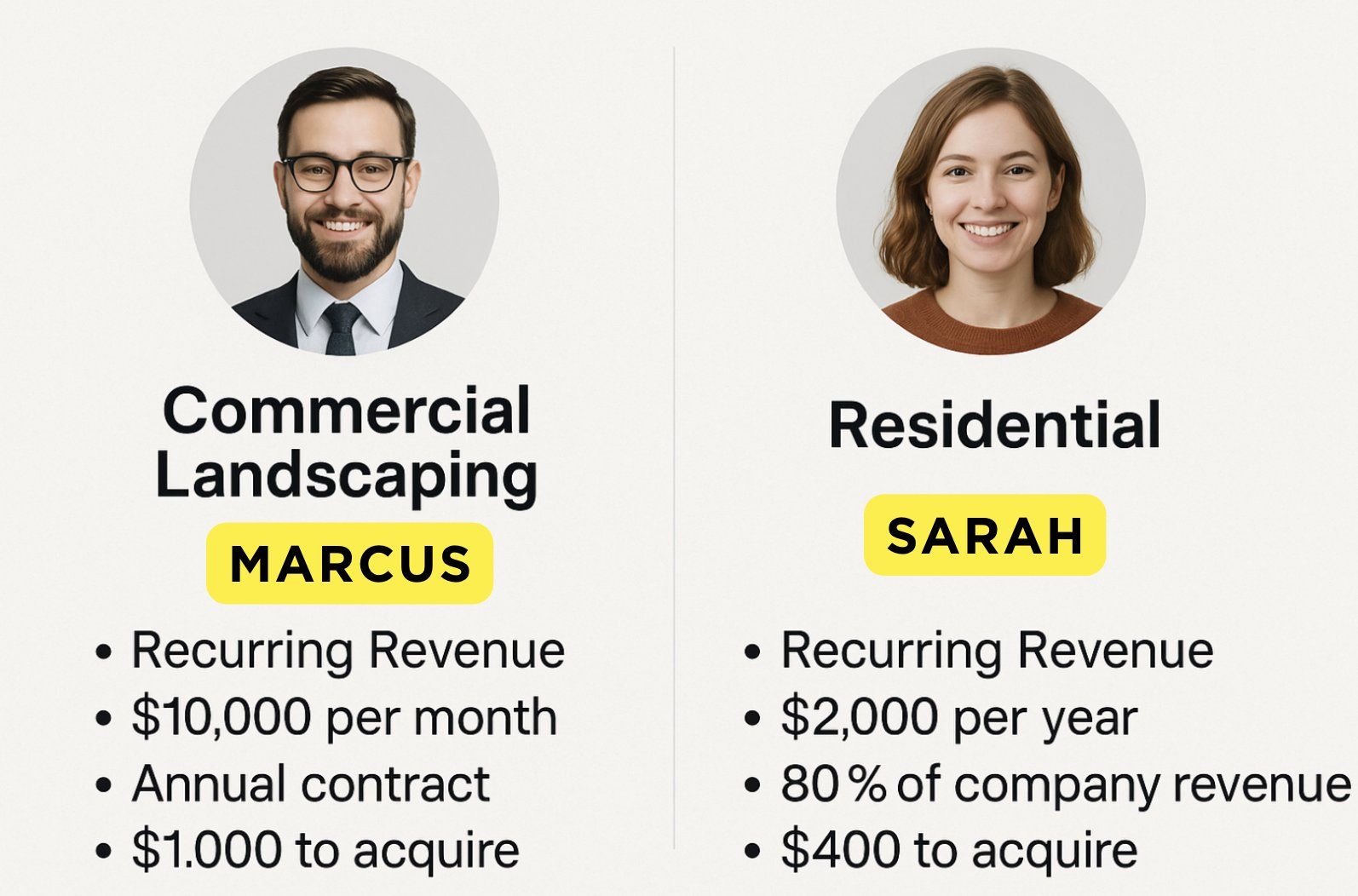
When we popped the hood, roughly 80% of his business was residential; 20% was commercial. He was even considering dropping commercial work because it looked like a distraction.
So we asked: Who is your most valuable customer? And which work actually makes you the most money?
The answer was (drumroll, please) commercial contracts. They paid more, didn't require constant site hopping, and needed recurring work.
So he changed direction: focus on more recurring commercial accounts, and start dropping the scattered one-off jobs.
That shift coincided with 200% profit growth and a 20X increase in customer lifetime value.
(Individual results vary; those figures are self-reported and not a promise for other businesses.)
Basically, Jack got clear on his customer avatar and doubled down on selling to them.
The lesson isn't that commercial always beats residential. After all, if you live in a less metropolitan area, residential might be your only option. The real takeaway is that your most common customer might not be your best customer.
What the heck is a customer avatar?
An avatar is just a working profile of your best-fit buyer: who they are, what pushes them to buy, where you reach them, and what they're actually worth to your business.
Not "anyone with money." Not "homeowners aged 25–65." That's not a strategy. That's a census.
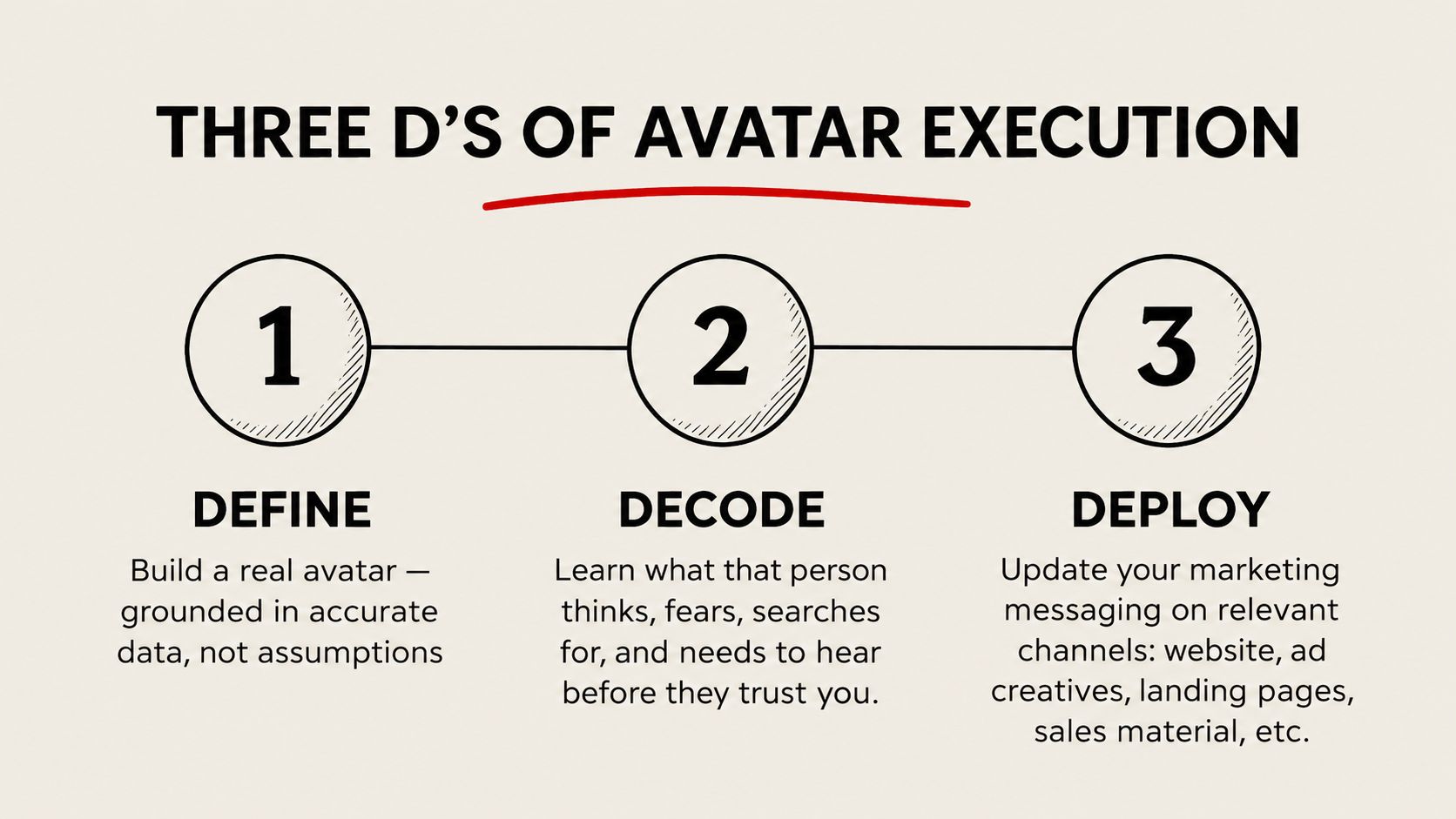
In our Growth Accelerator Workshop, we teach a simple operating system for this: Define. Decode. Deploy.
Quick note: this is just the overview. If you want the real thing, you gotta come see us in person.
D #1: DEFINE — Be specific enough to take action
If you sell to consumers, figure out their demographics, daily frustrations, buying triggers, where they hang out, and what they value most: price, speed, quality, trust?
If you sell B2B, you've got two avatars: the company and the decision-maker. Industry, company size, growth stage, budget, person who signs the check, and what event finally makes them say, "Okay, we need help."
A landscaper's first attempt might be "people who own lawns." Nice. Also completely useless.
A better version: "Property managers with multiple commercial locations, tired of vendor no-shows and juggling maintenance calls, who want one reliable contract." Now you know what to sell, what to say, and whom to call.
Give that buyer a name if it helps. Sketch their day. But don't confuse the pretend biography with proof. An avatar is a hypothesis until real customers back it up, and they will. In fact, brands get 73% more conversions when their avatar is clearly defined.
D #2: DECODE — Follow the money
Here's the part that might sting.
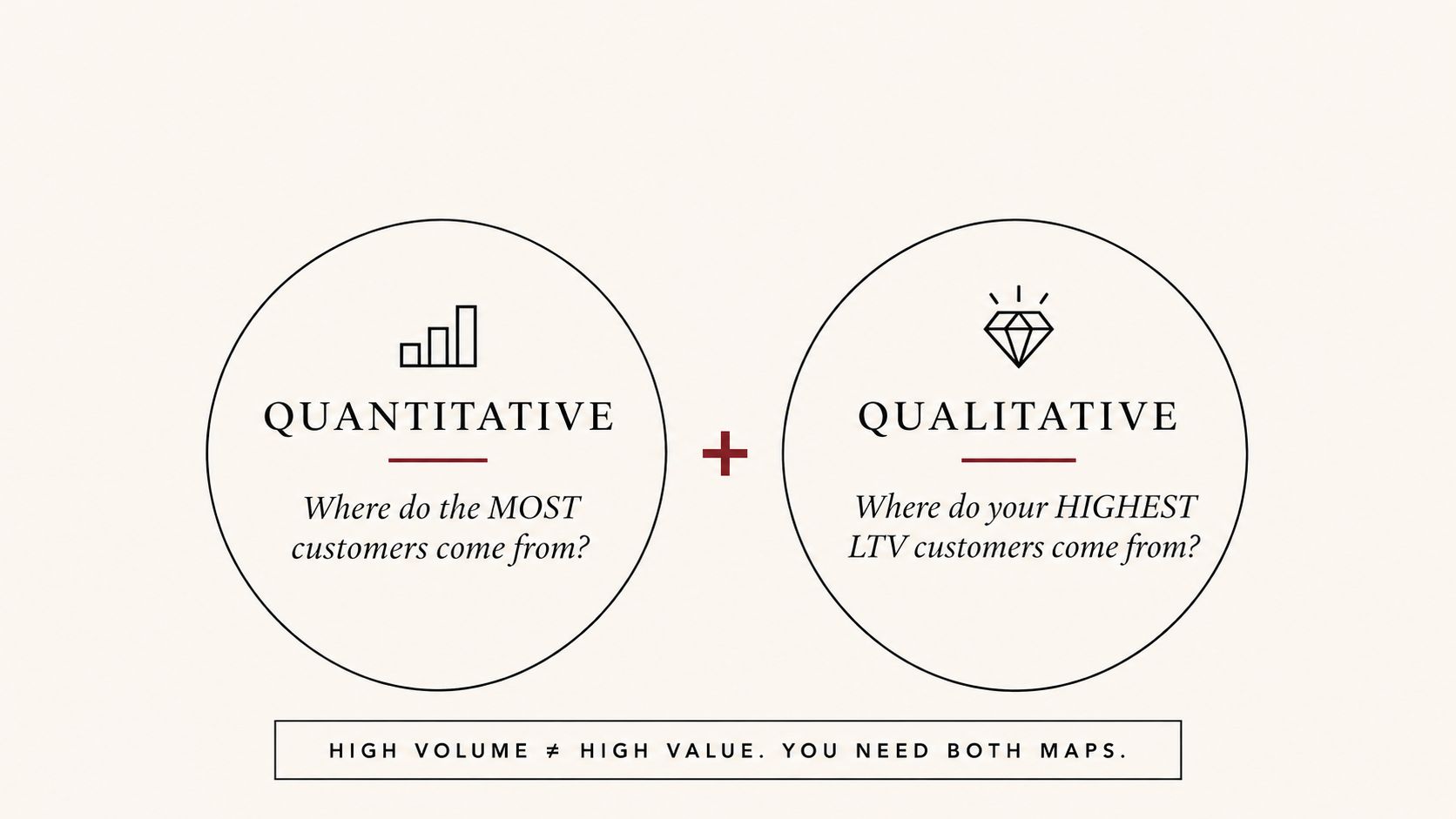
Your favorite customer isn't necessarily your most profitable customer, and your biggest lead source isn't necessarily your best acquisition channel.
Pull data from your actual customers. Your CRM, invoices, lead forms, reviews, and sales calls are a gold mine most owners never bother to dig.
Look at three numbers for each segment:
CAC (customer acquisition cost): what you spent to win a paying customer.
AOV (average order value): what they spend per purchase.
LTV (lifetime value): what they generate over the relationship.
Then add the number I don't want you ignoring: margin. A $10,000 customer who costs $9,500 to service isn't the flex you think it is.
Imagine one customer costs $50 to acquire and pays you $100 once. Another costs $200 to acquire and signs a $2,000-per-year contract for five years. Before service costs and retention risk, those are very different economics.
You need to know which business you're actually in.
Volume tells you where leads come from, but value tells you which leads are worth chasing.
Also ask: Who refers others? Who renews? Who pays on time? Where do your repeat buyers find you? You want quantitative data and the reasons behind it.
Read reviews, listen to calls, and ask customers: "What was happening when you decided to look?" and "What nearly stopped you?" The words they use beat the jargon you cooked up in a conference room during a brand meeting.
One caveat on using AI: it can help summarize appropriately anonymized transcripts and spot themes, which is all great. But don't feed it sensitive customer data, and don't use it as a substitute for your judgment.
Doing this on a napkin is a good start…
But doing it with your real CRM, your real invoices, and a room full of owners pressure-testing your answers is how you make real impact.
That's what we do at the Growth Accelerator Workshop, December 11-12 in Austin. You walk in with your customer list, and you walk out knowing exactly who to chase and who to let go.
PLUS: we always do a Q&A to answer your burning business questions.
Seats are capped, so if your business is doing at least $500K in revenue and you're ready to grow, you can apply for the last few seats below.
D #3: DEPLOY — Stop making pretty PDFs
This is where the best customer avatar in the world goes to die: in a Google Drive folder named "Brand Strategy FINAL v7."
The whole point is to change what you do starting NOW.
Rewrite your homepage around the specific problem your best customers have, put their words into ads and proposals, qualify leads earlier, and train salespeople to recognize the right buyer with a few key questions.
And fish in the right pond.
Someone actively searching for emergency plumbing is probably on Google. But a commercial buyer might find vendors through LinkedIn, local networks, or trusted referrals.
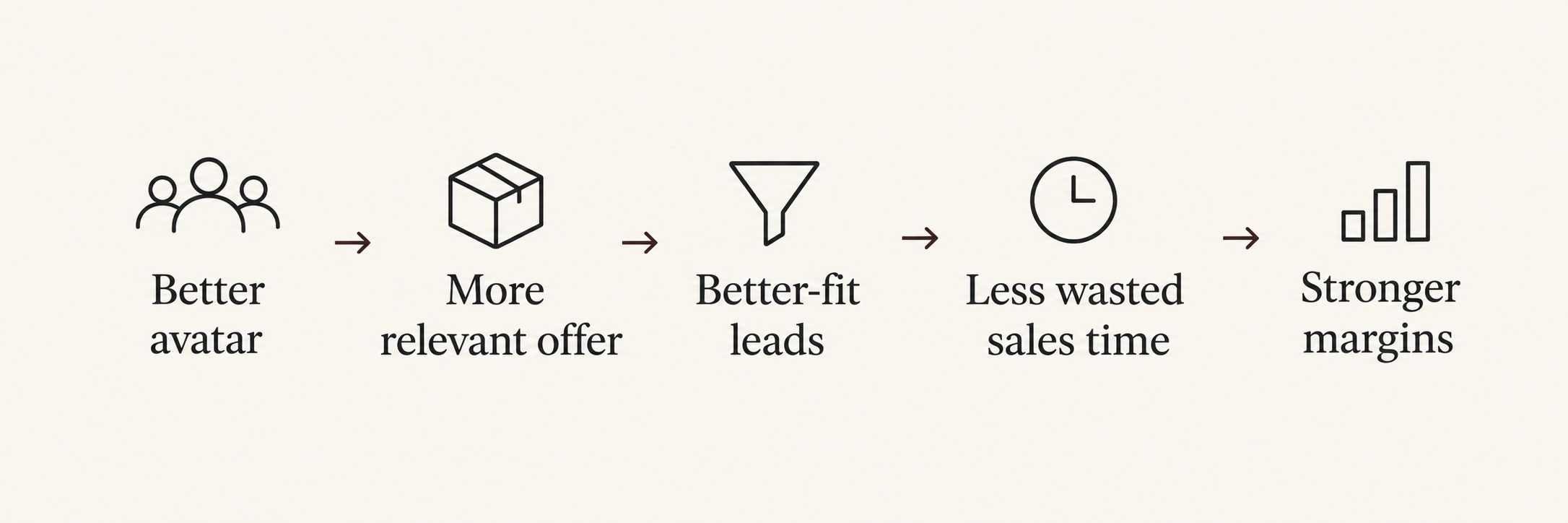
Better avatar = more profits. Simple.
Your 30-minute avatar audit
Here's what I'd do this week. Open your customer list, and pull the top 20 accounts from the last 12 months. Rank them by contribution profit, repeat purchases, and how painful they are to serve. Look for patterns, then interview three of the winners and find out why they chose you.
Write one sentence: We help [specific buyer] solve [specific urgent problem] through [specific offer], because they value [specific outcome].
Now change one thing: a homepage headline, an ad, an intake question, a sales script. Watch whether better-fit leads and profitability improve. If your results aren't tracking, redo the avatar audit and try again.
Your avatar isn't a tattoo. You can change it when you get more data.
And remember, more customers isn't the goal. More of the right customers is.
Own or Be Owned
— Codie
The information contained here is educational, may not be typical, and does not guarantee returns. Background, education, effort, and application will affect your experience and the profitability of any business. Individual results may vary.