You're not stuck, you're just alone at the top. Most entrepreneurs hit a ceiling, not because the opportunity isn't there, but because you're solving $10M problems with $1M strategies.
Bill Perkins always knows exactly what to say to get you thinking.
We were at a Main Street Over Wall Street event, surrounded by people who had already built businesses, bet on themselves, and done “hard” things.
And Perkins, hedge fund manager and author of Die With Zero, stood up and said something that’s still clanging around in my head:
"All of my regrets basically come down to one thing: whenever I didn't do my best. Whatever period of life you're in, if you've chosen a dream, do your fuckingbest to pursue it."
-Bill Perkins
In a world where it feels like everyone’s looking at you and you’re one wrong move away from being memed, it’s easy to phone it in and play it safe.
But you shouldn’t.
Because that’s how you die with regrets.
The Avoidance Trap
Most people spend their lives afraid of the wrong kind of regret.
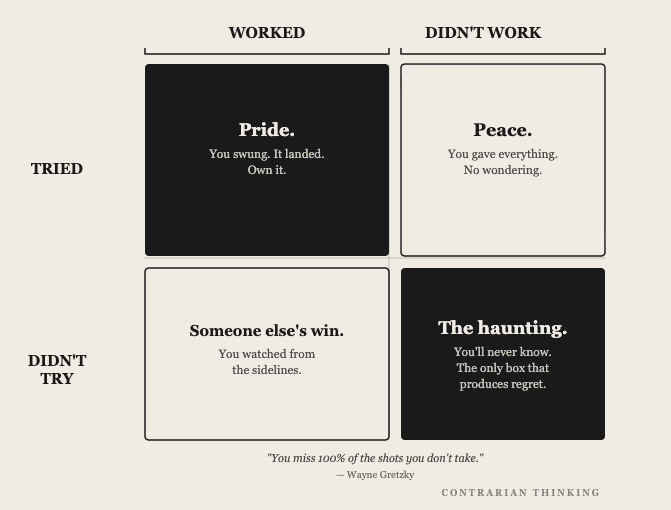
They're terrified of failing, of looking stupid, or of putting real effort into something and having it not work out.
So they hedge.
They keep 1 foot in and 1 foot out, "think about it" for another year, and then try a half-assed version of the thing they actually want to do.
And here's the painful irony: that avoidance is exactly what creates the regret they were trying to avoid.
You won't regret trying and failing, but you WILL regret trying halfway.
How To Minimize Regret
Jeff Bezos figured this out in 1994.
(You’ve heard of him, right?)
As the story goes, he had a secure, well-paid job at a Wall Street hedge fund, when he had this crazy idea for an online bookstore.
His boss warned him to think carefully before throwing it all away, so Bezos gave himself 48 hours and built what he called the Regret Minimization Framework.
Here’s how it works: project yourself forward to age 80, look back, and ask 1 question.
Will I regret not having tried?
Not “will I regret failing,” or “will this work?”
Just: will I regret not having given this a real shot?
Bezos knew he wouldn't regret trying and coming up short…
But not trying would haunt him every. Single. Day.
So he left his job to build what eventually became Amazon, and the rest is history.
His framework is effective, because it separates outcome regret from effort regret.
You can make peace with a bad outcome, and as a future (or current) business owner, you’re gonna have to.
A lot.
But it's almost impossible to make peace with knowing you had more left to give.
The Regret Test
Every big decision you'll ever make either passes or fails The Regret Test.
And it’s stupid simple.
Just ask yourself: at 80, will I regret not having gone all in on this?
If yes, you already have your answer, and everything else is noise.
Put on your best sound cancelling headphones and ignore the static.
The Regret Test doesn't ask you to be reckless though. It asks you to be honest.
There's a version of you decades from now who has a very clear view of what mattered and what didn’t.
So the question is whether you're willing to listen to that person now, when it's still possible to act.
Because the reality is, you can’t redo the past.
What No Regrets Looks Like
Let’s talk about one of our community members, Jared.
He's 24 and never had a W-2 or finished college.
(Wow.)
Jared grew up working in his dad's funeral homes in New Jersey, where the family lesson was non-negotiable:
"Number one, if you don't work, you don't eat. Number two, don't work for anyone."
At 16, he started his first marketing agency, where it took him 9 months to make $5k, but he didn’t stop there.
He built and scaled a second agency to $300k a month in revenue, tried to exit, and walked away with next to nothing.
(It happens.)
He could have stopped there, thrown in the towel, and gotten a “real” job.
But his father’s words were etched in his brain, “Don’t work for anyone.”
So he joined the Contrarian Academy, and by 24, he had:
opened an ice cream franchise doing nearly $1M in annual revenue
acquired a capital-stacking business via seller financing
grown it to $200k in monthly revenue with $100k in monthly net profit
built an 11-person global team with zero outside investors
Talk about a comeback.
the face of no regrets
When we asked him what kept him going through the years that didn't work, he said this:
"I wouldn't have been able to do what I'm doing now without all the experience I had before. It's been 8 years, and I'm really starting to make something from all this."
8 years of all-out effort, always trying his best.
Here's what stands out about Jared: he passed The Regret Test every time, even when the outcome was bad.
The ice-cream franchise wasn’t his first deal.
In fact, he went under contract on a daycare, a fire truck auto shop, a moving company, and several other deals that fell through before finding the one that worked.
But Jared wasn't half-in.
He was all-in, every time, on every deal he touched. So when the right opportunity finally came, a business that was about to shut down, completely seller-financed, he knew exactly what he was looking at and moved on it.
"I didn't want to buy an online business, but I could see how I could make money with this. And I'm so happy I did because I think this will be the biggest company I ever run."
That clarity doesn't come from luck: it comes from 8 years of refusing to half-ass it.
How To Apply It Yourself
Take 5 minutes to do this little “Deathbed” test.
1. What's the thing you keep almost doing? The business you almost looked into, the decision you keep "thinking about," the choice you keep avoiding. Write it down.
2. At 80, looking back, will you regret not having gone all in on it? Yes or no. Either way, you have your answer.
3. Are you currently in a season of life suited to pursue it? Energy, time, obligations, health, finances. Basically, is this your window? Shoot for 3/5 for a passing grade.
4. What does "going all in" actually look like for you right now? Not a fantasy, but a concrete next step. What would giving it everything require in the next 30 days?
5. Which kind of regret are you more afraid of: a bad outcome, or never knowing? Your answer tells you everything about whether you're making this decision from courage or from fear.
One Last Thought
Bill Perkins has more money than he’ll ever need.
He's built and sold more than most people will ever attempt.
As a poker player, he’s won and lost MILLIONS.
So it’s safe to say the man knows about money and business…
But when he stood in front of a room of people who wanted his insight, he didn’t warn them about bad deals or crappy businesses.
He warned them about regret.
His advice was about the periods of his life where he didn't fully show up for the thing he said he wanted.
So ask yourself: at 80-years old, will you wish you had tried harder?
Or are you gonna go for it today?
See you on Main Street.
— Codie
The information contained here is educational, may not be typical, and does not guarantee returns. Background, education, effort, and application will affect your experience and the profitability of any business. Individual results may vary.














.svg)


