You're not stuck, you're just alone at the top. Most entrepreneurs hit a ceiling, not because the opportunity isn't there, but because you're solving $10M problems with $1M strategies.
I pulled her into a room because I'd run out of other options.
For weeks she'd been touring the company like a lounge act. Different audience, same whiny set. We work too hard, this place is crazy, everyone else is the problem.
"You've told me you have a problem with your manager, with ops, with the content team," I said. "Have you actually talked to any of them about it?"
She looked at me. "Well, no. They wouldn't listen anyway."
There it was. All she'd ever wanted was an audience. So I decided to give her a new one.
Firing her took 20 minutes. Undoing what she'd already done to the team took months.
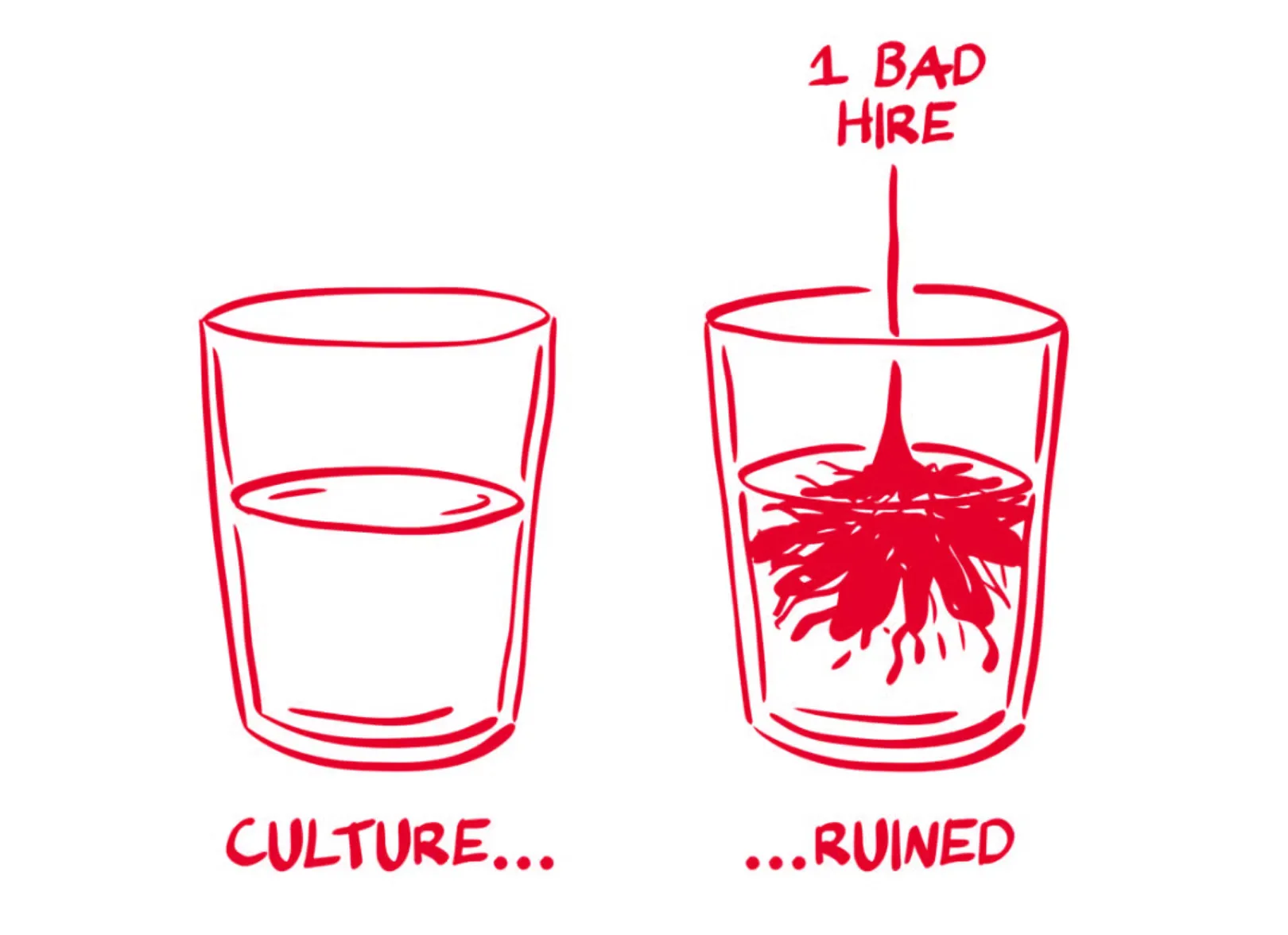
Here's what you might not know about a bad hire: underperforming is the least of it. The real damage is how they poison everyone around them.
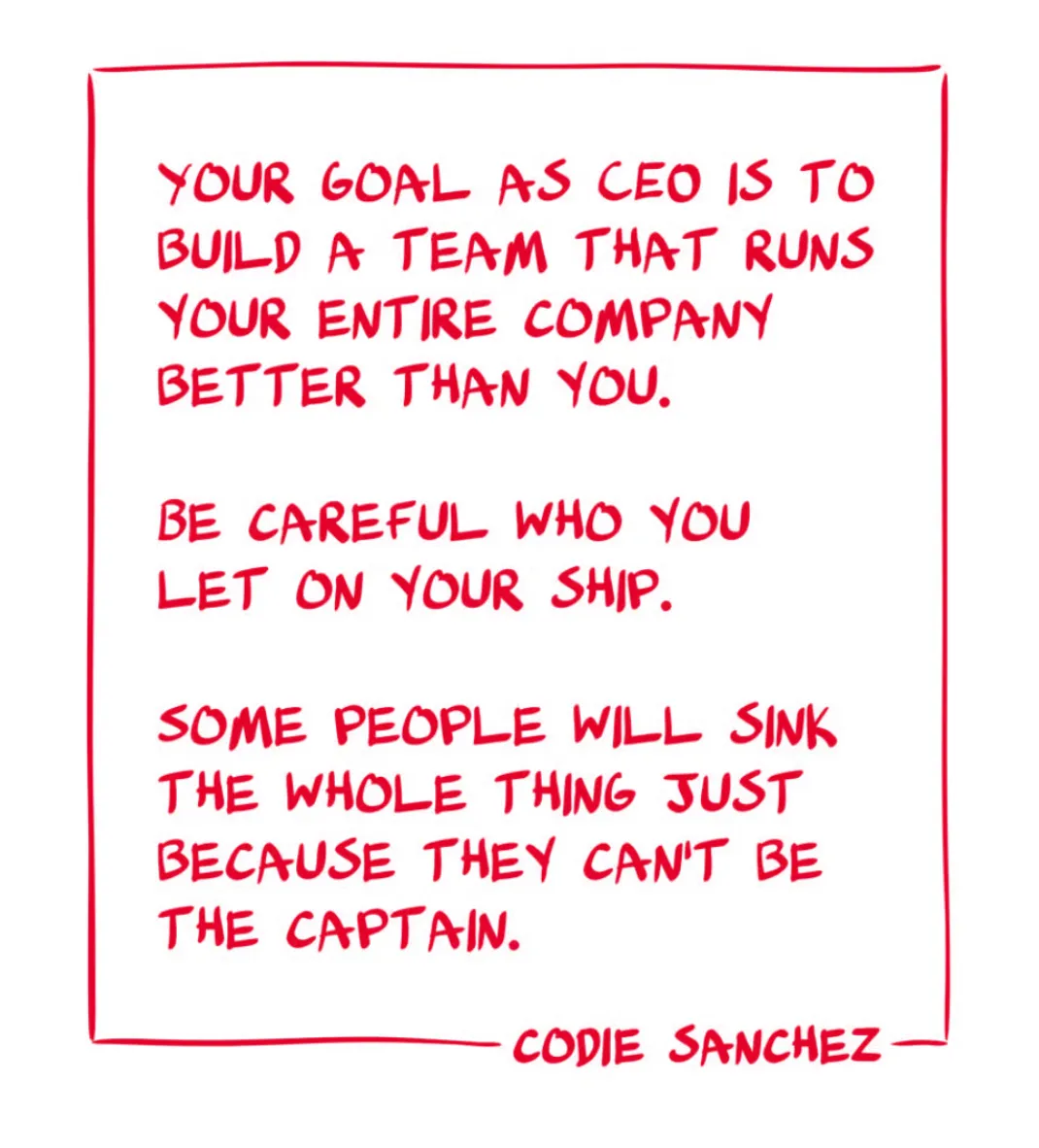
Every person you bring in either compounds your standard or corrodes it.
Most owners run the wrong version by accident. They talk to 3 or 4 people, pick the least terrible one, and act shocked 5 months later.
Turns out, hiring is hard.
It's why we built a process the whole company follows for every single hire. We’ve had to. Contrarian Thinking has outgrown 3 offices since we started in 2019, and over the last 9 months we've added about 50 people to the payroll.
We've gotten it down to a science, so go ahead and steal it for your next search.
The Hard Part
You want better hires? Fix the core problem: too few candidates, and a standard so flexible it could be an Olympic gymnast.
Here's the math. For every 50 profiles you scroll, 10 to 20 turn into real conversations, and 1 turns into an offer.
Top performers are already winning somewhere else, which means you have to go get them. Block an hour a day for hunting.
Open LinkedIn, type "Austin, Texas, Chief Marketing Officer," and start DMing strangers. One of our best content hires came from a cold DM to someone who wasn't looking.
Two things do most of the filtering before you ever score anybody.
1. A job description that repels people
Most job postings are a duty list. A list of tasks only speaks to the B's and C's of the world.
Here's what a duty list looks like:
Nothing in there tells anyone anything useful about the culture or the expectations. It's a Tinder bio for an office drone.
Any job description you write should read almost like a warning label. Replit's careers page has an entire “Reasons NOT to Join” page.
Love it.
Here's a description we've used in the past:
Read that and you immediately know what kind of company we are, what the mission is, and who we want on board.
Contrarian Thinking only wants A-players, and anyone who isn't one won't enjoy working here. That doesn’t mean they aren’t valuable, it just means Contrarian Thinking won’t be a fit.
The right people read that and feel recognized. The wrong ones self-screen before they ever hit your inbox.
So don't just think about who you're trying to attract. Think about who you don't want in your org.
2. Read for receipts, not logos
A shiny brand on a resume could just mean they interview well and understand corporate politics. It doesn't prove they built anything useful.
When somebody leads with "I went to Harvard," I smile and think, we can rub that Harvard right off your rugby sweater.
It's not about where you've been. It's about what you've done.
What a weak resume line sounds like:
Congrats, they own a thesaurus.
What a strong one sounds like:
Numbers, ownership, and proof attached so you can fact-check.
You should push on their resume claims during the interview. "What was revenue when you started? When did you leave? What did it cost you to get that growth?"
If they can't answer, that's your first red flag. Then go even deeper. "What did you own that wasn't happening before you got there?"
My favorite one: "If we had the budget, who would you bring with you?" Real A-players start recruiting during their own interview. If they can't name a single person, they've never led anybody.
The Hiring Matrix
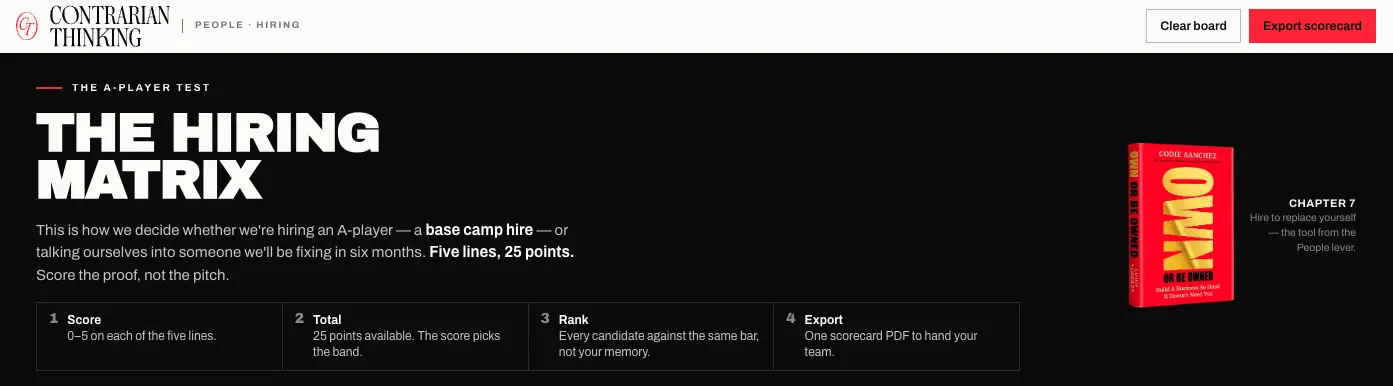
This matrix is our hiring law. We trust the numbers, not our gut.
Own or Be Owned breaks it down in Chapter 7. And if you want the custom tool we made so you can track candidates against each other, I’ll tell you how to get it at the book launch.
Here's how it works.
5 categories, 0 to 5 each.
Known candidate. Have I or someone I trust actually worked with them?
Proven experience. Have they done this exact job?
Proven industry. Have they done it in our market?
Proven problem set. Have they faced our specific problem?
Proven scale. Have they operated at our size or bigger?
One rule: no 3s.
I call it the Coward's 3. A 3 means "I don't want to say they sucked, but I can't say they were good either." It's how you avoid having an opinion while looking thorough.
You're not a judge on a baking show softening the blow. You're deciding who sits next to you inside your business every day.
Strong opinions only.
Score them once before the trial project, and score them again after. If you can't get to 18 out of 25, you don't have your hire.
How it worked on the scariest hire I've made
Marc Hustvedt spent 3 years as president of MrBeast, and when we started talking, I was scared. Not of him, but of the gap. He'd been running ops at a company significantly bigger than we were at the time.
Here's how I scored him.
Notice the 2. I hadn't worked with him directly. That's fine. 20 out of 25 said keep going, and his 30-day project confirmed it.
Inside 48 hours he'd found 2 bottlenecks in our production process I'd been missing for a year. And here's the reframe that got my stomach to unclench about salary. You don't pay people annually. You pay them monthly, and you test for 90 days.
So the question was never "can I afford this salary." It was "can I afford 90 days to find out if this person changes everything?"
By the end of his first week, Marc made a call on vendor contracts I would have agonized over for a month, and I found out after the fact.
My first instinct was annoyance. My second, about 3 seconds later, was relief so intense I almost laughed. He was making decisions without me, and that was the entire point of the hire.
One more thing, or the matrix doesn't work
Somebody has to hold the line.
Every company needs one person who protects the bar when you're not around.
It can't be up to the manager who's desperate to fill the seat because they're drowning. That person will always find a way to a 3.
The line holder asks one question: are you hiring the right person, or the right-now person?
Bottom line: if it's not a hell yes, walk away.
🛑 STOP RIGHT THERE
The Hiring Matrix is 1 tool out of 12 in my new book, Own or Be Owned.
On September 18th, I'm giving away the best playbooks and strategies I've learned after scaling over 30 companies worth hundreds of millions combined.
And ICYMI, there’ll be over a million dollars in cash and prizes, and a few billion dollar entrepreneurs joining me on stage.
I've never been more excited for you to see something than this.
Some of you will literally walk away with your life changed.
Save your free spot below:
This Part Stings
Look at whoever is draining you most this week. The one who needs 3 reminders and turns every KPI into a wrestling match. You hired that. Probably on a random Tuesday, when you were tired, and your gut said no, and the seat had been open for 6 weeks.
You threw up your hands and said, "Fine. Good enough."
That happens because the hiring standard wasn't concrete, not because you're a bad judge of people. Which means you can fix it, one scorecard at a time.
Run the matrix on your next open role. Then, if you're feeling honest, run it on the people already on your payroll.
You already know someone who wouldn't clear an 18.
The only question is what you do about it this week.
-Codie
The information contained here is educational, may not be typical, and does not guarantee returns. Background, education, effort, and application will affect your experience and the profitability of any business. Individual results may vary.










.webp)


.webp)
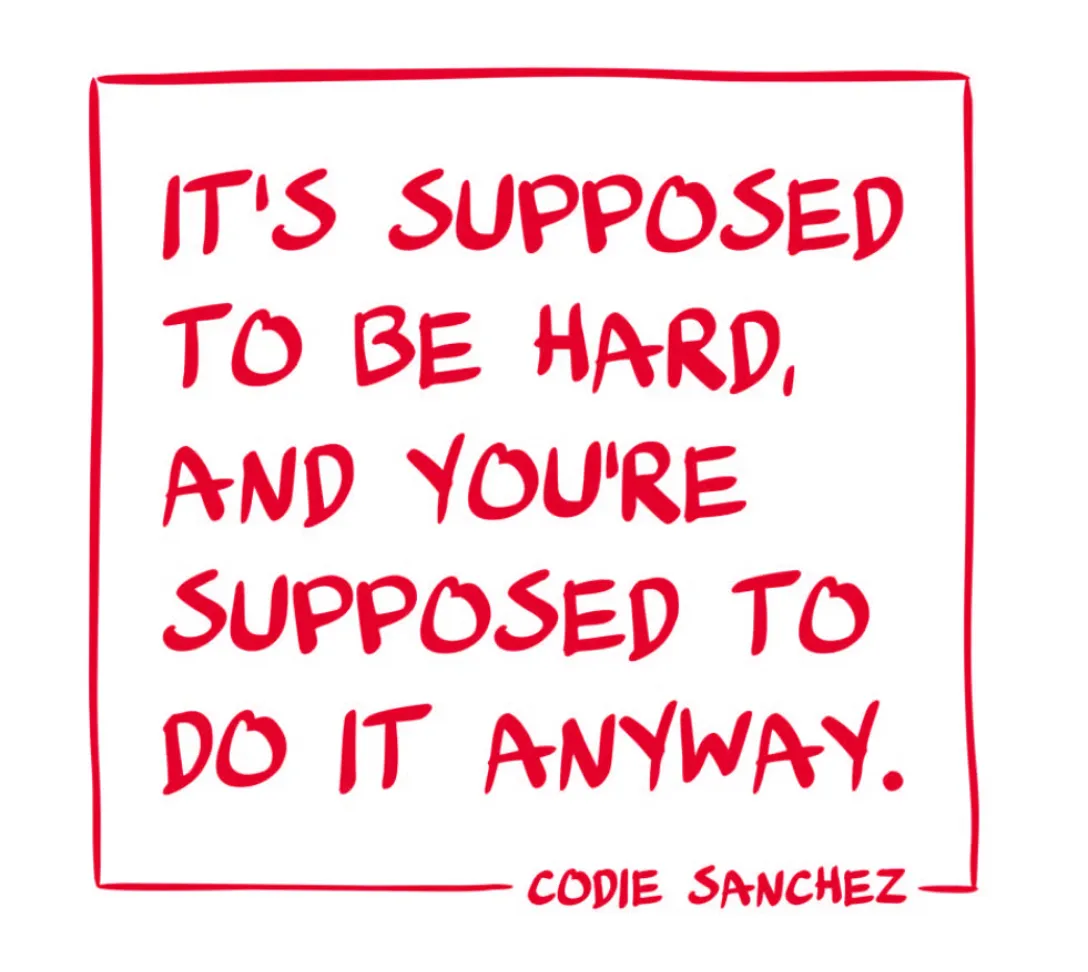



.webp)


.svg)


