You're not stuck, you're just alone at the top. Most entrepreneurs hit a ceiling, not because the opportunity isn't there, but because you're solving $10M problems with $1M strategies.
The Silver Tsunami: What Baby Boomer Business Sales Mean for Buyers
February 16, 2024
5 min read
From the Contrarian Thinking newsletter, originally sent February 16, 2024 as "What to Know About Biz-Buying’s Silver Tsunami"
Quick answer: The silver tsunami is the wave of baby boomer owners expected to sell or close their businesses as they retire. Live Oak Bank's 2023 research found 70% of small businesses have no succession plan, yet nearly a third plan to transition ownership within five years. That creates real opportunity for buyers, but it will not make buying easy: many of these businesses are not sellable, and plenty of other buyers are chasing the good ones.
Watch: Codie on the kinds of established businesses worth buying instead of starting from scratch.
Hi Contrarians,
Ever heard the term “silver tsunami?”
No, it’s not referring to some massive surge in silverware sales or some Hawaiian seniors’ surf competition (as much as we’d all love that).
But it is referring to an AARP armada — an aging population and its impact on society, healthcare, the economy, and, for us, small business acquisitions.
Today we’re here to discuss the latter.
Small business owners are getting older…
Many experts think America’s silver tsunami will have a HUGE impact on small business acquisitions.
So let’s take a look under the hood, shall we?
Yup, definitely skewing up and to the right.
To an extent, this makes a lot of sense. If you’re older, you’ve had more time to launch or buy businesses, so of course most business owners are older.
But think about this for a moment.
As of the 2020 Census, about 17% of the U.S. population was 65 or older, about 55.8 million people.
Despite representing less than a fifth of the country, they represent a TON of the wealth.
According to a 2019 CNBC report, boomers alone own an estimated 2.34 million small businesses in the U.S., employing more than 25 million people.
We’ve got a lot to learn from them, too — the vast majority of boomer businesses are profitable, according to reports.
At the same time, here’s the truth: They’re getting ready to pass the baton. Many already are, even if they don’t know it yet.
Experts estimate that roughly 10,000 Baby Boomers retire each day.
Think about how many might want to soon but aren’t quite sure how.
How can you sell a business if you are the business?
And even if your business can operate without you, it still may be tough to find a buyer
This is becoming an especially challenging issue in other countries, like Japan.
This is a critical problem — and opportunity — for us to confront, and we will confront it by elevating people’s capacity to become owners.
Locally-owned biz’s are said to recycle 3 times the money back into local economies than “absentee-owned firms or corporate chains.”
So it’s critical we do.
Why you should give a damn (look at the data)
Here’s the deal: Most business owners DO NOT have a succession plan in place.
That much is clear.
Recent survey data on hundreds of American small businesses from Live Oak Bank found 70% have no real succession plan, yet nearly 1/3 plan to transition ownership within 5 years.
Additionally, among owners who are transitioning or plan to within five years, Live Oak found that 26% have accelerated those plans due to the state of the economy.
Many aging business owners will soon be looking for an out. What do these people care about when they sell? According to the research:
43% care about the preservation of company legacy/integrity
24% care about the price they can sell at
22% care about the next owner’s treatment of their customers and employees
It’s no longer as simple as handing off a farm to your kids for them to manage.
(Not that that’s ever been particularly simple…)
So say a buyer commits to those items above, that could be all an owner needs to hear…
Across the board, as passing on a business to your kids becomes less common, other options will probably increase in popularity.
5 things to think about before you ride this wave…
1. Don’t lose sight of reality
While many existing businesses will likely go up for sale in the coming years, they certainly aren’t all going to be good businesses, and they certainly won’t all be available at good terms. As you already know, terms are king.
2. Business ownership isn’t for everyone
Hang on, let us repeat that: Business ownership 👏 is 👏 not 👏 for 👏 everyone.
Hiring good talent, firing people to their face, managing terrible customers, making loan payments, meeting payroll… A good portion of the population is simply not built for that.
3. Know what you’re getting into
Sure, there’s a Harvard MBA out there who thinks he can roll up 3 HVAC businesses in Bismark, North Dakota no sweat, mix in some digital marketing, and call it a day. Maybe he can.
But maybe he doesn’t even know what HVAC stands for yet, let alone how to operate a screwdriver. Know what you’re getting into.
4. Don’t assume all boomers will sell
Some owners may opt for the stable cash flow and choose to hold on to their businesses as long as humanely possible.
This could present a major opportunity where “sweat equity” comes into play, meaning, you could partner with (and work for) an aging owner in a way that sees your compensation and ownership stake grow over time.
5. Call in the military
In the U.S., a steady stream of service members moves from active duty to civilian life every year. According to the Bureau of Labor Statistics, “Veterans are 45% more likely to be self-employed than non-veterans.”
As owners across the country seek out compelling buyers, this group could stand to benefit big time — if they act.
The counterpoint: why the silver tsunami may not flood the market
Two months later, in our April 16, 2024 issue, "Why the “Silver Tsunami” Might NOT Happen in SMB…", a broker in our community made the case that the wave would not make buying easy. Here is that piece.
Why the “Silver Tsunami” might NOT happen in SMB (according to one broker…)
Earlier this week, Contrarian Community Facilitator (and biz broker) Clint Fiore wrote about why the “Silver Tsunami of Boomers” doesn’t mean biz-buying will come easy.
And let us just tell you this: the man’s post brought people out of the WOODWORK.
Here’s the main idea:
“I came into business brokerage 10 years ago with a promise of a ‘Silver Tsunami,’” says Clint, “a demographic wave of Baby Boomer business owners with no succession plan and trillions of dollars of small businesses needing to sell in the next 10-20 years.”
In theory, he says, we should be seeing a huge supply of businesses and a shift to a record-large buyer’s market.
But we’re not. From his perspective, it has yet to be the case.
Clint’s 7 theories on why the SMB “Silver Tsunami” hasn’t happened…
1) The “Buyer Tsunami” is bigger than the Silver Tsunami
SMBAs: Business schools are increasingly teaching about ETA (Entrepreneurship through Acquisition)
Contrarian factor: Folks like Codie “are turning people onto entrepreneurship at a staggering rate. It’s becoming mainstream-cool to leave the corporate 9-5 and go buy or start an SMB,” he says.
Current owners: Per Clint, more and more are adding onto their current businesses as a way to grow.
“Combined — many more buyers entering the space than retiring Boomers can satisfy the demand for.”
2) COVID did a number on Sellers
Many businesses took a hit during the Pandemic, either closing permanently or struggling to adjust to a new world with new valuation expectations.
“So they’re closing or just limping along mortally wounded unable to come to grips with selling for a much lower value,” Clint explains.
3) Boomers suck at preparing their books
To have a sellable business, you need to make it sellable. That means being able to clearly and easily prove your profits.
In Clint’s experience, old-school owners have “decades-old ingrained habits of keeping lackluster records,” which make deals a whole lot less bankable.
“Today’s Buyers want to borrow and leverage SBA loans and if the business can’t easily pass underwriting with its historical tax returns, they’re VERY hard to sell,” he says.
4) Commercial real estate appreciation
No, not “appreciation,” as in you’re fond of it and there should be a CRE Appreciation Day.
He’s talking about appreciation, as in prices are through the roof.
Boomers who are looking to sell real estate tied to their business know they’re sitting on gold mines. Unfortunately, many buyers can’t afford to buy gold mines, and the businesses they’re buying aren’t lucrative enough to solve the real estate equation.
Clint says some sellers may close or liquidate their businesses to get top dollar for their real estate, but “many remain in purgatory unwilling to close their business they love and unwilling to accept offers for the RE that the business can sustainably support.”
5) The Boomer psychological barrier
“This generation highly identifies with their businesses. They feel like they are the business, and selling feels like they’re losing their meaning, their worth, and even reason to live.”
The result? They hold on too long, often to a point where the business is no longer sellable, according to Clint.
6) Many biz’s may not be sellable in the first place…
A lot of the sub $1M revenue business are built around an owner’s skills and lifestyle. They leave? The business may go poof.
For buyers, many businesses may not make enough profit to service debt, hire an operator, and support the buyer on top of that — which is why deep due diligence is crucial.
7) Owners often sell to owners
There’s a lot of “insider trading” in biz buying, in the sense that owners in certain industries often quietly sell to friendly competition rather than go through the whole process of a brokered sale to an unknown buyer.
“If you’re a Buyer frustrated with market dynamics seemingly making buying a business an uphill battle, hopefully this helps you understand why,” says Clint.
“There is hope though! You can still win as a Buyer but it’s not easy and you need to learn the game and get good at it!”
“This is the realest post I’ve read about SMB acquisition in a while…”
Our community members had some thoughts here…
Lance: “This makes perfect sense. I see this mentality also in some Gen X. Most of my friends and family who own small businesses are just job owners even if they have a few employees. The CT community has really opened my eyes to what a business is truly worth.”
Sonja: “What a fantastic post. Gems! Point #6 is really the one biggest clarity point for me after 8 months of searching. Sooooo many businesses for sale are really not businesses as you say — just jobs.”
Evelyne: “This is the realest post I've read about SMB acquisition in a while. This is exactly what I've been running into, day in, day out. I've been overwhelmed by the amount of businesses out there that are just not worth buying, 100+ reviewed and still counting...”
And one more thing…
Inside our community, Clint added that he still firmly believes there’s “still a lot out there.”
“It greatly benefits you to get in the game now so you can be one of the friendly competitors as soon as possible,” he says, “gobbling up retirees that never made a plan and absorbing customers from ones that close.”
“That’s the play. You’re in the right place. Just gotta get in the game.”
Team Contrarian
Silver Tsunami Buyer's Guide: How to Find a Retiring Owner's Business
What the data says
The demographic shift is real. The 2020 Census counted 55.8 million Americans age 65 or older, 16.8% of the population (U.S. Census Bureau). Boomers own an estimated 2.34 million small businesses that employ more than 25 million people (CNBC).
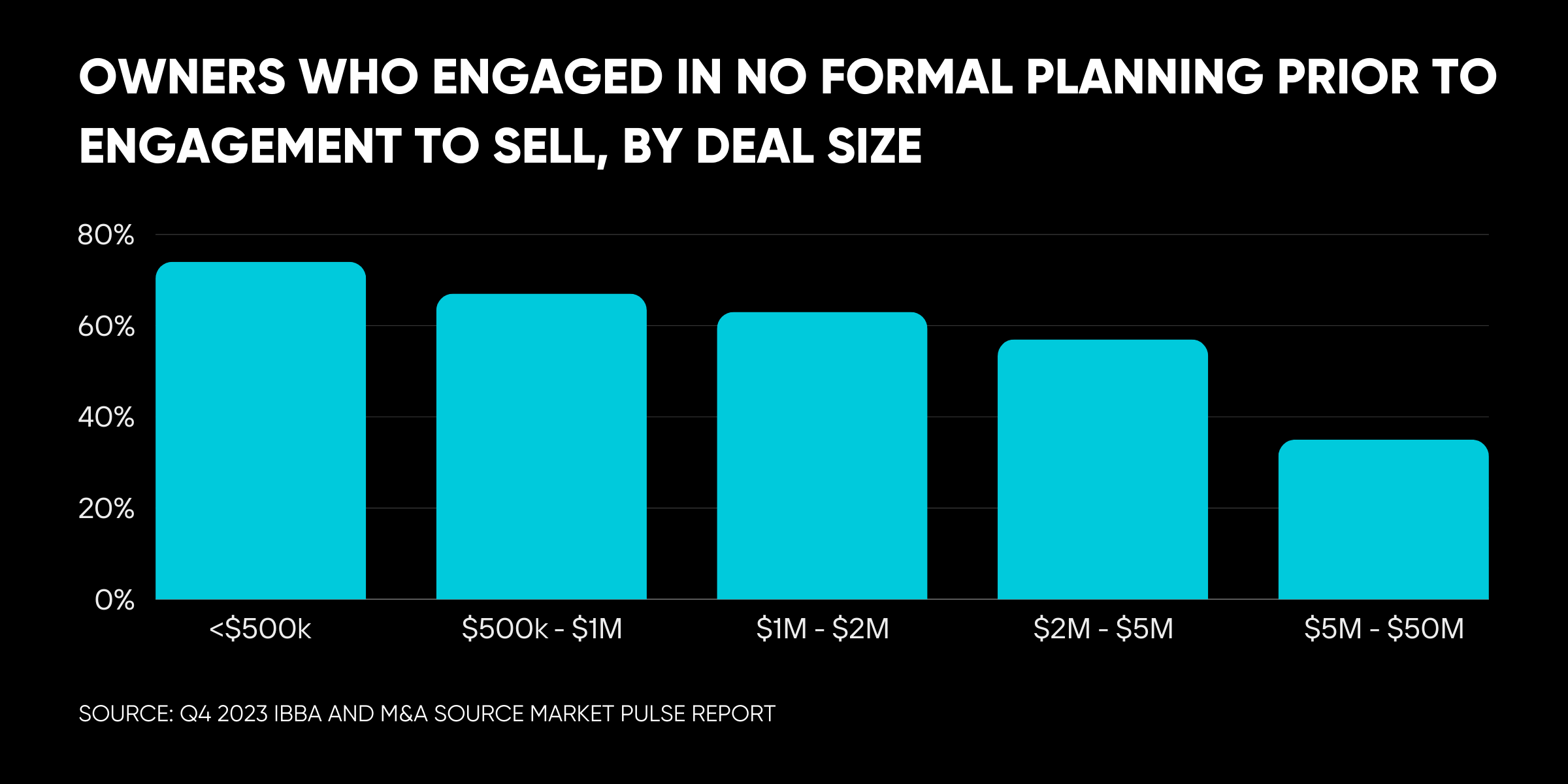
The planning gap is real too. In Live Oak Bank research from the third quarter of 2023, 70% of small businesses had no succession plan, 24% had one and 6% were unsure. Brokers see the same thing at the closing table: in the IBBA and M&A Source Market Pulse report for the fourth quarter of 2023, retirement was the top reason sellers went to market in every deal size, and 74% of owners selling businesses under $500K had done no formal exit planning.
Why it may not feel like a buyer's market
The second half of this article is the counterweight. Clint Fiore, a broker who facilitates in our community, explained why the wave has not turned into a flood of easy deals: more buyers, weaker books, real estate that costs more than the business can support and owners who hold on too long.
Put the two views together and you get the practical takeaway. Supply is growing, but the share of businesses that are profitable, documented and ready to transfer is much smaller than the headline numbers suggest. Expect to review a lot of listings to find one worth buying.
What retiring owners care about
Price is not the only lever. Among owners planning a transition, Live Oak found 43% put preserving the company's legacy first, 24% put price first and 22% put the treatment of customers and employees first (Live Oak Bank).
That gives a prepared buyer an edge. Show the owner how you will keep the name, the team and the customer relationships intact, and you can compete with buyers who only talk about multiples.
How to position yourself
Get your financing story straight early. The SBA lists changes of ownership as an approved use of 7(a) loans, up to $5 million (SBA).
Look for the books problem before you fall for the business. If the tax returns do not support the profit, a lender will not either.
Separate the real estate from the business when the owner wants top dollar for both.
Ask about the owner's plans for life after the sale, not just the price.
Consider a path in over time. Some owners who are not ready to sell may welcome a partner who earns into ownership.
Where veterans fit
The Department of Defense notes that veterans are 45% more likely to be self employed than non veterans, citing the Bureau of Labor Statistics (U.S. Department of Defense). Skills like leading teams and running process translate well to buying an established business.
Frequently Asked Questions
What is the silver tsunami in small business?
It is the wave of baby boomer business owners expected to sell or close their businesses as they retire. Boomers own an estimated 2.34 million small businesses, and most small businesses have no formal succession plan.
Is the silver tsunami a good time to buy a business?
It can be, but it is not easy. More owners are retiring, yet many of their businesses depend on the owner, have weak records or cannot support debt. A growing pool of buyers is also competing for the best ones.
Why are so many boomer owned businesses hard to sell?
Common reasons include books that do not pass lender underwriting, owners who are the business, real estate priced above what the business can support and owners who wait too long to sell.
What do retiring owners look for in a buyer?
In Live Oak Bank's 2023 research, the largest group of owners planning a transition put preserving the company's legacy ahead of price. Showing how you will care for the team and customers can win deals.
The information contained here may not be typical and does not guarantee returns. Background, education, effort, and application will affect your experience. Your results will likely vary.
Thinking about buying a business? Learn how in Codie's free live masterclass.
A two day, in person workshop in Austin with the Contrarian Thinking team. Find hidden profits, close the gaps in your business and map the steps to grow revenue.