You're not stuck, you're just alone at the top. Most entrepreneurs hit a ceiling, not because the opportunity isn't there, but because you're solving $10M problems with $1M strategies.
Buying a Food Distribution Business: A $3.5M Frozen Food Deal
June 11, 2025
7 min read
From the Main Street Minute newsletter, originally sent June 11, 2025 as "Would you buy this $3.5M frozen food business?"
Quick answer: Buying a food distribution business can be attractive when it is lean and profitable, but customer concentration can make or break the deal. Mark reviewed a B2B frozen food wholesaler priced just under 4x 2024 SDE, with no employees, no inventory and one customer at nearly 70% of revenue. He proposed 10% down, a 75% SBA loan and 15% seller financing, and the parties were negotiating a $500k+ seller note that is forgiven over time if the biggest customer shrinks.
Watch: Codie's 80 minute playbook on finding businesses to buy, including the deal box and seller financing.
👋 Welcome to Main Street Minute, your shortcut to Main Street acquisitions.
This week, we take you inside a deal for a $3.5M frozen food business that had our community asking: Is this a goldmine or a ticking time bomb?
Let’s dive in.
INSIDE THE NUMBERS
Would You Buy This Business?
Today’s deal is a relationship-driven B2B frozen food wholesaler built by a husband-and-wife team. It’s lean, profitable, and surprisingly simple — no employees (really), no inventory, and just a handful of key players holding it all together.
For Mark, the buyer, it checked a lot of boxes.
The business has strong cash flow. It’s been remarkably consistent. And after nearly four decades of running it quietly and efficiently, the soon-to-retire owners, now in their late 70s, are finally ready to pass the torch.
But beneath that calm surface is a single relationship that’s carried the business for decades — one customer that makes up nearly 70% of revenue.
That could be a sign of durability… or a disaster waiting to happen.
Let’s take a look under the hood.
DEAL GLANCE
What It Has Going For It
This business was built to be lean. No inventory. No employees. No overhead bloat. Just co-packers making the food and brokers getting it sold.
According to Mark, the sellers even “intentionally avoided growth to keep operations small and manageable.” And yet, the business has grown anyway.
In late 2024, a major new customer came on board — and it’s already moving the needle. Mark believes this buyer will become the company’s second-largest customer, reducing concentration from ~70% to ~58% by the end of this year.
It’s a business built on relationships, and Mark sees that as a feature, not a bug.
He and his business partner come with deep expertise and networks in hospitality. They’ve both run operationally complex companies and aren’t concerned about learning the nuances of this one.
Their plan is also to go where the seller never did: outbound.
They’re planning to grow by leaning into their networks: hotel chains, cruise lines, and large foodservice contracts. The current owners spend maybe 10%-15% of their time on sales. Mark will be doing closer to 100% on Day 1.
DIGGING DEEPER
Industry Snapshot
Frozen food wholesaling is a $151B market, and most of it is dominated by big players moving generic products at scale.
This business is focused on private-label goods like egg rolls and spring rolls sold into hot bars, cruise ships, and buffets. No inventory. No real brand. Just a product that reheats well and relationships that have lasted decades.
That’s the upside: lean ops, consistent margins, high repeat volume.
The downside? The model is hard to value and hard to underwrite, especially without many contracts or hard assets to back it up. (You’re buying trust, not trucks.)
SBA lending to food distribution has fallen in the past few years. Low SBA lending to frozen food wholesalers could signal that these businesses are asset-light, relationship-heavy, and riskier to underwrite, meaning buyers need strong operational chops and creative deal structures to succeed.
Still, for the right buyer with foodservice connections and an appetite for relationship-driven growth, it’s a wedge into a giant industry.
COMPS
What’s It Worth?
This deal is priced at just under 4x 2024 SDE.
Mark’s proposed financing:
10% down payment
75% SBA loan
15% seller financing
But this isn’t a typical business with assets, contracts, or staff. It’s lean and fragile.
Here’s what you’re getting:
No employees
No ops team to retain
No hard assets
Few long-term agreements
A single customer driving ~70% of revenue
As one community member put it, “If that customer leaves and you’ve got a $3.5M loan and zero infrastructure…”
So, how does the valuation stack up?
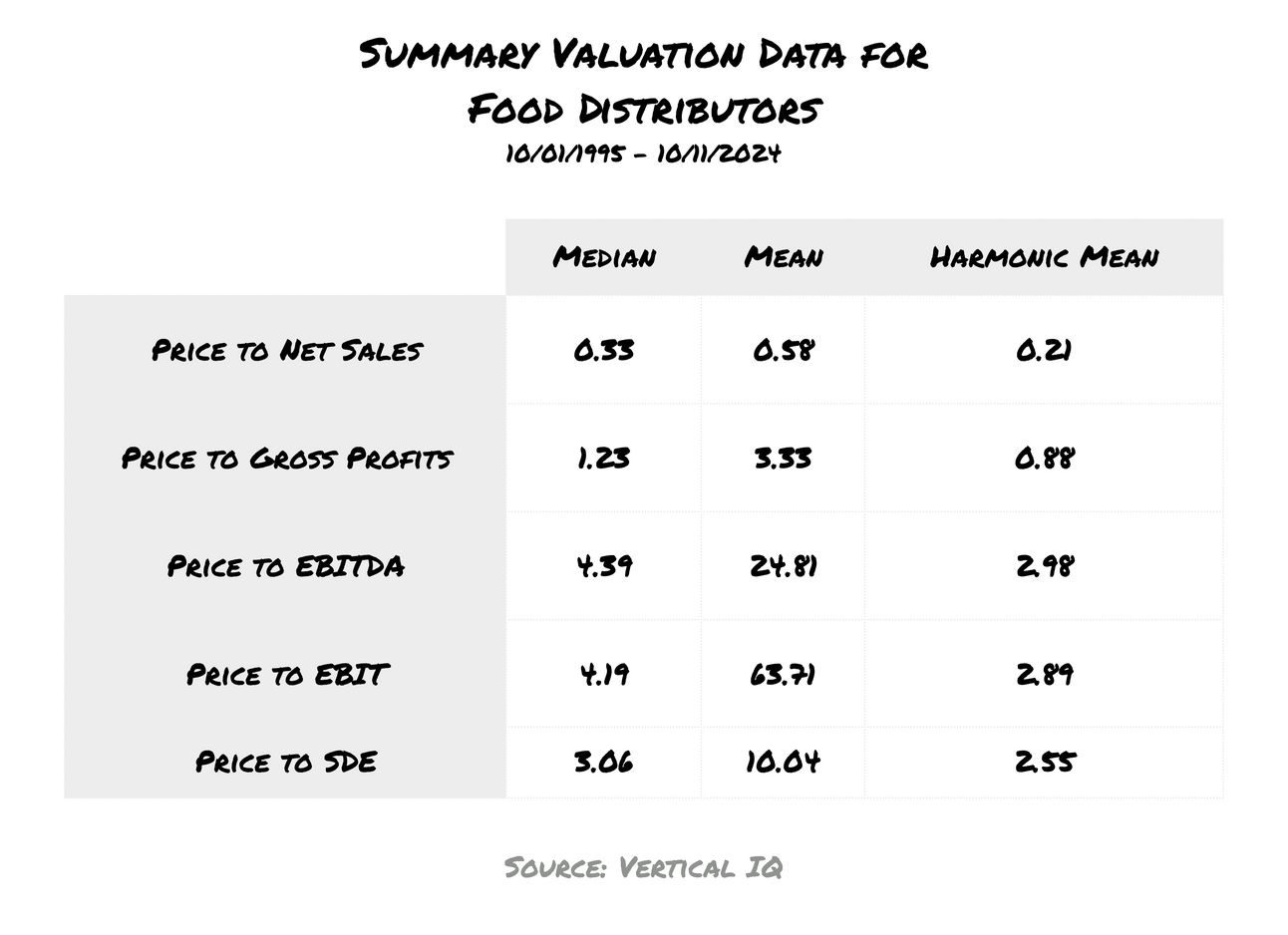
Let’s look at where food distributors typically land on multiples, keeping in mind this is a related but not identical business model:
All this is why the parties are negotiating on a creative safety net: a $500k+ seller note that gets forgiven over time if the biggest customer starts to shrink.
Here’s how it works:
If Customer #1 falls below 50% of total revenue, the note is forgiven in 20% chunks per year over five years
If they don’t? The full balance comes due in a balloon payment in 2029
It’s a smart buffer — but not a full parachute. If that customer churns, the seller note helps, but you’re still on the hook for hundreds of thousands in annual SBA payments while rebuilding the top line.
RED FLAGS
1 Big Potential Roadblock
This business doesn’t just rely on one major customer — it relies on someone else’s relationship with that customer.
Here’s how it works: Customer #1 accounts for nearly 70% of total revenue. But the seller doesn’t interact with them directly. That relationship is managed by a third-party food broker.
That dynamic raised immediate red flags during the community review, including from one of our deal coaches, Candice:
In other words, the customer doesn’t just have the power to leave — the broker could take them elsewhere.
To mitigate that, Mark floated the idea of bringing the broker into a performance-based comp plan, not equity, but a way to keep them aligned financially. Whether the broker is open to that remains to be seen.
For now, Mark hasn’t met them. That’s scheduled for diligence.
The lesson here: if the core revenue of a business is routed through someone outside the deal, you need to know exactly what makes them stay — and what might make them leave.
THE BOTTOM LINE
What Other Experts Flagged
Our deal coaches raised additional concerns that go beyond the obvious risks:
1. Cash Flow Can Compound Risk, Fast
Deal coach Candice flagged the importance of understanding the business’s cash cycle, especially when supplier payments and customer collections are mismatched.
Mark acknowledged this and confirmed the business operates on net-30 terms, offers a 1% discount for early payment, and carries no inventory. Still, with one customer making up most of the top line, any delay has an outsized impact.
2. You Could Build This… But Should You?
As one deal coach put it:
The seller grew this over decades, organically, likely without debt, and with minimal overhead.
Mark, on the other hand, is stepping in with a multi-million-dollar leveraged buyout. And here’s the tough question: with his industry connections, sales experience, and access to co-packers… could he build the same thing from scratch for less?
This deal isn’t just a handoff — it’s a shortcut. But shortcuts come at a premium, and with a clock attached. That doesn’t mean it’s a bad deal, just a different risk profile, and it’s important to recognize.
3. Suppliers Today, Competitors Tomorrow?
While many focused on the customer side, deal coach Stan Sanchez raised a less obvious concern: supplier risk.
In plain terms: Could your co-packers go direct?
Mark mentioned one co-packer actually introduced a new customer — a good sign. But the business is entirely reliant on two producers, and there’s still diligence to do on exclusivity and long-term alignment.
THE DECISION
How It Played Out
At the time of the call, Mark is one of the deal’s finalists.
The seller likes him — maybe because he’s local, maybe because he’s asking the right questions.
His next steps are clear:
Meet the food broker
Review contracts
Pressure-test co-packer relationships
Find alternative financing beyond the SBA loan
Mark’s doing what real buyers do, testing the risk, not ignoring it.
The deal’s not done. But it’s in motion. And this — the messy, high-stakes middle — is where real deals get made.
This story scratched the surface of just one of the dozens of real deals our members are working on inside the community every month. Want in? Reach out to our team here.
Buyer's Guide: How to Buy a Food Distribution Business
Here is what any buyer can take from this deal, using only the numbers and lessons in the story above.
The deal by the numbers
Price: about $3.5M, just under 4x 2024 SDE.
Model: private label goods like egg rolls and spring rolls, made by two copackers and sold through brokers into hot bars, cruise ships and buffets.
Team: no employees. Inventory: none.
Concentration: one customer at nearly 70% of revenue, expected to fall to about 58% with a new customer added in late 2024.
Sellers: a husband and wife team in their late 70s, running it for nearly four decades.
Payment terms: net 30, with a 1% discount for early payment.
How the financing worked
Mark proposed 10% down, a 75% SBA loan and 15% seller financing. The SBA caps 7(a) loans at $5 million and lists changes of ownership as an approved use, so most Main Street acquisitions fit inside the program (SBA).
The safety net under negotiation is a $500k+ seller note with a forgiveness clause. If Customer #1 falls below 50% of total revenue, the note is forgiven in 20% chunks per year over five years. If not, the full balance comes due as a balloon payment in 2029. It helps, but if the customer leaves, the SBA payments are still due.
The newsletter also notes that SBA lending to food distribution has fallen in recent years, a sign these asset light, relationship heavy businesses are harder to underwrite. Mark's next steps included finding financing beyond the SBA loan.
What to look for in a food distribution business
Who owns the customer relationship. Here, a third party food broker managed the biggest customer, not the seller.
Supplier dependence. With two copackers making everything, check exclusivity and whether they could go direct.
Cash cycle. Mismatched supplier payments and customer collections can compound risk fast.
Growth room. The sellers spent maybe 10% to 15% of their time on sales. Mark planned to spend close to 100% on Day 1, using hospitality networks like hotel chains, cruise lines and foodservice contracts.
Risks and mistakes to avoid
Customer concentration. As one member put it, if that customer leaves and you have a $3.5M loan and zero infrastructure, you are in trouble.
Paying for something you could build. One coach asked whether a buyer with Mark's connections could build the same business from scratch for less.
Few contracts or hard assets. You are buying trust, not trucks, which makes the business hard to value.
Steps to buy a food distribution business
Meet the broker or rep who owns the key customer relationship.
Review every customer and supplier contract.
Test copacker relationships and exclusivity.
Model the downside if the top customer shrinks or leaves.
Negotiate protections like a forgivable or performance based seller note.
Line up backup financing options.
Frequently Asked Questions
Is a food distribution business a good business to buy?
It can be for a buyer with foodservice connections. This wholesaler was lean, consistent and profitable, but asset light and relationship heavy businesses are harder to underwrite.
What is customer concentration risk?
When one customer makes up a large share of revenue. Here one customer was nearly 70% of sales, so losing it could leave the buyer with a large loan and little revenue.
What is a forgivable seller note?
A seller note that is reduced or forgiven if certain conditions occur. In this deal, the note is forgiven in 20% chunks per year if the biggest customer falls below 50% of revenue.
How do you finance a food distribution business?
Mark proposed 10% down, a 75% SBA loan and 15% seller financing, and planned to look for financing beyond the SBA loan given lower SBA lending in the sector.
The information contained here is educational, may not be typical, and does not guarantee returns. Background, education, effort, and application will affect your experience and the profitability of any business. Individual results may vary.
Thinking about buying a business? Learn how in Codie's free live masterclass.
A two day, in person workshop in Austin with the Contrarian Thinking team. Find hidden profits, close the gaps in your business and map the steps to grow revenue.