You're not stuck, you're just alone at the top. Most entrepreneurs hit a ceiling, not because the opportunity isn't there, but because you're solving $10M problems with $1M strategies.
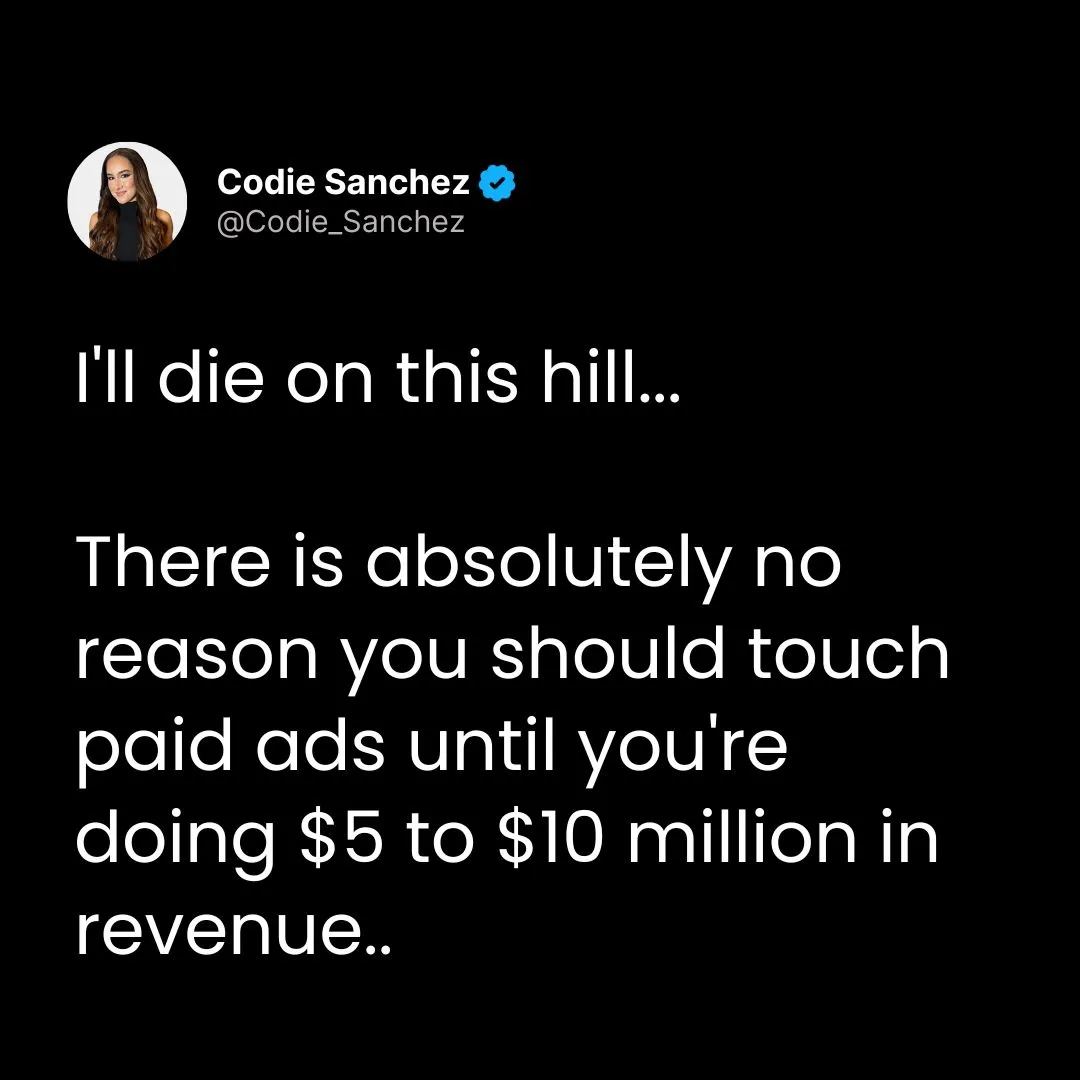
Look, sometimes I like to be a little hyperbolic to get a conversation started. Fair point by the trolls. And sometimes that conversation turns into a shouting match in the comments.
Marketing agencies came after me like I'd kidnapped their families. Ad buyers called it naive, along with some other choice words. Someone informed me I'd clearly never scaled anything real. LOL.
Here's what's funny about that: marketers make money when you run paid ads.
Their business model relies on you spending as much as possible, because most agencies get paid a cut. Most marketers obsess over ROAS instead of profit. Most salespeople care about top line, not profit.
I've even heard media buyers brag about budgets the same way other people brag about horsepower.
Pretty much everyone arguing with me had a financial reason to.
And I get it. Advertising is their job. From their perspective, as long as the ROAS works, everybody's happy.
Which is why I devoted a whole chapter to advertising in my new book.
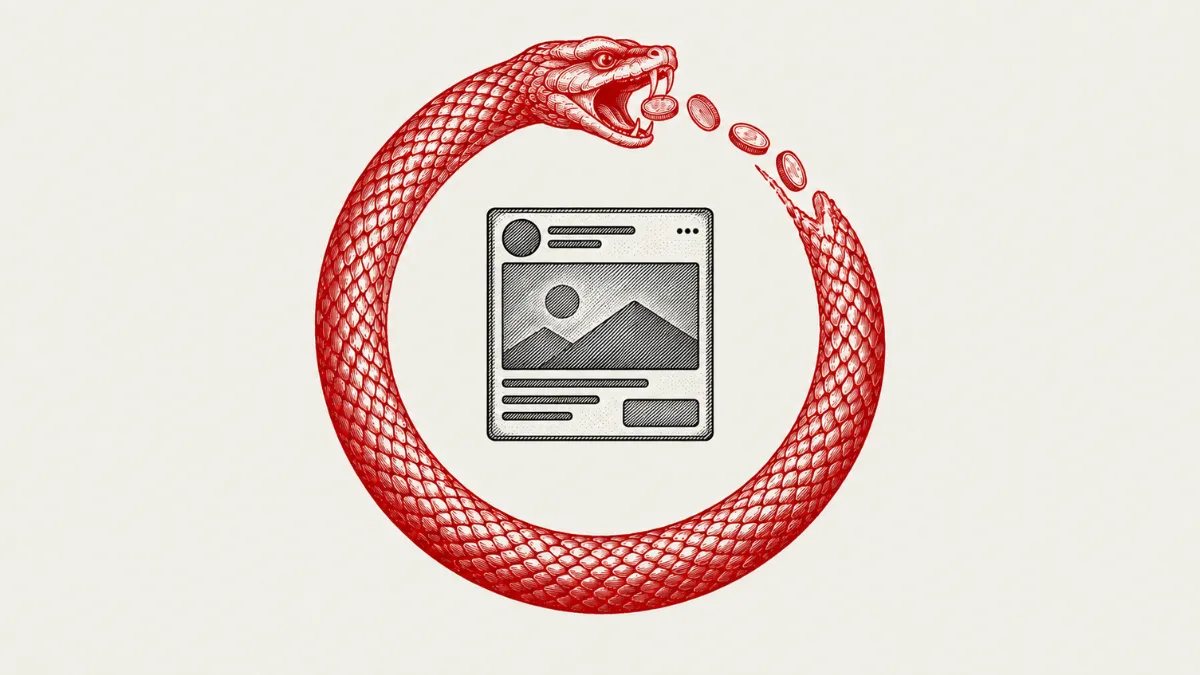
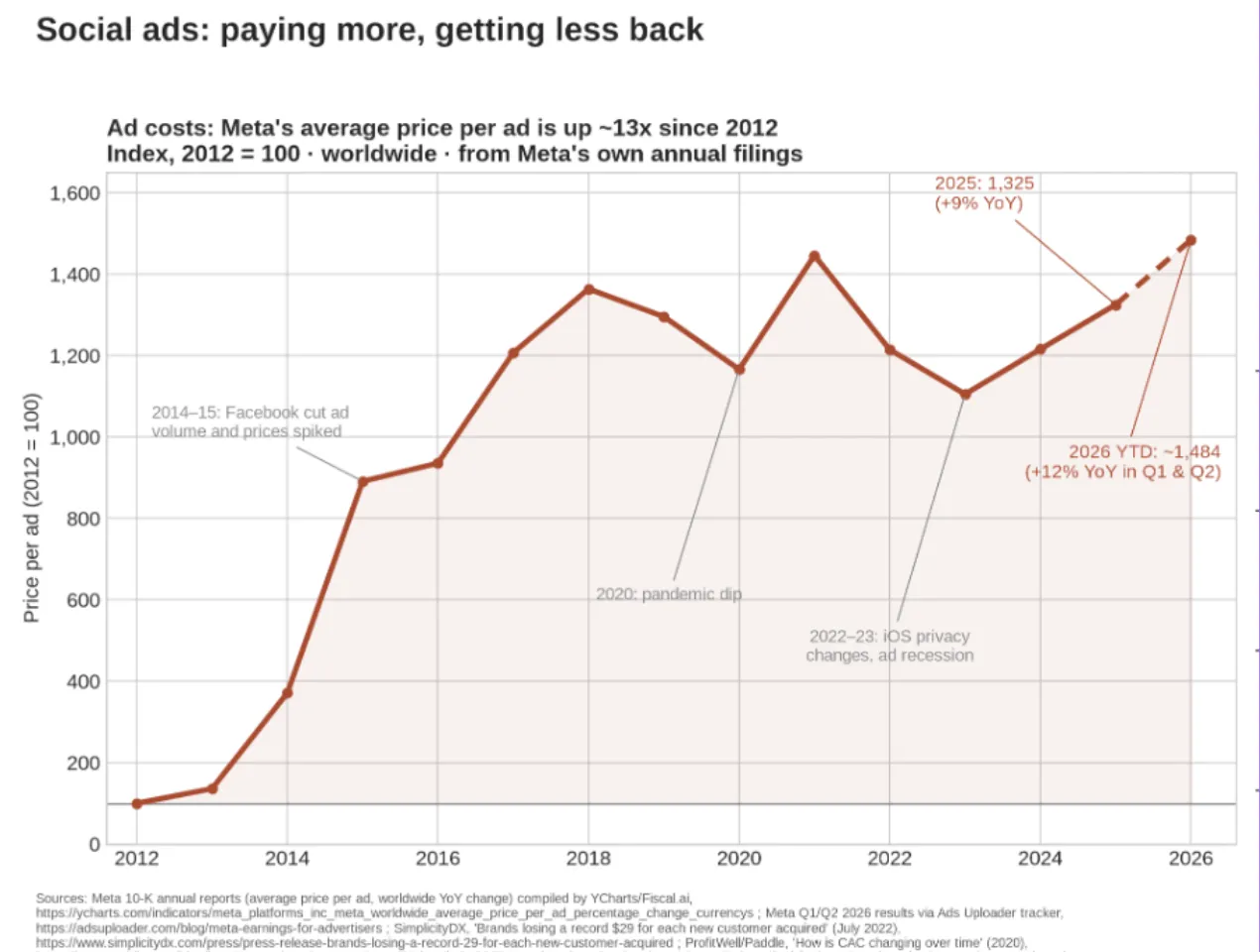
In Own or Be Owned, this idea has a name: Promote. It's 1 of the 12 Profit Levers, and done right it builds an asset that accelerates your growth. Get it wrong and you'll be paying Meta more rent every year for less return.
Which brings me to the $10 million business we told to turn off every ad.
A Method to the Madness
Imagine throwing $200,000 a month into Facebook and Google.
That's more than most people make in a year.
For the company we were looking at, that was just the cost of doing business. Their ads drove phone calls. Calls turned into appointments. Appointments turned into revenue.
Nothing wrong with that.
At $10 million a year in revenue and 70% margins, there were no red flags.
For about 2 years the math had been mathing. Put a dollar in, get 2 out, spend more, make more, repeat. The team felt smart.
Then performance started slipping. Slowly at first, so nobody panicked.
Eventually they couldn't ignore it. They were making less money and something had to change.
First they blamed the creative. A few weeks of new hooks and rebuilt landing pages. Results spiked, then slid again.
Then they blamed the sales team and brought in a top-level trainer. Close rates went up. Acquisition costs kept climbing.
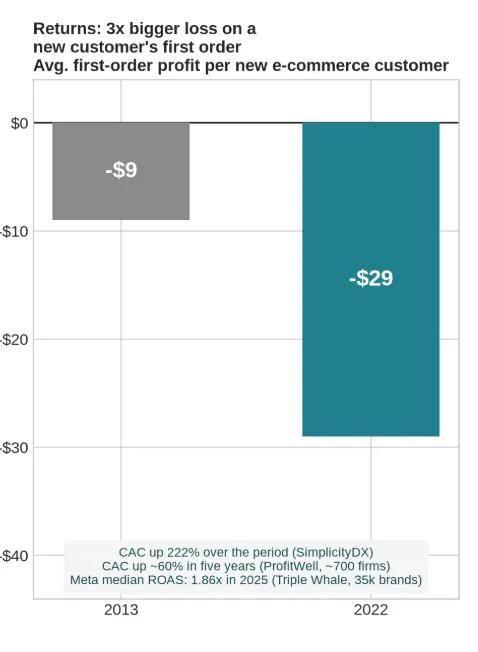
Over 18 months their CPMs more than doubled. A customer who used to cost $50 to acquire cost $100, then $125, then $150.
Our owner was in trouble.
The ad platforms were raising the rent, and he paid it, because he didn't know another way to get someone through the door.
To stay even he had to squeeze more out of every buyer. Margins fell from 70% to 40% to negative.
The business wasn't growing anymore. It was spending more and more just to stay in place.
So we told him to cut the ads.
Revenue dropped about 30% almost immediately, from $10 million to $7 million.
But profits went up.
He moved some of the ad budget into pop-ups and influencer partnerships. Revenue and profit both climbed past where they started. He got back into ads eventually, but they weren't the only lifeline for his business anymore.
The Ad Trap
The Ad Trap is what happens when your paid growth outpaces your real economics.
And it always starts by rewarding you. Kinda like a good drug dealer. The first hit gets you hooked, then you keep coming back for less and less satisfaction.
Here are the 2 formulas to keep in mind if you want to wean yourself off the paid ad train.
Profit = (LTV − CAC) × Customers
When the cost to acquire a customer climbs faster than what that customer is worth, your profit shrinks while your revenue grows.
Which is why your top line can look healthy while your profit slowly dies.
Your ROAS is lying to you
This is where owners like to argue with me. "My ROAS is 4x. I'm fine."
I'll bully you on this one. ROAS measures revenue, not whether you made money.
Now subtract what it cost you to deliver that $400,000:
Cost of goods
Fulfillment
Sales commissions
Discounts and refunds
Payment processing fees
Repeat customers you'd have gotten anyway
Whatever the platform overstated in its attribution
The float between paying for the click and collecting the cash
Say all of that runs $330,000. You just lost $30,000 before a single overhead bill hits.
The dashboard still reads 4x.
Here are the metrics I'd rather watch:
Contribution profit after advertising
Marginal ROAS on the next dollar, not the average one
CAC by customer segment
Cash payback period
90-day contribution LTV
Blended marketing efficiency
Any 1 of those beats a ROAS screenshot.
The Elephant in the Room
Most owners we see below $10 million don't run their own ads.
They're too busy with fulfillment, and they're not internet marketers. They're plumbers, handymen, dentists, doctors.
So your media buyer gets a flat fee plus a percentage of your ad spend. The more you spend, the more they earn, even while your profit chokes.
It'd be like hiring a trainer who gets a bonus every time you gain 10 pounds.
Your sales team gets paid per closed deal, so of course they want the top of the funnel crammed full. So do you. The difference is they don't care what it cost to fill their pipeline.
Nobody is going to care about profit the way you do. Own it.
The Rent Check
Pull these 3 numbers this week. They'll tell you whether you own your demand or rent it.
1. Ad Dependency Ratio
Paid-ad revenue ÷ total revenue.
Under 30% is healthy. 30% to 60% is danger. Over 60% and you're already in the trap.
2. Real Profit
Revenue − Ad Spend − COGS − Fixed Costs.
Run it across your last 3 months. If revenue is up, ad spend is up more, and this number sits flat or falls, you're renting.
3. CAC Trend, 12 Months
Flat or falling and you're fine. Climbing faster than a customer's LTV and you've got a leak.
Then use this to decide where to focus:
Media channels work like a ladder, not a lottery ticket. Owned media comes first, earned second, and paid last, as amplification only.
If the business can't sing without ads, don't turn up the volume. Fix the song.
Replacing ROAS
With ads, you're renting attention.
If they don't buy on that click, the dollar is dead, and you pay again tomorrow for another shot.
With content, you own attention. A follow, a view, or an email opt-in means you can reach that person next week, next month, and next year, for free.
So I stopped measuring only return on ad spend and started measuring return on content spend too. ROCS.
ROCS = (Audience Value × Frequency × Lifetime) ÷ Content Spend
Audience value is what 1 person on your list is worth to you in a year. Frequency is how many times you show up for them in that year. Lifetime is how many years they stick around.
ROAS prices a transaction. ROCS prices a relationship.
Here's mine from the first 3 years of our media business, running zero ads:
Year 1: $3 million+ in revenue on under $10,000 of content spend
Year 2: $5 million+ on $200,000
Year 3: $7 million on roughly $1 million, counting my time and a small team
The ratio compresses every year as the team grows. It still lives in a different universe from the 2x to 3x ROAS most owners squeeze out of Meta at their peak.
And unlike ads, it keeps working after you stop paying.
Judy's Pancakes
Judy Wang runs a café in Galesburg, Illinois.
She'd never posted on social media in her life. She's not a marketer. She just went completely unhinged about pancakes, in tiny round black sunglasses she never takes off.
Her videos cut from a motorcycle crash to Judy standing in the wreckage holding a plate. In one, 2 people in a car whisper "don't look at her, she'll make you come eat her pancakes," and the camera pans to the back seat. She's already there.
In a single month her café's content reached tens of millions of people, and the parking lot has stayed full ever since. People drive hours to stand in a line around the block. She's opened a second location.
Zero ad dollars.
Run ROCS on that. Content spend of roughly nothing, 1 person filming clips on a phone. Return of a full parking lot in a town where a full parking lot shouldn't happen, and a face people recognize from 3 states away.
She earned an audience instead of buying one, and now it shows up whether or not she posts.
Every dollar you spend on ads buys you a customer today. Every dollar you spend building your own audience buys you a customer who comes back on their own.
Is there a place for paid ads? Of course. But no amount of paid ads saves a bad product or service.
You don't really own a business if you have to pay rent every month just to talk to your own customers.
Diversify. Whether you wait until $5-10M in revenue to do it, that's up to you.
Although I think the greats would say build a better product, talk to more customers, and ask for referrals before you burn money on ads.
But then again, what do I know. I'm just a girl who's built a ton of businesses with and without ad spend.
-Codie
The information contained here is educational, may not be typical, and does not guarantee returns. Background, education, effort, and application will affect your experience and the profitability of any business. Individual results may vary.




.webp)







.svg)


