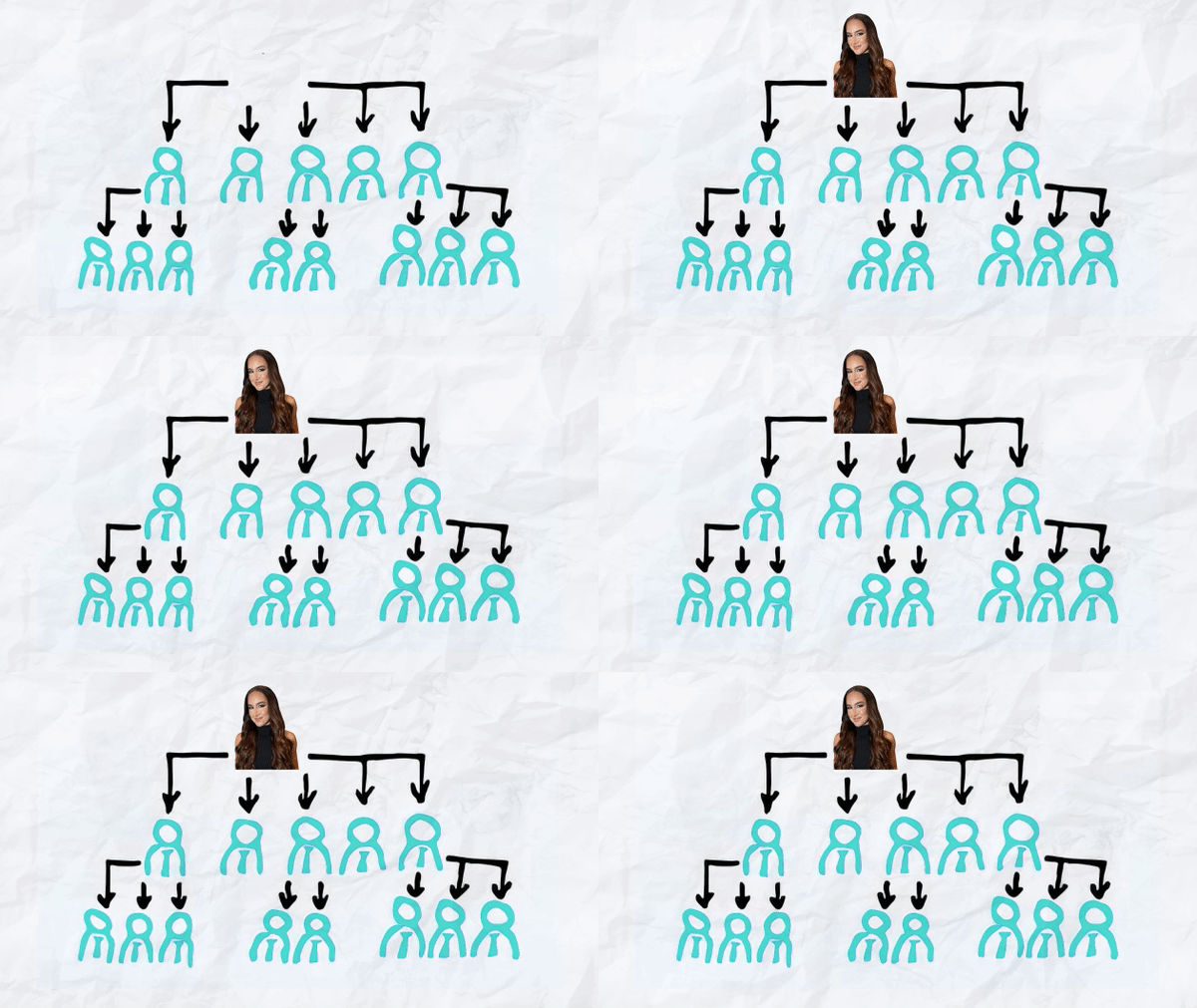
You're not stuck, you're just alone at the top. Most entrepreneurs hit a ceiling, not because the opportunity isn't there, but because you're solving $10M problems with $1M strategies.
How to Delegate as a Business Owner: The Sticky Note Challenge
November 17, 2023
7 min read
From the Contrarian Thinking newsletter, originally sent November 17, 2023 as "Scaling 101: How I Buy Back My Time Through Delegation"
Quick answer: To delegate as a business owner, write down every task you do for a week, mark the ones only you can do, and hand off the rest starting with the work that drains you most. Give each task a clear outcome and deadline, check in on a schedule, and accept that some handoffs will not go exactly your way. Codie expects about 10% of delegation to miss and does it anyway.
Watch: Codie on getting your time back by fixing what you spend your days doing.
Hey Contrarians,
You have one job as a business owner: Fire yourself from as many roles as you can.
Until you learn to delegate well, you’ll be owned by your business, not the other way around.
Nobody delegates well in the beginning. But I’ve picked up some actionable lessons on the subject along the way. So today, I’m sharing exactly what I think about delegating and how I do it. No shame, no regrets.
Contrarian framework: The sticky note challenge
Here’s how I weigh what to delegate in the first place.
This comes from my friend who runs an outsourced virtual assistant company. Back in the day, he taught me something called the sticky note challenge.
Nowadays, I’m guessing that’s also the name of some controversial TikTok trend, but today we’re talking about this one:
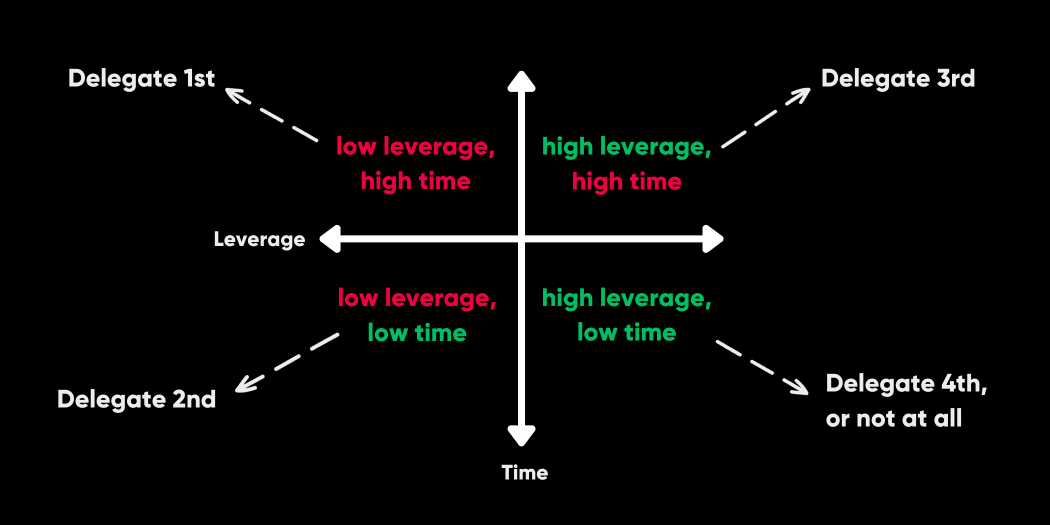
Here’s how it works. Over 3 weeks, EVERY TIME you work on a task, write it on a sticky note. When time’s up, organize the tasks into four categories:
1. Low leverage, high time: These are time-consuming tasks that have low impact. Delegate these first.
2. Low leverage, low time: These ‘infrastructure tasks’ are less critical but also consume less time. They’re likely neither a strength nor a passion. Delegate these second.
3. High leverage, high time: It often makes sense to spend time on these because of their complexity or importance, but time isn’t on your side. Delegate these third.
4. High leverage, low time: High-impact tasks that don’t require a lot of time. Delegate these last. Heck, once you whittle it down to these, you probably won’t want to delegate them at all.
Alternatively, try separating all the tasks into revenue-producing and non-revenue-producing stacks. It’s pretty eye-opening how much time these tools have shown me I’ve spent on things that don’t move the needle.
For the owners and managers out there, this is how you should be thinking through what you do and how valuable it is for youspecifically to be doing it.
What delegating has to do with your underwear
Remember Marie Kondo? She’s a professional organizational consultant, and I don’t mean “organizational” as in big, Fortune 500 company-wide re-orgs… I’m talking about the socks and underwear in your closet.
Her method involves pulling out every single thing you own and asking yourself if it brings you joy. If it doesn’t, get rid of it.
I feel the same way about delegating tasks.
At my stage, I’m focused on obsessively doing only the things that I’m uniquely skilled at and that I love to do. If a task doesn’t bring me joy, is there someone out there who does find joy in it? If so, I need to find them, cause they’ll do it better than me, faster than me, and probably make more money at it than me.
Still, your first instinct should never be to just… delegate. Way before that, you need to figure out what can you eliminate or automate. What does not need to be done?
Every time we weigh the need for a new hire, in the back of my head I try to remind myself to ask, “Is this a failure by me and my leadership team to eliminate or automate something?”
Eliminate, automate, then delegate, not the other way around. Just please don’t eliminate, automate, or delegate underwear-wearing.
The hardest task for me to delegate, and more quick-hitters…
1. The hardest task for me to delegate
I actively eliminate, automate, and delegate across finance, sales, and marketing. Doing that’s become pretty easy for me.
Right now, the absolute hardest thing for me to delegate is content.
We’re managing the process. I have designated times to record content and a creative team to help produce it. I film and record voice memos while in the car and on walks. I transcribe. I repurpose.
Delegating content is just really hard. It’s personal; it’s my face, my voice, my brand. I have to be really particular about what my brand is saying about me.
2. My first-ever hire
The first hire I ever made was a virtual assistant. I was still an employee working in finance at the time. I didn’t ask my boss for permission. I just paid out of pocket and I had them do every task reasonably possible that wasn’t related to my job. I was lucky to afford it, and it was a huge time unlock. Still is.
3. My best-ever hire
(My team is reading this like 👀).
The truth is, hiring my first executive, a head of operations, was transformative. My strength lies in executing ideas and visions big enough to fit other people under the umbrella. One of my weaknesses is managing the day-to-day details. Do we have the right CRM connections for the right email marketing campaign? That’s not really my strength. Hiring a COO early on was huge for me.
4. Things I delegate with zero regret
Food and clothes. I don’t really care what I eat as long as it’s healthy and tasty. My team often picks stuff they think I’d like for breakfast and lunch, and then my husband does the same thing for dinner.
The other thing that I delegate that’s a little weird is clothing. I don’t like to go shopping at all. So I outsource this. Yup, I pay someone to buy my clothes. I like the style more. I return the stuff less. It’s optimized for time. Sue me.
Side note: My first company was in this space. The biz was called ThreadsRefined. I ran it and tried (but failed) to sell it. I lost ~$200k by the end of it.
The hardest part is that humans don’t naturally delegate well, especially in the beginning.
Early on, without systems, documentation, and processes in place that new hires can use, you’ll both suffer for it. This is the stuff people like to hit snooze on, but for the business owners out there:
You must take yourself to the verge of irrelevance. Until then, you will be owned by your business.
Generally, I expect delegation to fail around 10% of the time. For 10%, things won’t be done the way that you want them to be. You have to let that go. Expect a 10% failure rate. It’s still better than you trying to manage 100% of everything.
Know this: The time-to-action advantage
The whole point of eliminating, automating, and delegating is to decrease time-to-action.
It’s one of the simplest ways to set yourself or your business apart, and I’m always trying to push my team on this.
Just me, or has it become super normalized to say, “Hey, let’s circle back on this next week in our meeting.” It feels like the whole of corporate America has normalized 7 days. I’m not sure why.
If everyone else’s activation time is 7 days, and we’re also working on a 7-day timeline, then we’re competing against a lot of people.
But if we reduce that time-to-action to, say, 24 hours, then without being smarter, having more money, or even having a better business model, we’re setting ourselves up to lap the competition.
Let’s finish with this…
I wanted to hear about some of the funny, weird, random stuff that you all delegate with zero regrets, so I asked my Twitter followers to shout some things out.
The most relatable response, for me, was probably the person who said, “Dog poop pick up. No shame.”
The funniest was the dude who said, “I hire someone to take my girlfriend on dates for me. Frees up so much of my time to make cold calls.”
Love the sarcasm, but men, please don’t get any ideas...
Team Contrarian
How to Delegate When You Are Used to Doing Everything
Why it is hard
Writing in Harvard Business Review, Jesse Sostrin describes the move from doing to leading as one of the most difficult transitions a leader makes (HBR). Owners who built a business by doing everything tend to keep doing everything. The sticky note challenge below makes the work visible so you can decide on purpose.
Tasks someone else could do at least 80% as well as you.
Work that drains you, even if you are good at it.
Anything you keep putting off.
Keep the few things only you can do, such as key relationships, big decisions and setting direction.
How to hand off well
Describe the outcome, not every step.
Give a deadline and a check in date.
Share examples of what good looks like.
Write the process down once so the next handoff is faster.
Expect the first few handoffs to take longer than doing the work yourself. That time is an investment. As Codie puts it below, about 10% of delegated work will not be done the way you want, and that is still far better than doing 100% of it yourself.
If you have no one to delegate to yet
Start small. Codie's first hire was a virtual assistant. A contractor for a few hours a week can take admin off your plate before you are ready for a full time hire. When you do hire employees, the SBA's guide covers payroll and the labor law basics (SBA).
Frequently Asked Questions
What should a business owner delegate first?
Start with repetitive admin and anything someone else could do nearly as well as you. Then hand off work that drains you. Keep key relationships, big decisions and direction for yourself.
Why do business owners struggle to delegate?
Many built the business by doing everything themselves, and handing off feels slower or riskier. Expect some mistakes and focus on whether the outcome is good enough, not identical to yours.
What is the sticky note challenge?
Write every task you do on a sticky note for a week, sort them by what only you can do versus what someone else could do, and start handing off the second pile.
Can I delegate if I do not have employees?
Yes. Virtual assistants, freelancers and contractors can take on admin, bookkeeping and marketing tasks a few hours at a time.
The information contained here may not be typical and does not guarantee returns. Background, education, effort, and application will affect your experience. Your results will likely vary.
Thinking about buying a business? Learn how in Codie's free live masterclass.
A two day, in person workshop in Austin with the Contrarian Thinking team. Find hidden profits, close the gaps in your business and map the steps to grow revenue.