You're not stuck, you're just alone at the top. Most entrepreneurs hit a ceiling, not because the opportunity isn't there, but because you're solving $10M problems with $1M strategies.
The ULTIMATE Guide to Building a Sellable Business
February 5, 2026
10 min read
We work with hundreds of scaling business owners every day.
Most people run their business until they're miserable… And then they try to sell it.
Don't be most people.
Build a business so it's sellable… and you'll never have to sell.
The Backwards Approach: Start with the End in Mind
Here's the secret to building a sellable business: You need to work backwards from what makes a business valuable in a buyer's eyes.
When you understand what buyers are looking for, you can design your business to be valuable whether you sell it or keep it.
Because the qualities that make a business attractive to buyers are often the same ones that make it attractive to you as an owner.
Think about it: A business that runs without you, generates predictable cash flow, and has systems in place is a business you'd want to own AND a business someone else would pay a premium for.
A job: Stops producing when you stop working. Requires your specific skills or relationships. Often too small to hire an operator, and likely can’t be transferred to someone else without them taking over the job.
An asset: Remains valuable even when you're not actively producing. Runs on systems and a team, not just you. Will continue running even if transferred to a new owner.
The difference between these two determines how valuable your business is. Everything in this guide is about moving from the first category to the second.
How Buyers Think About Value
To build something valuable, you need to understand how buyers calculate what they'll pay. Let's break it down.
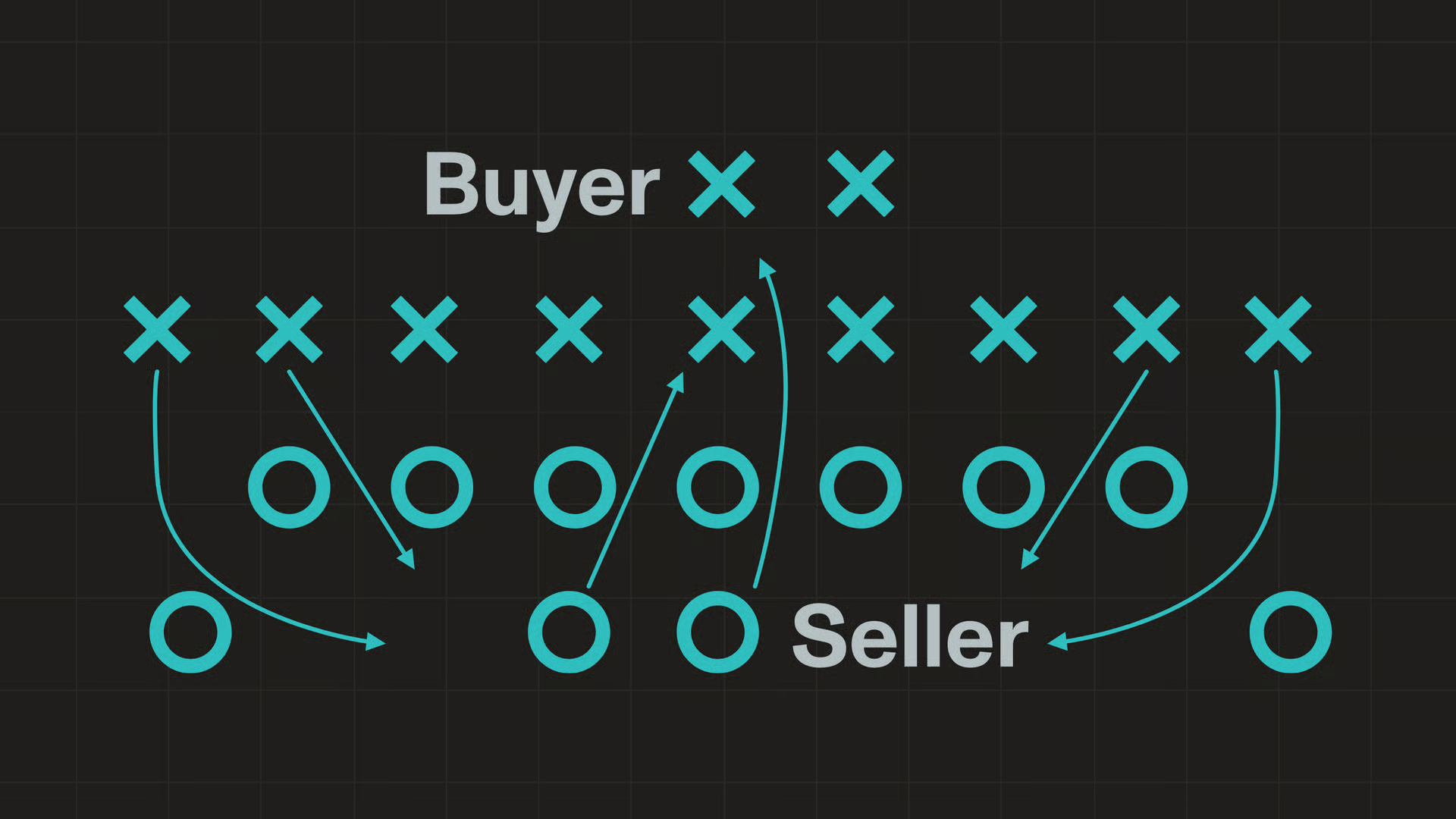
The 4 things everyone will want to audit…
Simplicity check: If you can't explain what you do in one clear sentence, you probably can't systematize it. Complexity might impress people, but it doesn't transfer well.
The bus test: Imagine you vanish tomorrow. What percentage of operations continue normally? If the answer is close to zero, you're selling a job, not an asset. (That’s fine for some, just be honest about it.)
Dependency scan: Look at your top customer, your critical supplier, and your key employee. If losing any single one would crater the business, that's a vulnerability worth addressing.
Value definition: What's actually changing hands in a sale? The clearer you can articulate this (equipment, customer relationships, processes, brand), the more confident buyers become.
As you build, keep asking yourself these questions.
The Recipe for a Great Multiple
Want to sell your business for a premium multiple? Here's what matters most:
Be profitable. No profits, no sale.
Be growing. Upward trajectory commands premium pricing.
Be diversified. Multiple customers, channels, and products reduce risk.
Be predictable. Recurring revenue + steady growth. People want to be able to forecast.
Get these right and buyers will be confident in what they’re buying. Buyers can overlook slow growth or some customer concentration, but they probably won't pay a great multiple for it.
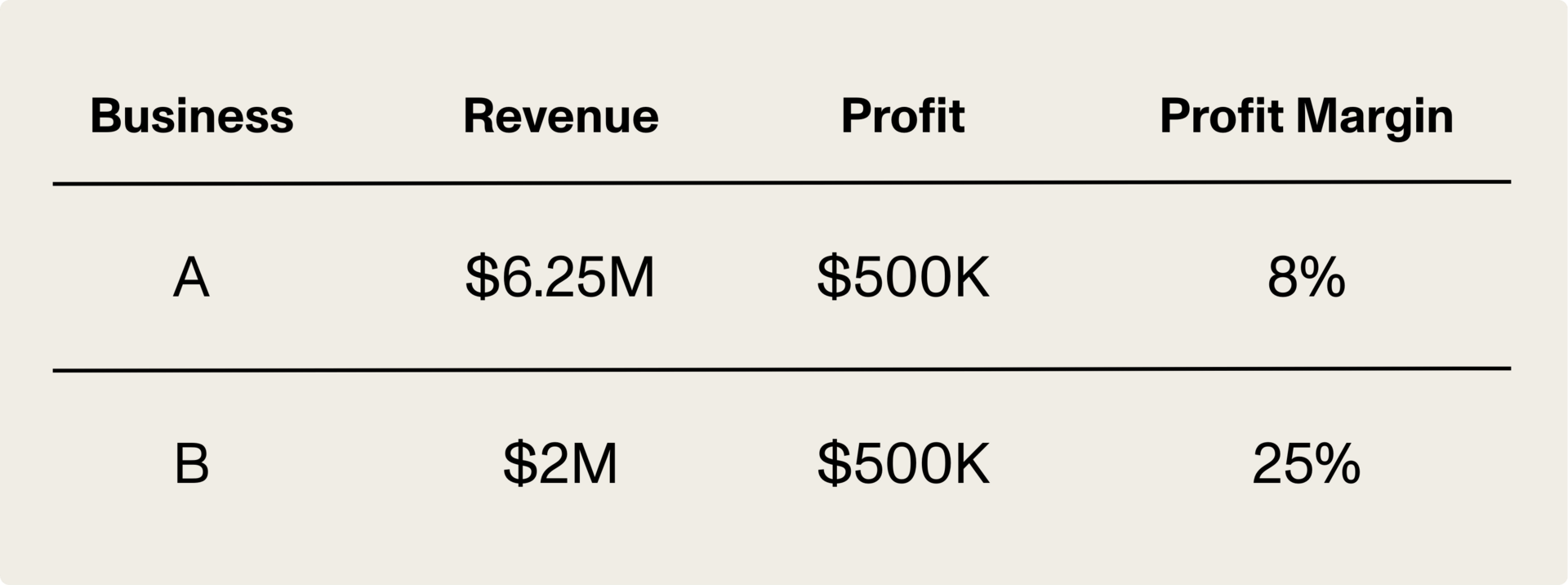
The bottom line: Profitability alone is necessary but not sufficient for a great multiple. Consider two businesses that have $500K profit but different margins:
Both produce the same $500K outcome, but Business B is far more efficient and has great room for error.
The SDE Formula: How Main Street Buyers Calculate Value
For Main Street businesses (roughly $500K to $5M in revenue), buyers use a metric called Seller's Discretionary Earnings (SDE) to determine the value the business generates for them.
SDE is considered the true earning power of your business. It's what you'd make if you owned the company debt-free, worked in it full-time, paid yourself $0, and only paid necessary expenses. It's the maximum theoretical earnings in a normal year.
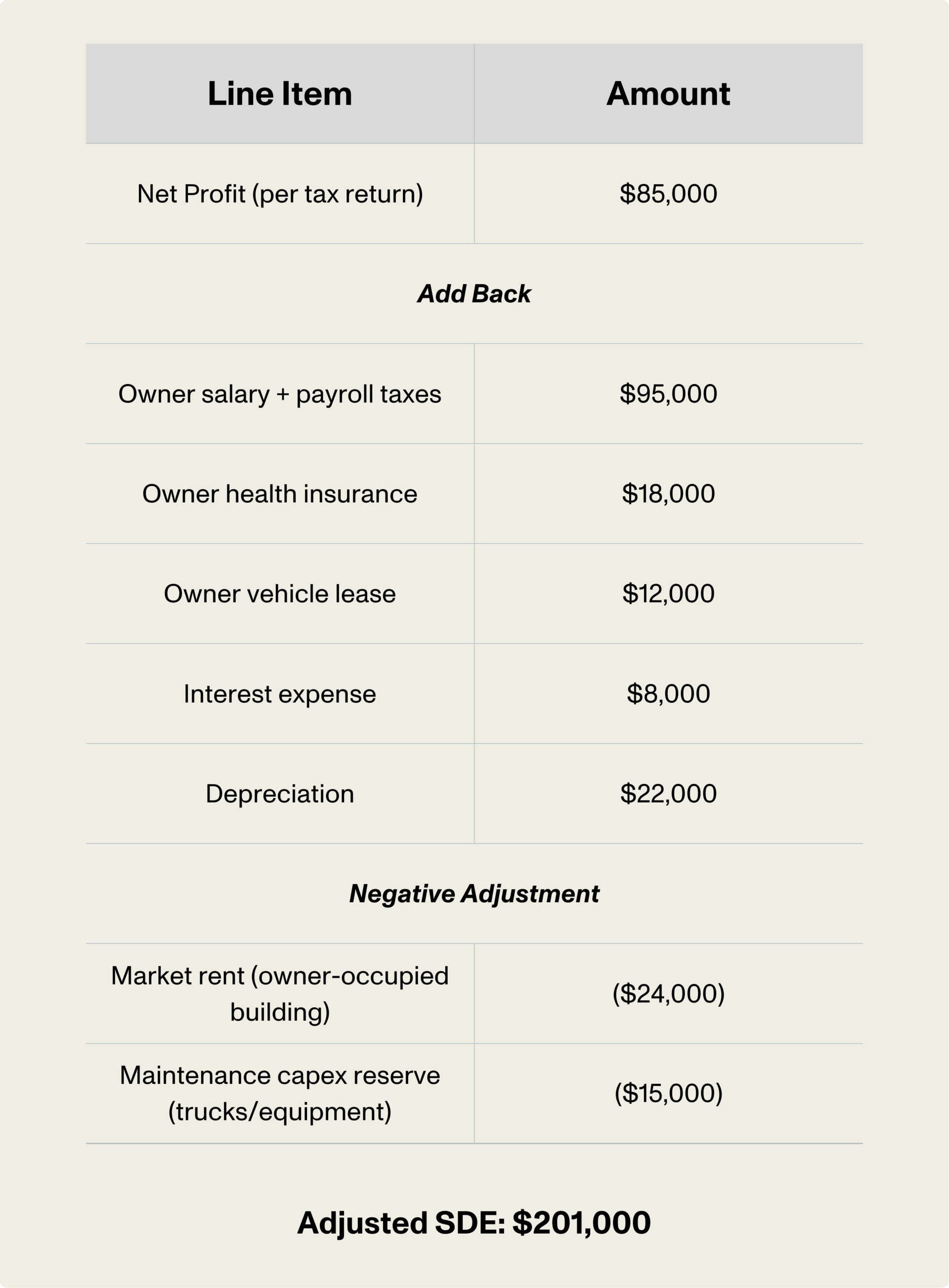
Let's walk through an example for an HVAC business.
Notice how the net profit of $85,000 transforms into SDE of $201,000. That's 2.4X higher. This is why understanding SDE is critical both for building and valuing a business effectively.
One layer of nuance: In this example, we’re “adding back” the owner's salary because the buyer is going to be doing the work. If the buyer is hiring an operator, or if the seller has some special certifications (Master Plumber / Electrician), you may not get that full add back.
The Multiple: What Determines Your Final Value
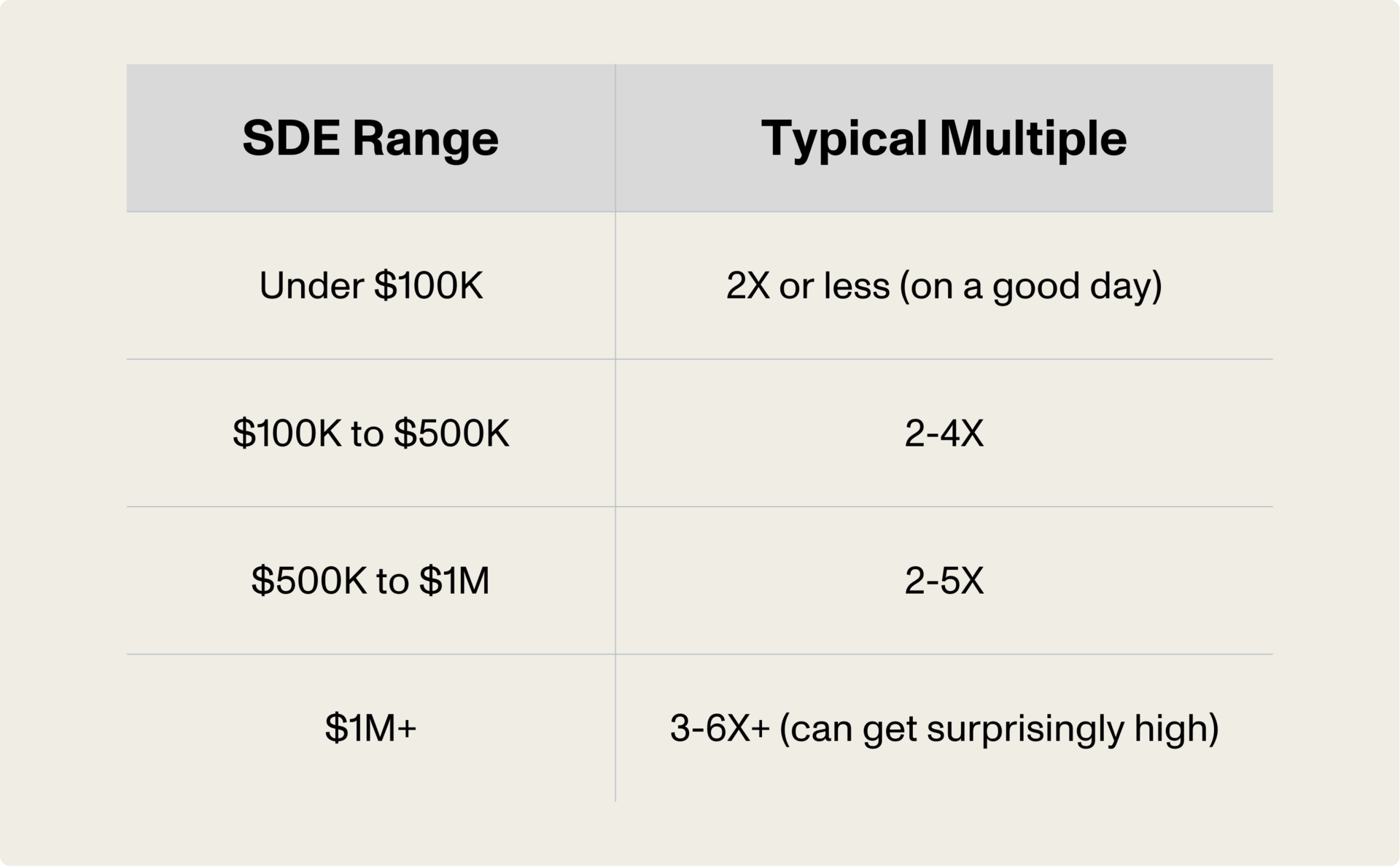
Once you have your SDE, buyers multiply it by a number (the multiple) to arrive at your business value. Here are some typical ranges:
Using our HVAC example: With $201,000 in SDE, let's say this business earns a 3.2X multiple based on industry comparables and its specific strengths. That means:
$201,000 SDE × 3.2 multiple = $643,200 business value
But that’s just a generalized estimate. Where your business specifically lands depends on quality factors we'll cover next.
What Moves Your Multiple Higher
Within your industry's typical range, your specific multiple depends on how your business compares to others. Buyers look for:
If your business has these qualities, you'll land at the higher end of your industry's range (or maybe even above it). If it lacks them, you'll be at the lower end. This is why building with these factors in mind is so valuable.
The Seller’s Reality Check
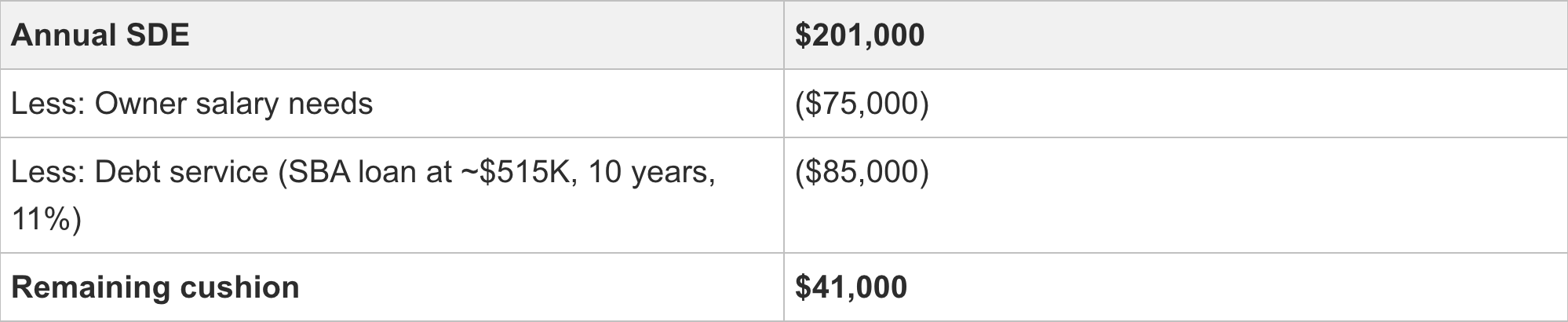
Buyers will be doing quick napkin math to think practically about whether the deal makes financial sense. They’ll ask: Can I make a living, service the debt (if using an SBA loan), and still have a margin for error?
Back to our HVAC example:
That's about a 20% cushion, which sounds relatively workable, but the actual numbers are very tight. For example, $40k is not enormous in the scheme of things. Regardless, buyers typically want to see 25% or more for safety. This math has to work for your ideal valuation to be realistic in the market.
What to Track and Document From Day One
Now that you understand how buyers value businesses quickly, let's talk about what you need to track to support that valuation. Start building these habits today.
Financial Documentation
Keep clean records of:
Profit and Loss Statements for the last three full years, minimum
Current Balance Sheet showing all assets and liabilities
Discretionary Expenses List (owner benefits, personal expenses run through business)
Real estate details (lease terms, rent amount, or property ownership details)
Owner compensation (what you pay yourself and what you actually do)
Family member roles (if any family members work in the business)
SOPs and processes (how things get done, step by step)
Sales playbooks (how you acquire and retain customers)
Key performance metrics (track weekly and monthly)
Why this matters: When it's time to sell, buyers will ask for all of this. Having it organized demonstrates professionalism and makes due diligence smooth. But more importantly, tracking these things helps you run a better business today.
Now Let’s Build Your Sellable Business
These are the building blocks that increase your SDE, push your multiple higher, and make your business valuable. Start implementing them today.
1. Diversify Everything (The 15% Rule)
Diversification is about reducing risk, and buyers will pay more for lower-risk businesses.
The 15% Rule: Aim for no single client to represent more than 15% of your revenue. If it makes sense, apply the same thinking to product lines and key suppliers.
Example: If you have $1M in annual revenue, your largest client should ideally represent no more than $150K. If one client makes up $400K of your revenue, that's 40% concentration. It's a red flag.
Work intentionally to diversify. If one client leaves or one product becomes obsolete, your business keeps running.
2. Build Recurring Revenue
Revenue is essential. Predictable revenue is valuable. Recurring contracts, subscriptions, retainers, and maintenance agreements transform your cash flow from lumpy to smooth.
Example: That HVAC company with $201K SDE? If 30% of their revenue came from recurring service contracts instead of one-time installs, their multiple might jump from 3.2X to 3.8X. That's an extra $120K in multiple value. Always look to find ways to convert one-time transactions into ongoing relationships.
3. Reduce Owner Dependency
A business that collapses without you isn't sellable. Period. Work toward a state where if you disappeared tomorrow, most things would still get done.
This means hiring capable people, delegating responsibility, documenting processes, and building systems. It also might mean creating incentives (equity, profit sharing, bonuses) to retain key people post-sale.
Think of it this way: The more the business needs you specifically, the riskier it is (and the less it's probably worth) to someone else.
4. Optimize for Cash Flow
Buyers want businesses that generate cash, not businesses that consume it. Do everything you can to optimize cash flow:
Get paid upfront or require deposits
Shorten payment terms (net 30 instead of net 60)
Cut unnecessary expenses
Negotiate better terms with suppliers
Manage inventory efficiently
5. Maintain Growth or Stability
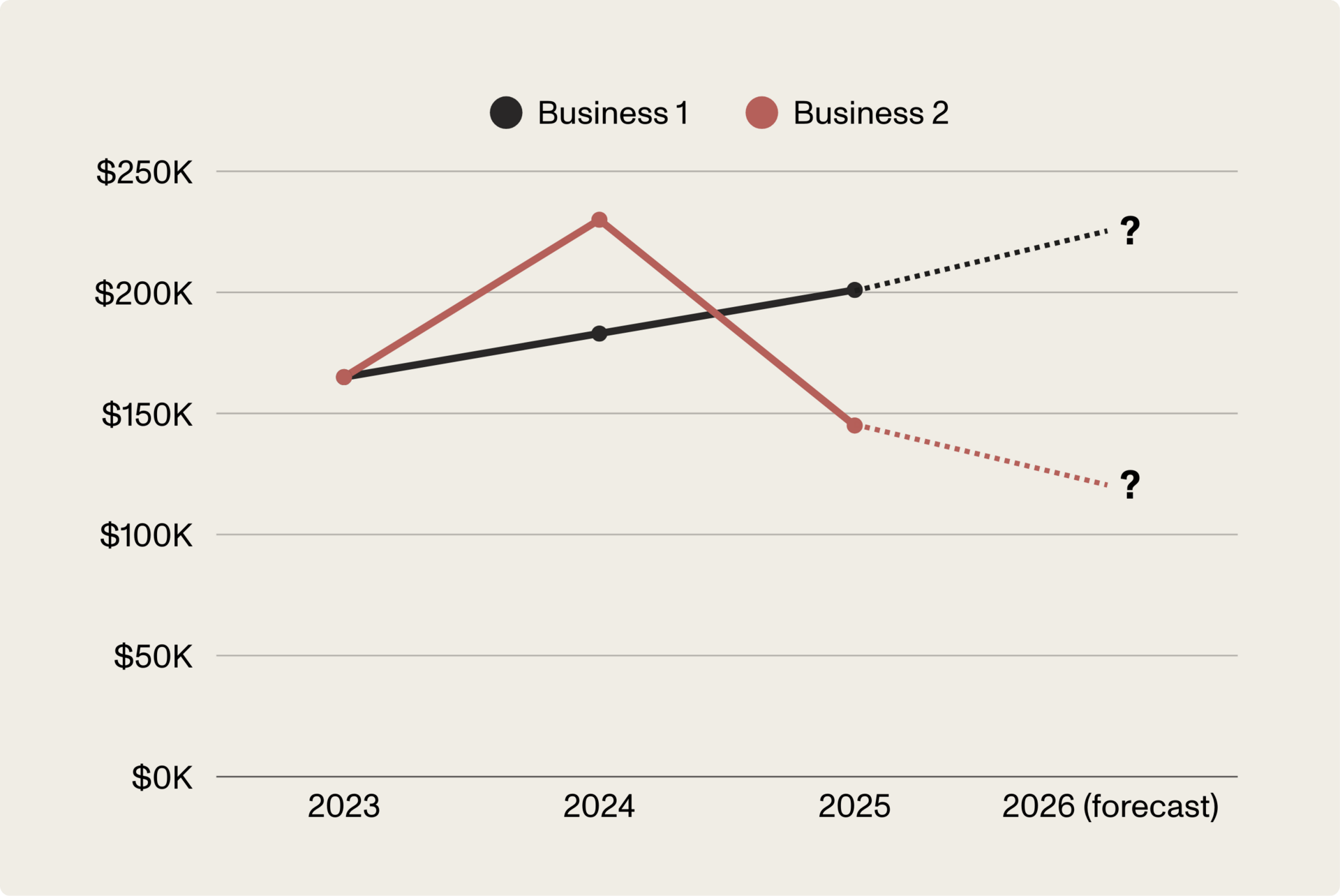
If your SDE is climbing year over year, you're golden. Buyers pay premiums for momentum and positive trajectories. The opposite is also true.
If your numbers are erratic or declining, they'll question everything, discount heavily, or walk away.
Critical reminder: Once you enter a deal process, don't take your foot off the gas. Any dip in performance will be noticed, extrapolated, and questioned. Keep selling, keep executing.
6. Invest in Systems and Technology
Buyers love businesses that run on systems. Better technology, documented workflows, clean books, professional websites, and modern equipment all signal that your business is mature and stable. The more systematized, the less risky it looks.
7. Build Strong Margins
If your margins are higher than the industry average, your multiple goes up. Focus on operational efficiency. Cut waste. Optimize pricing. Improve your value proposition so you can charge more.
Fat margins don’t guarantee it, but they signal a risk-averse business, and they’re especially appealing to a buyer who will likely have to use an SBA loan to acquire your business.
The Selling Process: When You're Ready
Okay, so you've built a sellable business. Now what? Here's what the actual selling process looks like.
Know Your Buyer Type
Buyers fall into two categories:
Financial buyers want cash flow. They're typically individuals using SBA loans.
Strategic buyers see synergies. They'll often pay more because your business complements theirs.
Remember Businesses A and B from earlier?
Business A (8% Profit Margin):
Revenue: $6.25M
Profit: $500K
Profit Margin: 8%
Business B (25% Profit Margin):
Revenue: $2M
Profit: $500K
Profit Margin: 25%
Assume they’re in the same industry.
Business A is going to be perfect for a “value buyer” or a “deal hunter.” The high revenue tells you they’re doing something right, but the low margin indicates they need to optimize.
Business B is more plug-and-play. Private Equity loves these for bolt-on acquisitions and roll-ups. Add this to a platform, make a few tweaks to squeeze out the last remaining margin improvements, and flip it within 2-4 years.
Find a Broker
Who you work with depends on the size:
Under $1M: Small business broker or direct listing
$1M to $10M: Main Street business broker
Over $10M: M&A advisor or investment banker
Create a Compelling Story
Your listing should outline what you do, who your customers are, why you've been successful, and why this is a great opportunity. Use all the data you've been tracking. Make your story stand out. Remember: Buyers scan hundreds (sometimes, thousands) of deals. Yours needs to be compelling.
Prepare Your Team
Don't tell them before necessary, but once you do, they need to believe they'll be as good or better off. Create plans for how to tell them, what incentives they'll receive, and how the transition will work.
Survive Due Diligence
Due diligence can take 60+ days. Buyers will want to verify everything. It will require patience. Negotiations will happen. Offers may shift.
This is critical: Keep running the business. Don't take your foot off the gas. Any performance dip will be extrapolated into the future and used against you in negotiations.
Timeline Expectations
Expect:
1 to 2 months preparing
2 to 3 months marketing
3 to 6 months closing
1 to 6 months transition
Here's the beautiful irony
When you build a business that's designed to sell, you often end up with a business you never want to sell.
A business with recurring revenue, diversified clients, strong systems, low owner dependency, and healthy cash flow is a business that runs well, scales easily, and gives you freedom.
Work backwards from what buyers want. Build those qualities into your business. And whether you sell or keep it, you win.
-Team Contrarian
The information contained here is educational, may not be typical, and does not guarantee returns. Background, education, effort, and application will affect your experience and the profitability of any business. Individual results may vary.











.svg)


