You're not stuck, you're just alone at the top. Most entrepreneurs hit a ceiling, not because the opportunity isn't there, but because you're solving $10M problems with $1M strategies.
Leadership Advice for Business Owners: 9 Lessons I Wish I Knew at 27
September 23, 2023
6 min read
From the Contrarian Thinking newsletter, originally sent September 23, 2023 as "Don’t Be an A-Hole (and Other Leadership Advice)"
Quick answer: The best leadership advice for business owners is simple and hard to follow: fire yourself from as many roles as possible, hire people you do not need to micromanage, cut meetings, track team and individual KPIs, never surprise someone with a firing, and own your mistakes in public. Research from Gartner and Gallup points the same way. People stay for leaders who are authentic, empathetic and good at managing.
Watch: Codie on why burnout is usually a broken systems problem, not a you problem.
Hey Contrarians,
Today marks 37 years since I was born on this floating rock.
And approximately 0 years since I've had all my sh*t together.
Constantly learning, constantly improving. And boy oh boy has there been a lot of learning and improving these last 10 years.
Starting Contrarian Thinking (and a couple other companies), buying several biz's, and investing in many more. It has me thinking often about leadership…
Today, indulge me in a reflection on the leadership lessons I most wish I could pass on to 27-year-old Codie.
CONTRARIAN FRAMEWORK: THE TRIPLE MENTOR APPROACH
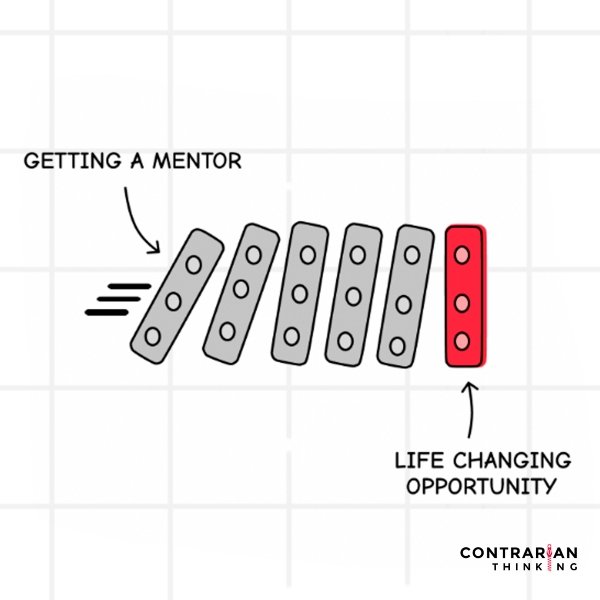
I believe one relationship has the power to change your entire life.
But it's always smart to look for more than one perspective…
I learned this triple-mentor framework from my friend Shaan Puri, and it’s changed my leadership landscape.
You should have 3 distinct mentor dynamics:
1. The Billionaire to Your Millionaire:
Someone ahead of you on the same path. You learn from their 10,000 hours and get insights beyond your current scope. Being in their orbit pushes you to think bigger.
Pro-tip: Never ask this mentor vague questions. “How do I get rich?” is a waste. Drop value bombs for them, then keep your asks small and pointed.
2. The Peer You Can Grow With:
You’re walking side-by-side. You’ll find fresh perspectives and mutual growth.
I find this one critical (and underrated). Sharing wins and getting harsh feedback from someone in the thick of it is what makes you exit your comfort zone.
3. The Up-and-Comer:
Put down the ego and learn from an emerging/younger voice in your industry. The up-and-comer injects innovation and insight into your approaches. They see the brilliant ideas your peers have already written off.
Most questions you ask about your business, career, finances, relationships, life? They aren’t answered by a “what” or a “how.”
The answer is a “who.”
9 LEADERSHIP PRINCIPLES I KNOW AT 37, I WISH I KNEW AT 27
1. THE BEST LEADERS FIRE THEMSELVES FROM AS MANY ROLES AS POSSIBLE.
You can't be the marketer, the strategist, the tech guy, and the customer service guru all rolled into one. And why should you?
You're the visionary, the driving force, the one who sets the course. So, embrace the power of collaboration. Build a team that complements your strengths, challenges your blind spots, and amplifies your impact.
And then actually trust them to do the work.
Sage advice: work on your business, not in it.
2. HARSH TRUTH: NO ONE CARES ABOUT YOUR BUSINESS AS MUCH AS YOU DO.
People don’t care unless you answer one question: “What’s in it for me?”
You have skin in the game. Do your employees?
Some of the best moves to give your team a stake in the biz and go to battle with you:
Encourage open communication. Do we execute on their ideas? A-players want to matter.
Involve your team in decision-making. Win-win: the biz becomes less reliant on you, and people feel the consequences of their choices.
Equity. I don’t give this lightly in my companies. But the best way to make your team care about your biz? Make it so they win when you win.
3. MICROMANAGING MEANS YOU HIRED WRONG.
Surefire way to tell you have the wrong people in the wrong seats:
You’re anxious about them. You double-check their work. You don’t trust them.
4. DO EVERYTHING YOU CAN TO DECREASE MEETINGS.
How you run meetings says a lot about how you run your life, your company, your team, and your mind.
A well-run meeting amps up your people, coordinates them, smooths out edges, and delivers a forward progression.
A bad meeting? Soul-sucking, inefficient, and feels like we’re somehow dumber than the sum of our parts.
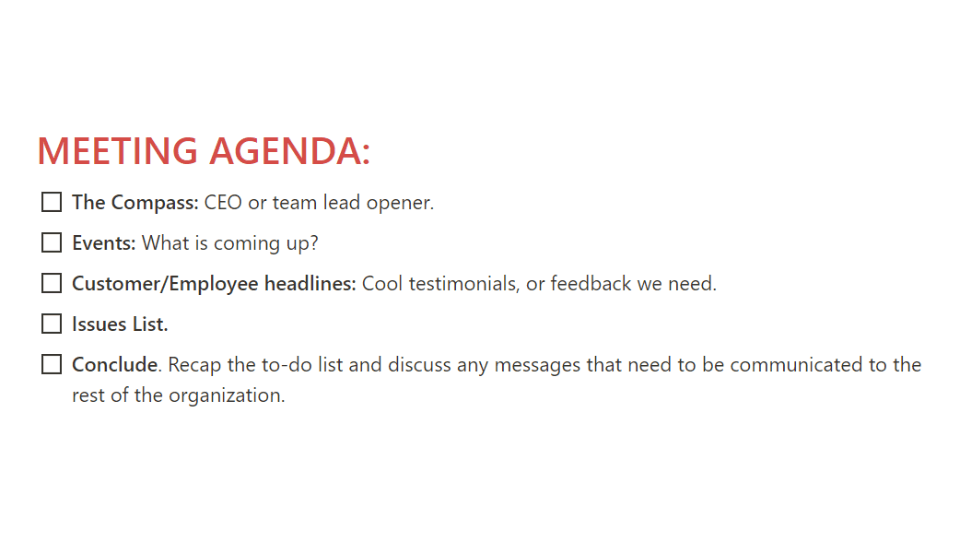
My hack for fewer meetings: Use an agenda structure. Make your team give you feedback on it. Constantly iterate.
5. NO ONE SHOULD EVER BE SURPRISED WHEN YOU FIRE THEM.
Aka: Don’t be a d*ck?
Firing's never easy. But I try to use a frame.
If they’re a low-performer, that means we hired wrong to start. Our fault, not theirs. Offer guidance, and redirect their efforts to a place better-suited for their level.
High-performer? This means they’re not in the right spot. I encourage them to do the thing they actually should do, whether that’s another area of the company, a friend’s business, etc.
Firing always feels like super-villain status, but you never know – it could be the re-direction your ex-employee needs to do bigger things.
Accepting mediocrity does no one any favors.
6. POOR PERFORMANCE ISN’T YOUR EMPLOYEE’S PROBLEM, IT’S YOURS.
Accountability starts at the top.
Did I lay out the game plan clearly? Did I give 'em the tools they need? Do I have the wrong person in this seat?
It's not just about calling the shots; it's about helping everyone load the gun right.
7. TRACK TEAM AND INDIVIDUAL KPIS.
KPIs aren't just numbers on a spreadsheet; they're your GPS for success. You need to know what’s working and what’s not. Who's crushing it and who needs a boost.
This data tells you where the whole ship's headed. And if you can’t tell who’s in charge, no one is.
8. ADMIT WHEN YOU F-ED UP, AND GIVE CREDIT FREELY & OFTEN.
Being human is a messy thing. So let’s check our ego and work with it.
Admitting our f-ups is where growth happens.
And if someone on my team nails it, you know I’m going to embarrass them by celebrating at the next meeting. (Try it, it’s fun).
We're in this together, and celebrating wins – big and small – is how we build a team that's got each other's backs.
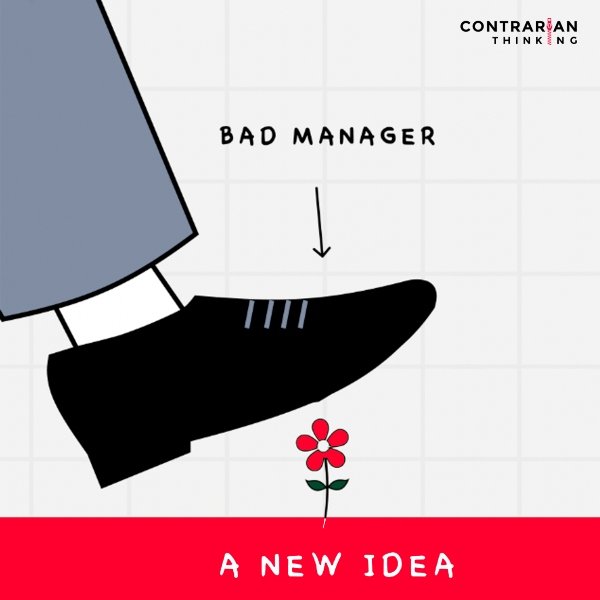
9. THE WORLD IS FULL OF SH*TTY LEADERS. THE TRUE DIFFERENTIATOR THAT ATTRACTS TOP TALENT? LEADING WELL.
I talk to a lot of small business owners. Their list of struggles is long, but always at the top? Finding and keeping good employees.
You may not be able to control the labor market, but what can you control?
You.
HR researchers at Gartner call it “human leadership.” The idea is that the best leadership principles aren’t so much the old fashioned ideas of strength of will, fearlessness, or the ability to charge into a battle. In Gartner’s 2022 research, 90% of HR leaders surveyed said leaders need to focus more on the human side of leadership (Gartner).
Rather, it’s much more simple:
Empathy, adaptability, and authenticity.
And most leaders aren’t hacking it. In Gartner’s survey of about 3,400 employees, only 29% said their leader fit that description.
Competence and realness. A little bit goes a long way. Turns out, good humans like working for good humans.
Team Contrarian
What the Research Says About Leading a Small Team
Human leadership
Gartner surveyed more than 230 HR leaders in March 2022, and 90% said leaders need to focus more on the human side of leadership. Gartner describes a human leader as authentic, empathetic and adaptive. In a separate survey of about 3,400 employees, only 29% said their leader fit that description (Gartner).
Managers make or break engagement
Gallup found managers account for at least 70% of the variance in employee engagement, and that companies fail to choose the candidate with the right talent for a manager job 82% of the time (Gallup). If you are the manager, that is a reason to work on it. If you are promoting someone, choose for talent, not tenure.
For a small business owner this cuts both ways. Your own habits set the tone for everyone you hire, and the first manager you promote will shape how every hire after them experiences the business.
Put the nine lessons to work
List the roles you still fill and pick one to hand off this quarter.
Write down two or three KPIs for each role, including yours.
Audit your recurring meetings and cancel any without a clear decision or owner.
Give feedback early so no one is surprised.
When you get it wrong, say so first.
Find mentors
Codie's triple mentor framework below works whether or not you have a team: someone ahead of you on the same path, a peer you can grow with, and an up and comer who sees what your peers have written off.
Frequently Asked Questions
What makes a good leader in a small business?
Clear expectations, honest feedback, tracking results instead of activity, and treating people well. Gartner calls this human leadership: authentic, empathetic and adaptive.
How do I stop micromanaging my team?
Hire people who can do the job, agree on outcomes and KPIs, and check results on a schedule instead of watching every step. If you still feel the urge to micromanage, it may be a hiring problem.
How should I handle firing an employee?
No one should be surprised. Give clear expectations, regular feedback and a chance to improve first, and document the conversations.
What is the triple mentor approach?
Learn from someone ahead of you on the same path, grow alongside a peer at your level, and listen to an up and comer in your industry. Each one sharpens a different part of how you lead.
The information contained here may not be typical and does not guarantee returns. Background, education, effort, and application will affect your experience. Your results will likely vary.
Thinking about buying a business? Learn how in Codie's free live masterclass.
A two day, in person workshop in Austin with the Contrarian Thinking team. Find hidden profits, close the gaps in your business and map the steps to grow revenue.