"It’ll probably take 5 years before everyone else in the world learns this..." 9 lessons from one of the most powerful CEOs in AI If you’ve ever thought: “How can I grow my business faster and more profitably using AI?” “Could I use AI to build a business, even if I don’t know how to code?” “Can I actually build something real with AI if I’m young, old, or just stuck in a job?” This guy has your answer (and he turned down a $1 billion offer for it): Amjad Masad built his company Replit around one goal: Anyone with an idea should be able to turn it into working software, even if they’ve never written a line of code. That vision has turned Replit into one of the fastest-growing companies in the world, and made Amjad one of the most influential voices in AI. But not everyone believed in the idea early on. Back in 2022, Amjad pitched legendary investor Peter Thiel. He thought Thiel would see the future. He didn’t. “He told me that I was engaging in buzzwords and hype. He said saying ‘AI’ is like saying ‘software’ or ‘computer’ — it’s meaningless.” After ChatGPT exploded, Thiel came around and started investing in AI. So, we asked Amjad: “Did you ever send him that ARR graph?” “I did... I sent him an email telling him how much I respect him and his brilliance, but that I hope now he sees that I actually saw the future.” Did Peter ever respond? ...No (lol). But Amjad’s not bitter. He’s building. And he believes right now is a once-in-a-generation opportunity for: Business owners Solo operators Anyone tired of watching from the sidelines In fact, here are 7 specific things he wants you to know, so you don’t miss out... 1. Clear Thinking Is the New Coding “A lot of people think I’m selling magic,” Amjad says. “I’m not.” “Management [of AI tools] is hard. You need to think
"It’ll probably take 5 years before everyone else in the world learns this..." 9 lessons from one of the most powerful CEOs in AI

A practical framework for fixing one of the most expensive things you'll ever pay for... You know something’s wrong with the way things are going at business school when you see a headline like this: That’s one of the top business schools in the world. A bunch of people will probably point out that this isn’t surprising, since business school isn’t really about learning anymore. “It’s all about the networking.” Even so, the network effect is now also a diminishing value prop, as technology enables new distributed networks that don’t cost an arm and a leg (~$250k). And for what? A high-paying consulting and finance role? Those jobs can work wonders for your career, wallet, and network, but even they are looking increasingly risky to spend years of your life breaking into. It’s not just business school, by the way. Young men graduating from college are having as much trouble getting jobs as their non-college-educated peers. Educators themselves are having trouble, too. Ask the founders of AI’s hottest companies, and this is what they’ll tell you: Anthropic co-founder Ben Mann: “If this were 10-20 years ago, I’d be lining [my daughter] up for top-tier schools and extracurriculars. But now I don’t think any of it’s going to matter. Learning facts is going to fade into the background. What matters is that she’s happy, thoughtful, curious, and kind.” OpenAI CEO Sam Altman: “My kid will never ever be smarter than an AI. That will never happen... But also, they’ll never know a world where products and services aren’t way smarter than them and and super capable... And in that world, I think education’s going to feel very different. I already think college is maybe not working great for most people... I think fast forward 18 years, it’s going to look like a very, very different
A practical framework for fixing one of the most expensive things you'll ever pay for...

This tech is quietly changing business forever... Let’s say we gave you $3 million to buy a business and become an owner. Not just any business — the right one for you: Profitable. Proven. A fit for your life. Think you could pull it off? Most people probably think so. “With that kind of cash, I’ll just make an offer and walk away with the keys.” But that’s not how it works. Historically, buying a business has looked a lot less like House Hunters ... ...And a lot more like The Lord of the Rings . Sure, money helps, but plenty of people with far less cash manage to close great deals. So what really breaks most people? The process. Just ask Sally and her daughter, her business partner. Sally had experience. She had capital. And her daughter brought serious digital talent. But still: 3 years searching for a business 3 deals fizzled out $45K in legal fees 0 businesses bought Until one small shift changed everything. If you’re building, scaling, or want to own something real in the next few years... Sally’s story is one you need to hear. The Tool That Changed Sally’s Life In 2008, Paul Graham drew the “Startup Curve”, a now-famous sketch of how building a startup actually feels. We think buying a business follows a similar path: Today, this process can feel like finding a needle in a haystack... in a dark room. But what if someone just flipped on the light and pointed you toward the needle? That idea has always been on our minds. ...And it’s why Sally’s story is so cool. See, Sally’s not your average buyer. She’s a high school dropout, who went on to earn 2 master’s degrees. She co-developed a cancer institute and worked in investment banking. She’s sharp. Experienced. Well-connected. Here’s why that’s critically important for you. Even with those advantages, Sally
This tech is quietly changing business forever...

Every biz needs A LOT more of this right now. Here's how we do it for (nearly) $0... There’s a massively underrated growth lever hiding in plain sight. It’s basically free, yet most owners never truly leverage it. Below you’ll see exactly how we turn it into a machine across our businesses. So, What’s the Growth Lever? One word: 89% of consumers check reviews before buying 66% say they’re the #1 influence on purchasing decisions Here’s the twisted part... 9/10 happy customers never leave a review. Angry customers are more likely to leave reviews than happy ones. So if you’re not engineering the ask, your haters are literally writing your story. If you ever build a business, you need to fix that. Here are 6 ways we make that happen. 1. We Built a Review Engine Across Contrarian Thinking, ResiBrands, and Contrarian Thinking Capital, we’ve learned that most businesses wait for reviews. Smart ones engineer them. What most people don’t understand is that you don’t need 10,000 customers to get 100 reviews . You need 100 customers and a damn good system: If you don’t capture the proof, you can’t share the proof, and your best marketing never leaves the room. So above all, build an engine to create and capture reviews. Here are some ways to do that... 2. Find Your Incentive Stack You need to make leaving a review a no-brainer , like this: For a home services business, that means aligning these incentives: The customer who wants to feel good about themselves The worker who wants recognition (and $) The owner who wants the review Our friend Nolan , a veteran-turned-landscaping operator with dozens of employees, nailed this. The customer feels good. The worker feels rewarded. You get 5 stars. Cheap. Fast. Win-win-win. 3. Know the Law of Reciprocity This is very similar, but with
Every biz needs A LOT more of this right now. Here's how we do it for (nearly) $0...

We just recorded a podcast with business legend Gary Vaynerchuk. Here are 6 of the most important ideas from our conversation. We just recorded a podcast with business legend Gary Vaynerchuk. Gary says he “truly had nothing” at 34. Couldn’t pay rent for his business. Started out of a borrowed conference room, what’s now a $350M company with 2,000 employees. He’s now 49, and after getting to know him over the last year, I think he’s playing the long game better than almost anyone. Below are 6 of the most important ideas from our recent 1-hour conversation. 1. Society Forgot How Hard $1M Really Is “Do you know how f*cking hard it is to make $1M a year?” One of the greatest things Gary says happened in his career is that he’s always been able to stay grounded. Case in point: One of the early VaynerMedia offices wasn’t in LA, San Fran, Tokyo, or London — it was in none other than Chattanooga. Why? Because “When you go to Chattanooga, Tennessee, if you make a $1M a year, you’re on a f*cking pedestal.” Knowing that keeps you grounded. 2. Your Empire Starts With Your iPhone We asked Gary: “Let’s say you had to start an entire empire from one laundromat today, what’s the playbook?” Took him milliseconds to answer: “I’ve talked for 15 years about how building your personal brand is the moat. It’s the one true asset that doesn’t get commoditized. Even in an AI world,” he says. “On Main Street, there’s a HUGE opportunity for people to build brand.” 3. The 10-80-10 Rule for Builders Gary has a great line: He thinks “winners and people aspiring to build big things spend way too much of their time in the middle.” So in his business, he lives by the 10-80-10 framework for leading without getting stuck in the weeds: 4. To Invest, You Need a Jockey and a Horse “Facebook, Twitter, and
We just recorded a podcast with business legend Gary Vaynerchuk. Here are 6 of the most important ideas from our conversation.

When 86% of Americans agree on something, you pay attention. That’s how many believe small businesses have a positive effect on the direction of the USA — more than any other U.S. institution, beating the military, in 2nd place, by 26%. That kind of trust says something. But for all that trust... there’s shockingly little training. Nothing makes you question the business education system like meeting a guy who dropped out of college with $12 and went on to build one of the fastest-growing franchise groups in America (true story). That’s not a dunk on MBAs. Plenty do incredible things. They lead great companies, become successful investors, shape entire industries — and the networks? Hard to beat. But let’s be honest: most business schools weren’t built for this era or for most people. They teach you to analyze a deal from 2007, not negotiate one tomorrow. In today’s world, what you can do increasingly matters more than what’s on your diploma. Skill and execution beat credentials and prestige. Real builders outpace résumé builders. But if the old playbook won’t cut it in 2030... what’s the new one? If we want a better economy for more people, how do we equip more people with the skills to own a piece of it? We think we might have the answer... Here’s Exactly How To Create More Owners The answer starts with an entirely new kind of business education. Not built around group projects and résumé padding, but around real-world execution. One that teaches people how to buy and build real businesses. Boring ones. Profitable ones. Businesses with trucks. And crews. And customers. Businesses that pay employees, support families, and keep towns running. We think the future of business education looks a lot more like that, and a lot less like a $200,000 PowerPoint. And it should
86% of Americans trust small business, yet ownership training barely exists. Here's how to create more owners, and why the country depends on it.

9 key business lessons from the man who wrote The Laws of Power. What no one tells you until it's too late... This was probably one of my favorite podcasts I’ve ever done. A couple months ago, I sat down with Robert Greene, master of human psychology and author of The 48 Laws of Power . What started as a conversation turned into a playbook for anyone building a business, leading a team, or navigating high-stakes decisions. 8 lessons from our chat that I think about almost every day while building Contrarian Thinking: 1. Never Outshine The Master I learned this the hard way, twice. I made myself look good instead of making my bosses look great. Both times, I got quietly iced out. Not fired. Just... bypassed. Robert nailed it: If I were still corporate, this would be tattooed above my desk. 2. Master The Art Of Observation Your natural instinct is to obsess over yourself. Robert calls that a trap. He learned this not from power, but from powerlessness , bouncing through jobs, watching people, studying flaws, decoding insecurities. Learn to read the room. Not just your own reflection. 3. Avoid Infectious People Some people don’t have bad luck, they cause it. I’ve seen it. I’ve hired it. And I’ve paid for it. If you sit near a top performer, you’re something like 15% more likely to perform well. Sit near a low performer? You’re 30% more likely to underperform. Energy is contagious. So is dysfunction. 4. Give Your Enemies a Golden Bridge In business, the instinct is to dominate. Win the deal. Crush the competitor. The smarter play is to let them leave with dignity. Give them an honorable exit, a way to make them feel like they “win” too. Robert said it best: I’ve used this in negotiations more times than I can count. Instead of cornering someone, I give them a way out — a
9 key business lessons from the man who wrote The Laws of Power. What no one tells you until it's too late...

Everyone’s either excited about AI or thinks it’ll steal their job. I used to be on the fence. Then I hired a full-time employee just to integrate AI into everything we do. His name’s Chadwick: The dude is half-human, half-android. His only job: Find every unfair advantage AI gives us... and leverage the hell out of it. We’re biased, but he’s building a free tool that might eventually become the #1 AI in the world for business buyers and builders. We’ll tell you more about it below... But first, here are some other tools I’m using to 2-3x my output across our business right now. If you’re trying to buy, build, or scale... these are force multipliers: 1. Whispr Flow I don’t type that much anymore. I talk . Hold the Fn key, speak like a normal human, and this thing transcribes it like a Hall-of-Fame court stenographer on Adderall. Punctuation? Flawless. Names? Capitalized. Swears? It knows the difference between “duck” and “f*ck.” This makes me 200-300% faster at typing. If you type with two pointer fingers like my dad... you’re no longer at a disadvantage. 2. Superhuman My inbox is a war zone. Inbox zero used to feel like a pipe dream... until I got Superhuman: You can layer it over your existing email with shortcuts You only need one letter to do everything AI autocomplete fills sentences before you finish typing What’s even crazier is that Superhuman auto-creates profiles for everyone who emails you. I used to pay a VA thousands to find that stuff. LinkedIn, website, and Twitter, all pulled automatically. Now it pops up like magic. 3. Perplexity Pro Imagine Yahoo Finance had sex with your best human analyst. Pull public company data instantly Make financial watchlists Run real-time valuation breakdowns Download it all Cost? A pie of pizza per month. Value? A
We hired a full-time employee just to integrate AI into everything we do. Then we built an AI Codie. Inside the experiment and the free tool it created.

Buffett, bikinis, and borderline illegal marketing stunts. The long game looks stupid at first... That line is classic Buffett. Absurd mental image. Top 10 business truth bomb. It applies to almost every part of investing and building. Still, most people ignore it. They want Year 7 abs after 1 month at the gym. Don’t get us wrong, speed is essential. But so is time. You need a long enough runway for the really interesting stuff to happen. This played out in my own career. On paper, it reads like a resume written by ChatGPT during a power outage: Walmart model Reporter in Latin America Wall Street Private equity investor Laundromat owner YouTuber Fund manager Zoom in? That resume looks deranged. Zoom out? There’s a common thread of ownership, finance, distribution, truth-telling, and a DEEP hatred of waiting for others’ permission. I always kept pulling the thread. And eventually, the thread became a moat. But it took time for the pattern to reveal itself. “In the business world, the rearview mirror is always clearer than the windshield,” as Buffett put it. I didn’t know I was building leverage. Yet by the time I launched Contrarian Thinking, I had all the raw material I needed plus a delusional level of conviction. ...Which brings us to Year 1. This Is NOT in the MBA Playbook If you think the early days of a company look like clean strategy decks and quiet focus time... you’ve never built one. I didn’t have a 5-year plan. Barely had a 5-month plan. We didn’t have a growth team. We had Google Docs, a shared Canva login, caffeine, some stickers, a mouth, and a chip on my shoulder. So we got scrappy and did what every rational person would do: 1. We printed 5,000 stickers and snuck into a newsletter conference we weren’t invited to. Covered the walls, bathrooms, and
Buffett, bikinis, and borderline illegal marketing stunts. The long game looks stupid at first...

It’s been a difficult week in America. Political violence struck again. The temperature of our national discourse rose higher. All of it made heavier by the dark anniversary that falls today. Moments like this test us. They remind us how fragile the things we build really are: families, businesses, buildings, trust. It is easy to lose faith in times like this. Today, many young adults feel they face more obstacles than their parents did. And confidence in our institutions has dropped to historic lows. Creation is the Only Path Forward The unfortunate truth is that it’s always easier to burn down than it is to build up. Which is why we must commit, again, to the harder path: building. A culture without belief in building for the future becomes reckless with the present. Ownership is the antidote to this. When you own something, you’re invested in tomorrow because you literally own a piece of it. When you have skin in the game, you have a stake in the future. The owners of a... Landscaping company in Arizona Diner in Ohio Accounting firm in Florida Wrought iron fencing business in New York ...aren’t plotting chaos. They’re working to make payroll, lend equipment, train employees, build relationships, or fix a roof. They’re too busy building to destroy. Reasonable people know this. Perhaps it’s why small business is the most unifying force in our country. To build is to give more than you take. Every brick laid, every job created, every customer served creates value that didn’t exist before. This is Why We Work When a new builder steps up, the effects run deep. The lessons a child absorbs from watching a parent wrestle with hard work, resilience, problem-solving, and responsibility will positively guide how they approach their lives decades later. That’s why we believe
Political violence and division test our faith in the future. Why building businesses, trust, and community is the only way forward in fragile times.

The most expensive lesson we ever learned. Last week, we covered why A players matter. This week? How to hunt them down. I’ve talked to 100s of founders about their biggest mistake, and it is usually not a “how” but a “who”. Choosing the wrong business partner is like entering business hell. I’ve done it twice. Each time I had to buy out my partner, and it wasn’t cheap. Problem is, most business builders hire like they’re staffing a youth soccer team. “Let’s get more players on the field!” Cool. Now you’ve got 11 toddlers chasing the same ball. You don’t need more people. You need the right people. Let me show you what that looks like. The Original 10x Engineer In 1975, Steve Jobs was 20. Living at home. Working nights at Atari. Smelling like innovation (and probably BO). His boss gave him a task: Build the game Breakout, but with fewer chips. Jobs didn’t really know how. So he called the smartest person he knew: Steve Wozniak. Woz was working full-time at HP. Didn’t need the money. Liked a challenge. As the story goes, Wozniak worked on the build for 4 nights straight. The result? A circuit board using a fraction of the chips Atari expected. So good, it was basically art. (Too good, actually. Atari had to redesign it because Woz’s version was too advanced for them to build.) Once you’ve worked with someone like that? You can never go back. 10x Talent in the Wild I saw the same thing running a finance business in Latin America. Our top reps weren’t a little better. They were 10x better — even in small, crappy markets. So we gave them the good markets. Suddenly, they were 20x better. Same people. Bigger opportunity. Stupid-good results. So the right question isn’t: “How do I get more help?” It’s: “How do I get more of these people?” Spoiler: It’s probably not on a job
The most expensive lesson we ever learned.

We bet our business on this (and it worked). “A small team of A+ players can run circles around a giant team of B and C players.” - Steve Jobs Everyone wants a business that runs like a machine. High-performing team. Fast-moving org. People who just get sh*t done. So what do most builders do to foster this? They take the MBA-approved route: Write “core values” no one remembers Host offsites where Tim from finance gets blackout on margs Slap “Excellence. Integrity. Teamwork. Family.” on the wall We’ve all heard the line: “Culture starts at the top.” Cool, then explain why your team acts nothing like you. Here’s the real reason: Culture doesn’t drip down. It radiates out. It spreads like a cold — person to person, desk to desk. It’s the people sitting 3 seats over. The ones employees text when you know what hits the fan. The ones they see online at 8pm and think, “Damn, I guess we’re still going.” That’s who drives the tempo. That’s who sets the tone. You know the person. That’s your Bobby. Our Bobby runs BizScout , our platform for buying and selling small businesses. The man is a Swiss Army knife with caffeine for blood. But (literally) kicking ass isn’t what makes Bobby special. This is: When we interviewed Bobby, we thought we were vetting him . Nope. He was vetting us. “How big do you think this company’s going to get, and why?” “What’s your 10-year vision?” “What’s the worst thing someone who’s partnered with you would say about you?” “When’s the last time you fired someone for underperformance?” “What will you do if this company runs out of cash?” He even asked about our summer plans. (Still not quite sure why...) Point is, finding someone like Bobby is an absolute cheat code for business builders. The moment Bobby showed up, things moved. Not because we told
We bet our business on this (and it worked).

This made our business 10x clearer and flipped how we build brands. “If you know the enemy and know yourself, you need not fear the result of a hundred battles.” -Sun Tzu Everyone wants to build something that makes them rich. The smart ones start with an enemy . Harley-Davidson figured this out in the 80s. They were getting bodied by Honda and Yamaha’s smoother, faster, quieter bikes. So Harley said screw it. They stopped selling motorcycles, and started selling middle fingers. They leaned into: Loud noise Leather jackets American steel Dudes named Snake who could replace a carburetor with a beer can Were the bikes better? Not really. But they gave people something to belong to, and something to push back against. And that? That sells. Now, we know what you’re thinking: “Cool story, but I’m not selling motorcycles.” Exactly. And that’s the problem. Motorcycles come with identity built in. Your business? Probably doesn’t. Without a villain, you can build a beautiful service, hire great engineers, drop $50k on Meta ads... And still end up a brand no one remembers. Think about it: YETI vs. disposable junk Apple vs. conformity Patagonia vs. fast fashion Elon vs. bureaucrats MrBeast vs. boring content Codie vs. financial gatekeepers Enemies clarify. They give your team a reason to show up, and they make it easy for people to relate. They help turn your business into a magnetic field , attracting the right people and repelling the wrong ones. So, how do you build that magnetic field? 1. Define Your Villain Your enemy is the thing that makes your customers mutter, “This is so stupid” at least 3 times a week. Sometimes it’s: A 47-step process that should take 2 A customer service line that plays smooth jazz for 40 minutes, then hangs up A 1997 backend duct-taped together by
This made our business 10x clearer and flipped how we build brands.

This 1 goal strategy changed everything... “Only those who will risk going too far can possibly find out how far one can go.” -T.S. Eliot Meet Steven. Steven runs one of the fastest-growing home service franchise groups in America — and we proudly own a piece of it. He started with $12 in his bank account. No trust fund, no pedigree, just a ridiculous work ethic... and one rule that most people would laugh at: Every quarter, Steven has his team set goals that sound — and this is his word — ridiculous . Not ambitious. Not “stretch.” Ridiculous. As he puts it: Why? Because he understands something most owners never figure out: Big Goals Create Gravity We call it Goal Gravity — the force that pulls everything in your business toward the target. Small goals? Your org drifts. Big goals? Priorities sharpen. People step up. Or get out of the way. Even if you miss — and you probably will — you land somewhere you couldn’t have reached playing it small. The Startup Crowd Gets This, Kind Of There’s a lot of hate tossed around about startup culture. Some of it is fair... Too many founders are playing milestone bingo, and too many investors are rewarding vibe or vanity over viability. But let’s not pretend Silicon Valley doesn’t have something figured out. At their best, venture-backed startup builders are world-class at one thing: Thinking bigger than the current reality. We see it all the time. Our venture fund backs founders trying to reshape entire industries. Some will win. Some won’t. But if they’re not swinging big? We’re not writing a check. On the other end, we invest in the small and sturdy, like Steven’s brands across window painting, roofing, garages, and more, and guess what we’ve learned? The small, “boring” businesses that actually scale? Their owners are thinking
This 1 goal strategy changed everything...

They should’ve taught this in school... “Show me the incentive and I’ll show you the outcome.” -Charlie Munger Something strange is unfolding in America’s workforce. A quiet unraveling the likes of which we’ve never seen. Not on factory floors. Not in shipping yards. But in offices. On college campuses. Inside the career paths we were taught to trust, and in DMs from students asking us what the hell is going on. Well, here’s what’s going on: Recent college grads are now going through their worst relative job market in almost 40 years. Our take? The companies that used to hire 10 new grads now hire 2, and hand the rest to AI. Pitch decks, research memos, junior-level code... all getting filled in by software that doesn’t need PTO, sleep, or health insurance. That’s crack for a CEO. Which means... the entry points to today’s white-collar America are shrinking — and fast. We believe in education. But something’s off when the cost of a degree keeps rising — up 41% since 2005, after adjusting for inflation — while the opportunities it’s meant to unlock keep disappearing. It’s part of why we built the Contrarian Community . But here’s the thing... None of this is surprising. It’s just incentives playing out. Schools reward good grades. So society built a system optimized for test scores and got grade inflation, cheating, and credential chasing. The economy rewards efficiency. So when a tool shows up that can work 24/7 without sleep, salary, or benefits... it gets the job. Whether you’re a student, an owner, or a 9-to-5er, the question shouldn’t be: “How do I compete with AI ”? That ship has sailed. The real question is: “How do I compete WITH AI”? So below is a simple framework for putting AI to work, before it puts you out of it... You Need to Think Like a Chef Ever
They should’ve taught this in school…
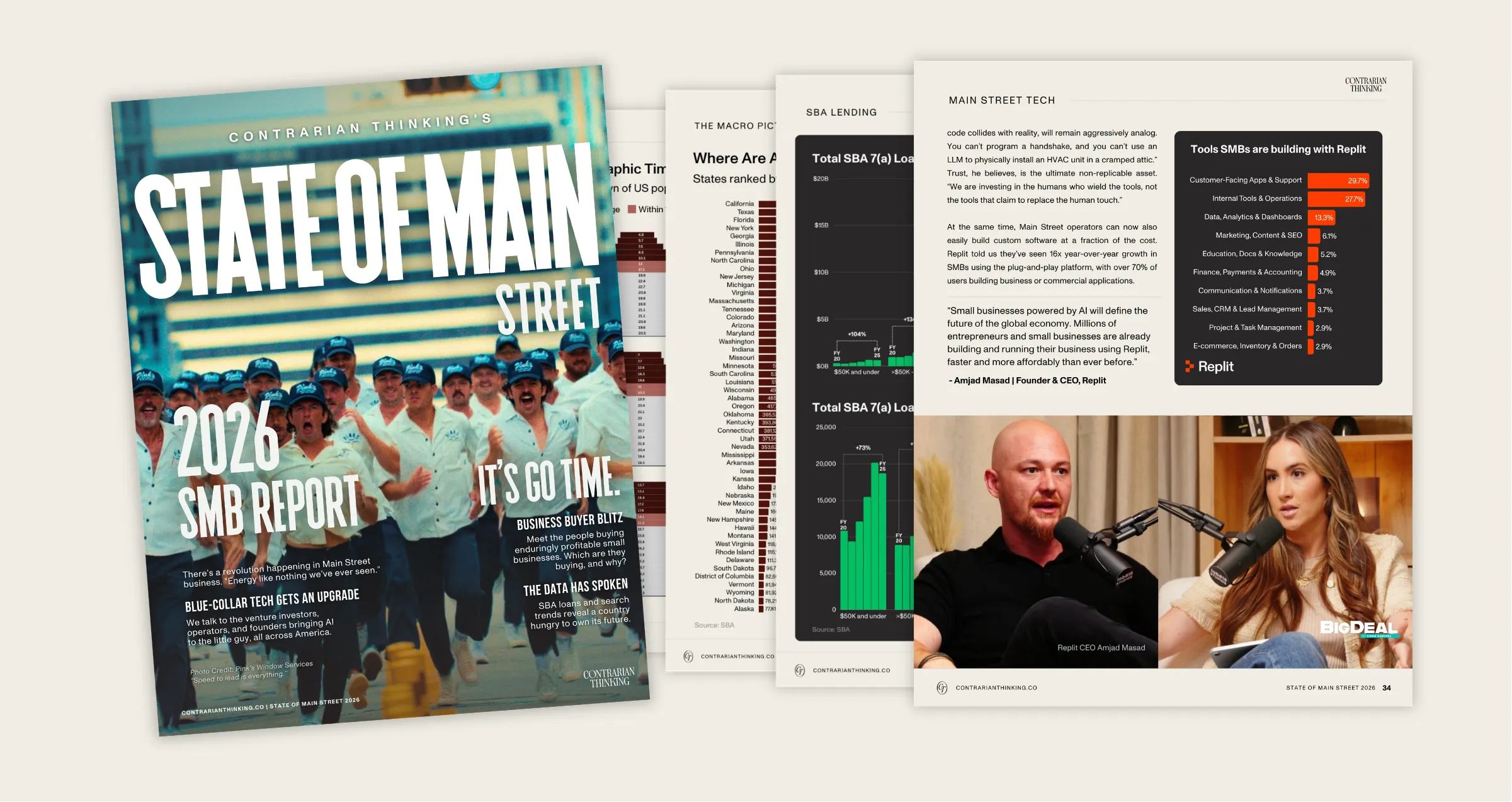
If you’re lost in the economy, read this. “The best way to predict the future is to create it.” -Peter Drucker At the start of the year, we asked a simple question: What are America’s small business builders actually thinking? We thought finding out would be a quick project. We were hilariously wrong. But hundreds of surveys, dozens of interviews, and 70+ pages of insights later, we ended up with one of the most detailed looks ever at Main Street business trends. Small businesses employ 46% of the workforce and create 64% of new jobs. If you care about where the real economy is headed, this is required reading. Yeah, we probably should’ve charged for this... Too late now. You can grab a copy today, totally free, by clicking here : BUT before you dive in, it’s worth understanding the tectonic shifts shaping it all. In fact, you should think of this report as a wake-up call, and here’s why... The Maps Are Broken 500 years ago, a bad map got you eaten by sea monsters. Today? It gets you $200k in debt, an unpaid internship, and a life of renting. You can see people feeling it everywhere. For a long time, the obvious paths worked. College. Career. Home. Retirement. Follow the steps, reach the dream. But the terrain shifted fast. Now college seemingly comes with 10x the debt and none of the certainty. The corporate ladder? Missing rungs. Housing? Good luck. The old maps don’t match the new world. And while most are still waiting for the routes to reappear... Others aren’t. They’re just building. No permission. No perfect timing. Just forward motion, and a new map of their own. In a tightening, shapeshifting economy, the winners won’t be the polished or pedigreed. They’ll be the ones who know how to move without a map . The good thing is there’s a navigation tool for doing
If you’re lost in the economy, read this.