8 hard truths about wealth from a true contrarian. Welcome to Contrarian Thinking, where we help you think smarter, build better, and live freer. This week, we share 7 strategies for living a more fulfilling life from one of Codie’s closest mentors. Let’s dive in... This is Bill Perkins. Hedge fund manager. Poker player. Asymmetric thinker. Worth hundreds of millions. Today, you’ll steal 7 of his principles for living a truly rich life, starting with... 1. Never Let “Small” Infect Your Thinking Bill doesn’t do polite encouragement. He does reality checks. Codie once shared her business vision with him — safe, reasonable, probably doable. He paused, looked her in the eye, and said: “Has small infected your thinking?” It wasn’t rude. It was a gift. Sometimes, playing it safe feels smart... when it’s actually just playing small. Most people don’t have anyone in their life who will call that out. Bill will. 2. Slow Is Expensive “We’re human beings, not institutions. We don’t live that long,” Bill says. Rich people aren’t usually much smarter. But they are often much faster. Bill calls it what it is: While most people are still planning step one, the best have already failed 4 times, maybe even lost money, and figured out the faster, better path to reach their goal. 3. Leave Your Ego at the Door Bill has a spicy take: If you’re educated, healthy, and halfway ambitious, you have no actual financial risk. You’re not going to starve or be homeless, he says. You can get a job — maybe not a glamorous one, but a job — any day of the week. What you probably have is “ego risk.” That idea hit home for Luke, a veteran and the CEO of our portfolio company, SkyFi: “People aren’t afraid of failing, they’re afraid of looking stupid,” he says. “That ego trap costs them real opportunity.”
8 hard truths about wealth from a true contrarian.

Avoiding risk? That is the risk. The same instincts that keep you safe... are also keeping you small. We call it Passive Ambition. You crave freedom, but fear risk You want all the upside, but avoid volatility You dream big, but act small Here’s the truth: Every builder you admire once looked like a fool. Building anything meaningful starts with a bet, usually on yourself. No safety net. No guarantee. The world is mostly built by people who didn’t wait for permission — they just started . Even when it felt reckless. Especially when it felt lonely. The scariest part is realizing no one’s coming to save you. But the best part is realizing you might not need them to. That’s why we’re hell-bent on helping people will things into existence. Because we don’t want to settle for a world of this: You the builders are this generation’s explorers, risk-takers, and adrenaline junkies. You do this because you’re wired differently. It’s hard, but that’s why you do it. So today let’s talk about taking risks — why avoiding them entirely can cost you everything, and how to do it without losing your mind or wallet. The #1 Way to Stay Stuck (Don’t Do This) If you’re looking for a rock-solid plan to stay stuck where you are right now — financially, emotionally, professionally — look no further: Step 1: Don’t Take Any Action Do the minimum Collect the paycheck Let someone else decide your trajectory Plenty of people build real wealth and ownership inside their W-2. They negotiate for equity. They invest their earnings. They stack skills and launch projects that make them indispensable. But even then, if you’re just clocking in and out, never raising your hand, then you’re not working, you’re waiting. Waiting for “one day” — the most expensive day of the year. Step 2: Take Action You Barely
Avoiding risk? That is the risk.
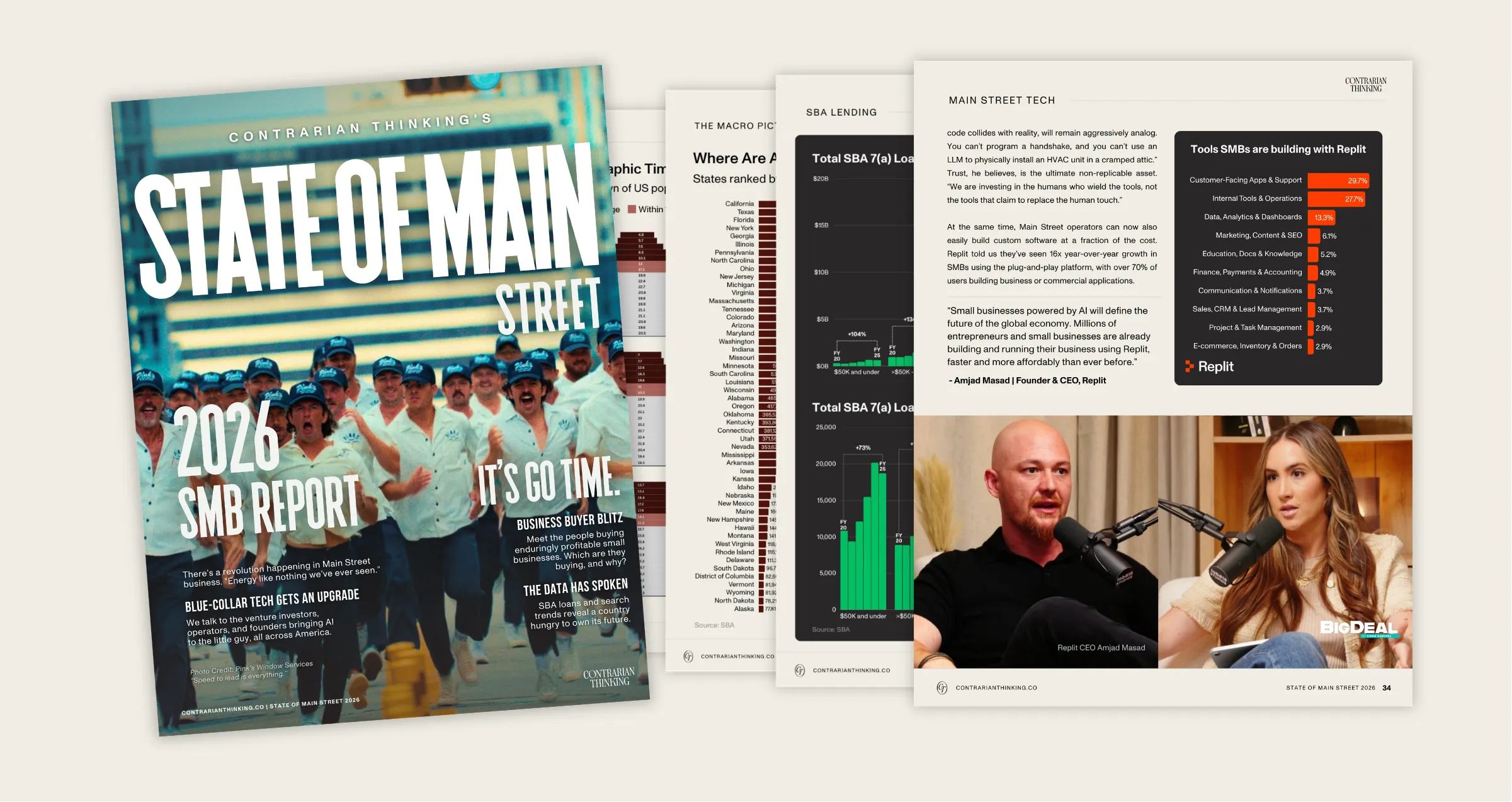
Click Here to Download the 2025 State of Main Street Report
Download the 2025 State of Main Street Report: exclusive data on small business ownership, deals, and the trends reshaping America's Main Street economy.
It's time to face the inevitable. The most powerful drugs in the world today? Certainty and uncertainty. This week, the markets snorted both. It started as trillions in value vanished on fears of a prolonged trade war. Then, just when it felt like the floor was giving out, salvation arrived. On Monday, a pseudonymous business news account named Walter Bloomberg, with 860k followers, zero listed credentials, and a clear knack for moving markets, tweeted a rumor about a “90-day tariff pause.” No cross-check. No verification. But the markets? For a brief moment, they ripped. Traders roared. CNBC scrambled. Then someone phoned the White House. “Fake news, dipshits.” The dopamine wore off just as fast as it had come on. “We’re so back” switched back to “it’s so over” in a matter of seconds. But the volatility wasn’t over. Yesterday, after Trump decided to temporarily play nicer with the world, stocks saw their best single-day gain since October 2008. Zoom out, and it’s clear: chaos and uncertainty aren’t the bugs anymore. They’re the operating system. The new normal is no normal at all. Every headline is a plot twist. Every day, an engineered mood swing. Here’s the thing: No one knows what will happen. BUT consuming tons of news will likely not make you more money. So while the world spirals in real-time, there’s another force cutting through the noise. Not a trend. Not a cycle. Not something to “keep an eye on.” It’s inevitable. And if you want to stay relevant — hell, if you want to stay standing — there’s one thing you actually do need to be watching. 1 Thing That’s Definitely Not Slowing Down Two weeks ago, OpenAI dropped its latest image model, and the internet promptly lost its mind Your thumb couldn’t scroll two inches without tripping over AI-generated Studio
It's time to face the inevitable.

Wealth starts in the bedroom. Your most valuable asset can’t be found on a balance sheet. It doesn’t show up in quarterly earnings. It doesn’t IPO. But it’s your greatest unfair advantage. It wakes up next to you. It’s seen you ugly cry and still thinks you’re hot. It either compounds your life, or quietly drains you. The most important deal you’ll ever close isn’t in the boardroom. It’s in the bedroom. Today, you’ll understand why. Your Economic Superpower: “I Do” The most important variable in your long-term outcomes isn’t what happens to the S&P 500, it’s your partner. If that sounds dramatic, it’s because it is. But also: it’s math. Married people build 77% more wealth than their single counterparts, according to research published in the Journal of Sociology. According to the St. Louis Federal Reserve, married couples had $393,000 in median wealth in 2022. Unmarried individuals: $80,000. Economists say married couples are more likely to own appreciating assets. Over time, that helps lead to data like this: When you have a partner, you share dreams and realities. You’re merging balance sheets and belief systems, and the ROI can show up in every part of your life: Better financial outcomes Higher net worth More emotional resilience A stronger foundation for your kids Longer lifespan, fewer health issues, lower rates of depression You Can’t Scale Alone There’s a tired narrative that rich people got ahead by stepping on everyone else. But the truth? Most successful people are elite partners . They know how to build systems with others. Syncs (family check-ins) Shared KPIs (financial goals, parenting) Delegation (who’s doing what?) Upskilling (therapy, books, mentors) Aligned vision (kids vs. no kids?) Funny how the habits that make a marriage strong... look a lot
Wealth starts in the bedroom.

If your business doesn’t have problems, it’s probably dead. A few months ago, Marc Andreessen was discussing why Elon Musk is able to build rockets, electric cars, brain chips, and tunnel-boring machines so effectively. Yes, this Elon: Marc’s answer was uncomfortably simple. “Basically, what Elon does is he shows up every week at each of his companies, identifies the biggest problem that the company’s having that week, he fixes it, and then he does that every week for 52 weeks in a row .” A relentless loop. Simple in theory and brutal in practice. It requires proximity. A willingness to live inside friction. Most people don’t operate this way. Most companies definitely don’t. Problems are treated like biohazards. First, they’re reframed. “Problems” become “challenges.” “Bottlenecks” become “growth opportunities.” Then they’re processed, redirected, and padded with layers of abstraction. This is the standard operating model of corporate America. We’ve become professionals at problem avoidance. At SpaceX, they do the opposite. They send a 400-foot skyscraper into the sky knowing full well it will probably explode. Spectacularly. Publicly. But they want to know exactly what breaks, when, and why, because every failure will help incapacitate dozens of future problems. Andreessen described Musk’s approach like this: “Incredible devotion from the leader of the company to fully, deeply understand what the company does... and being the lead problem-solver in the organization.” That last part matters. The lead problem-solver. That job isn’t glamorous. It involves surfacing uncomfortable truths and fixing things no one else wants to touch. But it’s where all the leverage is. What you earn usually reflects what you solve. You don’t need to like Elon to understand this model. You
Marc Andreessen on why Elon Musk builds so fast: attack the biggest problem every week. Why problems are a gift, and how to use yours to grow.

There is one thing that truly matters right now... Right now, execution is the only thing that matters. Consider this story. A decade ago, Chinese entrepreneur Zhang Yiming had an idea — one that would flip social media upside down and create an empire worth hundreds of billions. When investor Thomas Laffont met him and learned about the idea, the concept was so simple it almost sounded obvious. But no one else had done it. At the time, social media was a rigged game. Instagram? Twitter? Your reach wasn’t necessarily determined by how good your content was. It was determined by how many followers you had. The internet had become high school all over again — the popular kids got all the attention, and everyone else was invisible. On the All-In Podcast , Laffont recalled that TikTok’s founder saw the flaw and asked a game-changing question: “What if I take every piece of content that’s uploaded into the system and I show it to at least one other user?” That’s it. No gatekeepers, no legacy advantage, no “who you know” nonsense, just an open field. Post a video, and someone will see it. If they engage, more people will see it. The best ideas (or in this case, videos) would win. That one shift has changed social media forever. The algorithm wasn’t just surfacing trends, it was democratizing discovery. TikTok didn’t care if you were a nobody. If what you made was “good,” it would be seen. At Contrarian Thinking, we spend a huge part of our time focused on building at the intersection of media, startups, and acquisitions, so we’ve learned this lesson firsthand. Most people think business is just about making money, but at its core, it’s about making ideas realities. And the best companies don’t just generate ideas, they build systems that let the best ideas win. We’ve built
There is one thing that truly matters right now...

The costliest thing you can lose and the economy of connection... Your network is your net worth, and it’s shrinking. Today you’ll understand why. Behavioral scientist Nicholas Epley and Juliana Schroeder once ran an experiment on train commuters. They asked passengers to predict whether they’d enjoy their commute more if they kept to themselves or talked to a stranger. Most assumed silence would be better. We probably would, too. But when they actually tried it? The people who held conversations with fellow passengers reported feeling significantly happier than those who stayed quiet. This paradox is what we, as a society, are now dealing with at scale. We’ve built a world that defaults to isolation, even when real connection makes us happier and probably more wealthy. Derek Thompson put it bluntly in The Atlantic : We’ve increasingly been living a “remote life” amid a complete restructuring of human interaction. And we’re paying for it. We Call It The “Isolation Tax” You wake up, check your phone. Get work done, on your laptop. Buy your groceries, with a click. Order lunch and dinner, from an app. Watch a movie, on a screen. Go to bed, after one last scroll. A day of life, and you seldom have to talk mouth hole to mouth hole. If this feels normal, that’s because it is. But normal doesn’t mean good, and the data shows we’re choosing this path more than ever. In-person socializing dropped by over 20% between 2003 to 2023, with the decline surpassing 35% for unmarried men and young adults. 74% of restaurant traffic comes from takeout and delivery, up from 61% before the pandemic. Meanwhile, solo dining has surged 29% in just 2 years, according to OpenTable. The typical adult buys three movie tickets a year but watches the equivalent of about 8 movies per week at home
The costliest thing you can lose and the economy of connection...

There are 2 types of people in the world... “The world is full of problems.” True. “They should fix them.” Should they? Or should you ? Somewhere along the way, too many of us forgot about the importance of fixing things. Or worse, we stopped believing it was our job. Most people see the problem, the broken system, the bad process, the dishes in the sink, and they wait. Seems to us that’s the dividing line between two types of people in today’s world. At Contrarian Thinking, we call these Fixers and Freeloaders. The Leaky Ship Analogy Picture this: You’re on a boat in the middle of the ocean. Suddenly, a hole appears in the hull. Water pours in. What happens next? Here’s a good example we found out in the ether... Scary how accurate it is: The Freeloaders react — but they don’t act. “Someone fix this!” they yell. They point fingers. They debate who’s responsible. They theorize about why the ship is sinking. One starts a petition. One writes a think piece, “The Big Sink: Who’s Really to Blame?” Freeloaders never reach for the controls. They see things that need fixing, but that’s for someone else. The government. The boss. The committee. The next guy. Freeloaders notice problems. They comment on problems. But they do not fix problems. Because fixing something would mean taking ownership, and ownership is heavy. It forces action. Action invites failure, blame, and, worst of all, work. So they wait. They discuss. They theorize. They make sure everyone knows they’re concerned — as long as they don’t actually have to do anything about it. They live their whole lives nodding. They’re the ones in meetings who state the obvious like it’s an original insight: "We should really get better at customer retention." Thanks, Jeff. Incredible input. The Fixers, on the other hand
There are 2 types of people in the world…
2025 was just the warm-up. Learn about our biggest moves yet across media, investing, and education. Contrarians, First, thank you. Trust is a rare currency in today’s world, and you’ve placed yours in our hands. We don’t take that lightly. Inside this letter, you’ll find our annual update — where we’ve been, what we’ve learned, and what we’re building for you next. We vs. Me: Creating a Movement The American Dream is built on ownership. Today, ownership feels out of reach for far too many. Research shows that across the political spectrum, while faith in corporations, media, universities, banks, and government continues to decline, small businesses are far and away the most trusted institution in America. Main Street remains a cornerstone of economic stability. We aim to bring it to the forefront. My father always told me, “You can be selfish or great, but you can’t be both.” I remember the moment I knew my time in traditional finance was coming to an end. I was walking with my CEO — my boss — laying out a vision for the future. We needed to get on the internet, I argued. We needed to share our strategies, teach others about investing, and leverage email and social far more than we needed to sit in boardrooms and take partners out for steak dinners. He let me go on for a while. Then he looked at me and said, “Codie, here, we get rich quietly.” And just like that, I knew my last day was coming sooner than I had planned. We had two fundamentally different views of the world. His was built on exclusivity — keeping knowledge and capital behind closed doors. Mine was built on access, leveraging technology, transparency, and attention to create a new kind of advantage. He wasn’t wrong; being public is often not fun, but it is the future. Increasingly, intelligence
2025 was just the warm-up. Learn about our biggest moves yet across media, investing, and education.

These 3 rules changed everything for us recently. You might want to steal them. Most people think success comes from big moves. The reality? For 99%, it comes from one simple formula... Sell things to rich people... they pay more. That’s true. And cute. But is it so easy? Having sold clients who are both there is a truth to the meme: Rich people want you to sell them something. Remember that. Two worlds of entrepreneurship: One world — scraps, selling cheap products to price-sensitive customers who churn the moment they find a discount. Second world — sell fewer, better things for more money. The volume game can work. It's built some of the biggest business empires — Walmart, Amazon, McDonald’s. Three small issues. That game is brutally competitive. Scaling requires airtight infrastructure. Even the best eventually move into higher-margin products. A different path? Sell expensive things to people who can afford them. When was the last time you raised your prices? Our guess: 9 out of 10 small businesses undercharge. Why? It’s scary not to. If you start to realize wealthy customers want to be sold, your entire business can change. What Rich People Actually Buy There are five reasons rich people buy. Only five. Every single reason falls into this hierarchy we call The Rich Desire Pyramid. 1. Status – “Make me look important.” How to sell it: Position your business as the best, not the cheapest. Showcase expertise, exclusivity, and premium service. Think Hermes: Limited-run purses that are mostly handmade by one person each, from start to finish. 2. Convenience – “Make my life easier.” How to sell it: Eliminate friction. Offer white-glove service, subscriptions, and concierge treatment. Private jets. Fast. Expensive. 3. Exclusivity – “Let me in, keep others out.” How to
These 3 rules changed everything for us recently. You might want to steal them. Most people think success comes from big moves. The reality? For 99%, it comes from one simple formula...
Contrarians, In 2000, on a mild March morning, a stadium that had hosted Super Bowls, rock concerts, and millions of screaming fans stood silently, waiting for its final moment. At 8:30 AM, a series of explosions ripped through the Kingdome’s concrete shell. In 17 seconds, one of Seattle’s largest structures was reduced to dust. The event set a Guinness World Record for one of the largest buildings, by volume, ever demolished by implosion. Reportedly, the 125,000-ton destruction did not cause a “single crack” in the foundation of its replacement, being built just 90 feet away. The masterminds behind this work? The Loizeaux family, owners of Controlled Demolition, Inc. These are the people you call when something enormous needs to come down without turning everything around it into a crater. The group has spent decades bringing down some of the largest, most awkward structures on Earth. They did it in Detroit, taking down the towering J.L. Hudson’s department store — once the second-tallest retail building in the world — with pinpoint precision. They did it for the Sands Hotel and Casino in Vegas , erasing an empire in the blink of an eye. And recently, when Baltimore’s Francis Scott Key Bridge collapsed, who did the government call for help? Yup . To the untrained eye, demolition looks ugly. But to the folks at Controlled Demolition Inc., it’s art and science. Because real demolition isn’t destruction, it’s strategy. It’s knowing exactly where to place the charges, what to remove, and, most critically, what must remain standing nearby. Now, it seems, another record-breaking demolition is underway, only this time, it’s not the Loizeaux family holding the detonator. It’s Elon Musk. The thing he’s blowing up? One of the largest, most complex structures in the history of
The Kingdome took 17 seconds to demolish and decades to pay off. The hidden price of efficiency, and when slower, sturdier thinking wins.

We just saw one the boldest moves in years — hundreds of billions on the line, markets on edge, and a high-stakes negotiation unfolding in real time — here’s what it means for you. Contrarians, The louder the headlines, the harder it is to separate strategy from hysteria. So let’s make this simple. When we sat down to write this... President Trump had threatened Canada and Mexico with 25% tariffs, China with 10%, and everyone began scrambling. The economy was (and still is) having a minor panic attack, as Canada promised $155 billion in retaliation, and Mexico threatened retaliation. Debates raged: Is this an economic strategy, or a policy grenade with no clear exit plan? The question isn’t if this is a strategy. This is a clear, hardball negotiation. The Art of the Deal , live-streamed. This is about leverage. And when you understand leverage, you see how it moves everything... Today in 5 minutes or less: ✔️ What’s actually happening? ✔️ What this means for your wallet ✔️ 1 BIG hidden cost ✔️ The great global chessboard What’s Actually Happening? Is this 4D economic chess, or did Trump just start a trade war because he got mad at Justin Trudeau’s eyebrows? It’s Tru-deau. ;) Our take? This is all about leverage. Let’s step back... Based on government data released yesterday, the US trade deficit hit a record in 2024. With China : The U.S. trade deficit last year came in at around $295 billion, up from $279 billion in 2023. This deficit has been a political punching bag for years. With Mexico : The trade deficit was $172 billion, up from $152 billion in 2023, fueled by auto parts, electronics, and agriculture. Mexico recently became America’s largest trading partner — a tariff war here has serious consequences. With Canada : The deficit is smaller, a mere $63
We just saw one the boldest moves in years — hundreds of billions on the line, markets on edge, and a high-stakes negotiation unfolding in real time — here’s what it means for you.

Believe it or not, you still have 92% of the year to choose challenges that push you forward — rather than let them choose you. Contrarians, 2025 will be a year defined by how you choose your hard. Believe it or not, you still have 92% of the year to choose challenges that push you forward — rather than let them choose you. Take Blake Scholl. A decade ago, the man was trapped in the ninth circle of internet coupon hell. This week, his company Boom became the first private biz in history to build a supersonic jet and watch it break the sound barrier. Dude has a Top 5 all-time LinkedIn profile: Not saying you need to quit your job and start building aircraft like a maniac (Lord knows we wouldn’t...) But if you’re going to spend a 3rd of your life working, might as well work to build something that doesn’t make you want to eject. So today, we’ll show you how, starting with... 1 Wealth-Building Truth Biggest lie they told you: “Do what you love and you’ll never work a day in your life.” The truth is more like this: “Follow your passion” is feel-good nonsense that keeps people broke. Here’s why... 99% of the time, money doesn’t flow from passion. The guy in the video below didn’t make his money at the club being DJ D-Sol. He made it on Wall Street being David Michael Solomon, CEO of Goldman Sachs. Some of the best biz’s are often the ones you aren’t taught to be passionate about. No kid is out there saying, “When I grow up, I want to work in self-storage” — but guess what they start to dream of doing once they grow into adults? Yup. Self storage Home services Laundromats Professional services Real estate Trades ( plumbers > podcasters, every time) But here’s the thing — you’ll spend at least 1/3 of your life working. Might as well pick something that doesn’t make you want
Believe it or not, you still have 92% of the year to choose challenges that push you forward — rather than let them choose you.

We’re starting today with a simple, no-BS rule. Learn this well, and it could tip the scales of your path to ownership forever... Contrarians, Netflix is raising prices again. But somehow, Arizona Iced Tea has been holding strong at $0.99 since 1992. Consistency is underrated... It’s part of why we preach ownership. In the long run, ownership just never seems to go out of style. Figuring out how to get there, though? An entirely different story. Someone told us it’s “like standing at a crossroads with no map, no signs, and no idea which way to turn.” That’s why we’re starting today with a simple, no-BS rule. Learn this well, and it could tip the scales of your path to ownership forever... Today in 5 minutes or less, you'll learn: ✔️ Choose Your Hard: Hammer or Nail ✔️ The Bedrock Business Plan ✔️ The 1 Institution That Really Matters ✔️ How We’re Going to Help You Build Choose Your Hard: Hammer or Nail You ever notice how renters often treat their apartments like a crash pad? Owners see it differently. They think about the structural integrity, future value, and even how the bathroom tile might impact their sanity. This Owner Mindset isn’t just a mindset; it’s a way of operating that fundamentally changes the trajectory of your business and life. And here’s the idea at the center of it all... You’re either the hammer or the nail. Hammers make things happen. They drive the point home. They aren’t afraid to swing hard, take calculated risks, and make an impact. They don’t wait for things to happen; they make things happen. Nails? They get pounded. They hold things in place, but only because someone else decided that’s where they should be. They stay put, keep their heads down, and hope they don’t get bent out of shape. Nails might hold things together, but hammers build
We’re starting today with a simple, no-BS rule. Learn this well, and it could tip the scales of your path to ownership forever…

Here are 4 unconventional frameworks some are using to build ownership today... And how you can too. Grab a pen, your courage, and maybe a hard hat — it’s time to flip the script. Contrarians, Ownership in 2025 is breaking all the old rules. The gatekeepers are losing their grip. The days of waiting your turn, hoping someone hands you the keys? Gone. These new paths aren’t paved — they’re rocky, steep, and sure as heck not easy. But for those rough and resourceful, the playbooks are being written as you read this. Here are 5 unconventional frameworks some are using to build ownership today... And how you can too. Grab a pen, your courage, and maybe a hard hat — it’s time to flip the script. Today in 5 minutes or less, you'll learn: ✔️ The 401(k) Co-Founder ✔️ Learn-to-Earn ✔️ Skill Then Scale ✔️ The Contingency Plan ✔️ The Revenue-Backed Launch Presented By Guidant 1. The 401(k) Co-Founder Most people treat their 401(k) like an untouchable piggy bank — wait until you’re old, and hope it’s got enough cash to survive. But some are using a little-known tool to diversify and grow their retirement through small business ownership with Guidant. It’s called ROBS (Rollovers for Business Startups) , and it’s how you can turn your 401(k) into your small business co-founder. Instead of waiting decades, you can use these funds tax-free to do things like: Buy an existing business (that’s already profitable). Fund your startup (without taking on debt). Make a down payment on an SBA loan. According to the U.S. Bureau of Labor Statistics, 45% of businesses fail during their first five years. Guidant says over 80% of their clients who funded their business with ROBS have been in business for 4 years or more. How It Works (The “Retire to Acquire” Blueprint) Form It : Set up a C corp and
Here are 4 unconventional frameworks some are using to build ownership today... And how you can too. Grab a pen, your courage, and maybe a hard hat — it’s time to flip the script.